Rockets vs Launch Vehicles vs Missiles: Explore the difference!
Shri Varma opened with a question that seems simple but reveals the foundation of the entire discipline. The simplest analogy: a launch vehicle is a truck whose sole job is transportation, delivering cargo safely to a destination in space. A missile may use a rocket engine (like ballistic missiles) or a jet engine (like cruise missiles) – the distinction lies in purpose, not propulsion. At present, rockets remain the only technology producing enough thrust to escape Earth’s gravity and sustain presence in space, though air-breathing propulsion systems like scramjets may change that in the future.
The Operational Fleet: Three Vehicles, Three Capabilities
PSLV - The Workhorse
PSLV has been used for Earth observation satellites, geostationary transfers, and navigation missions. Its reliability and adaptability have made it the backbone of India’s space programme – the vehicle that proved India could build world-class launch systems independently.
LVM3 - The Heavy Lifter
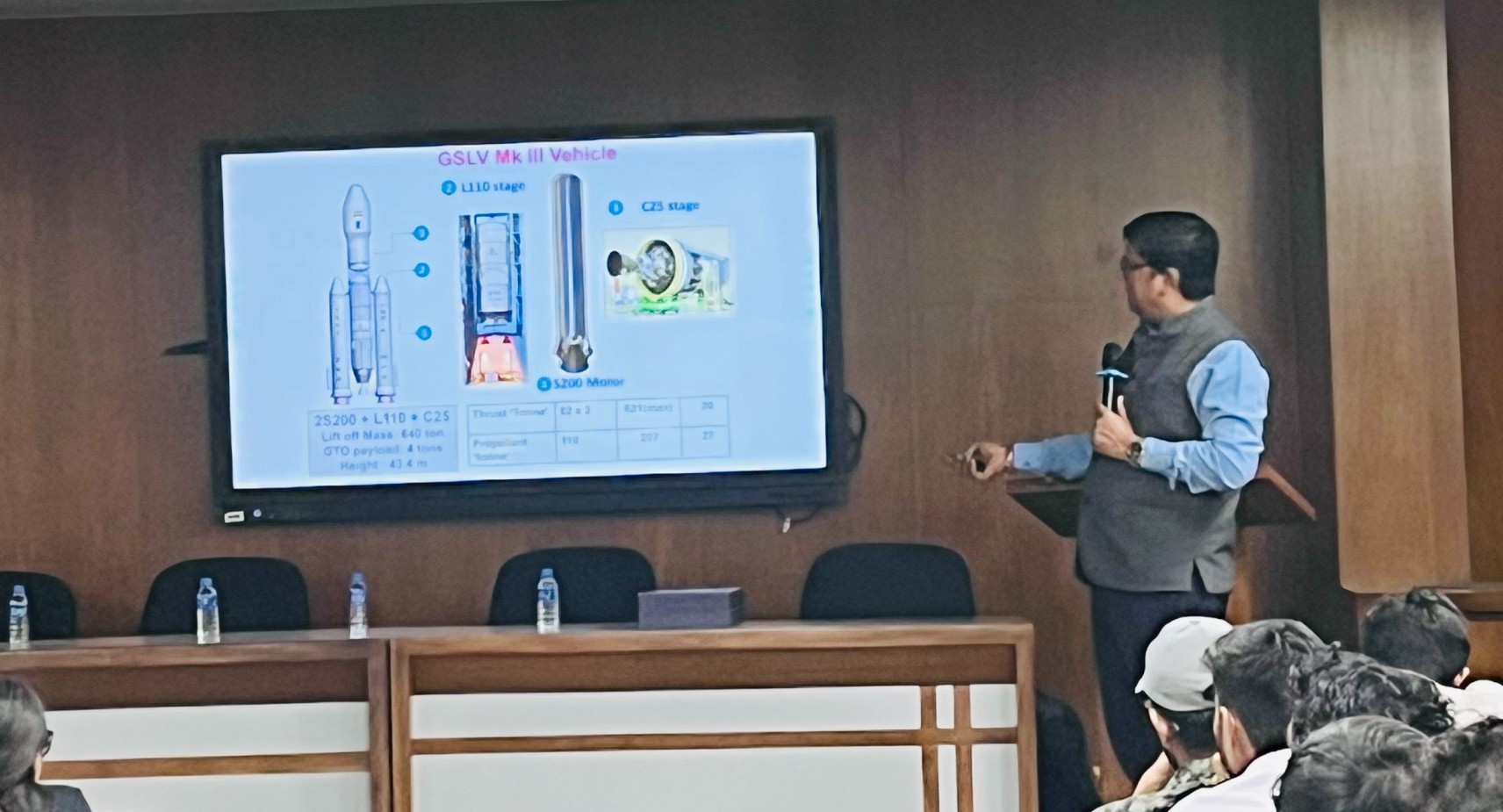
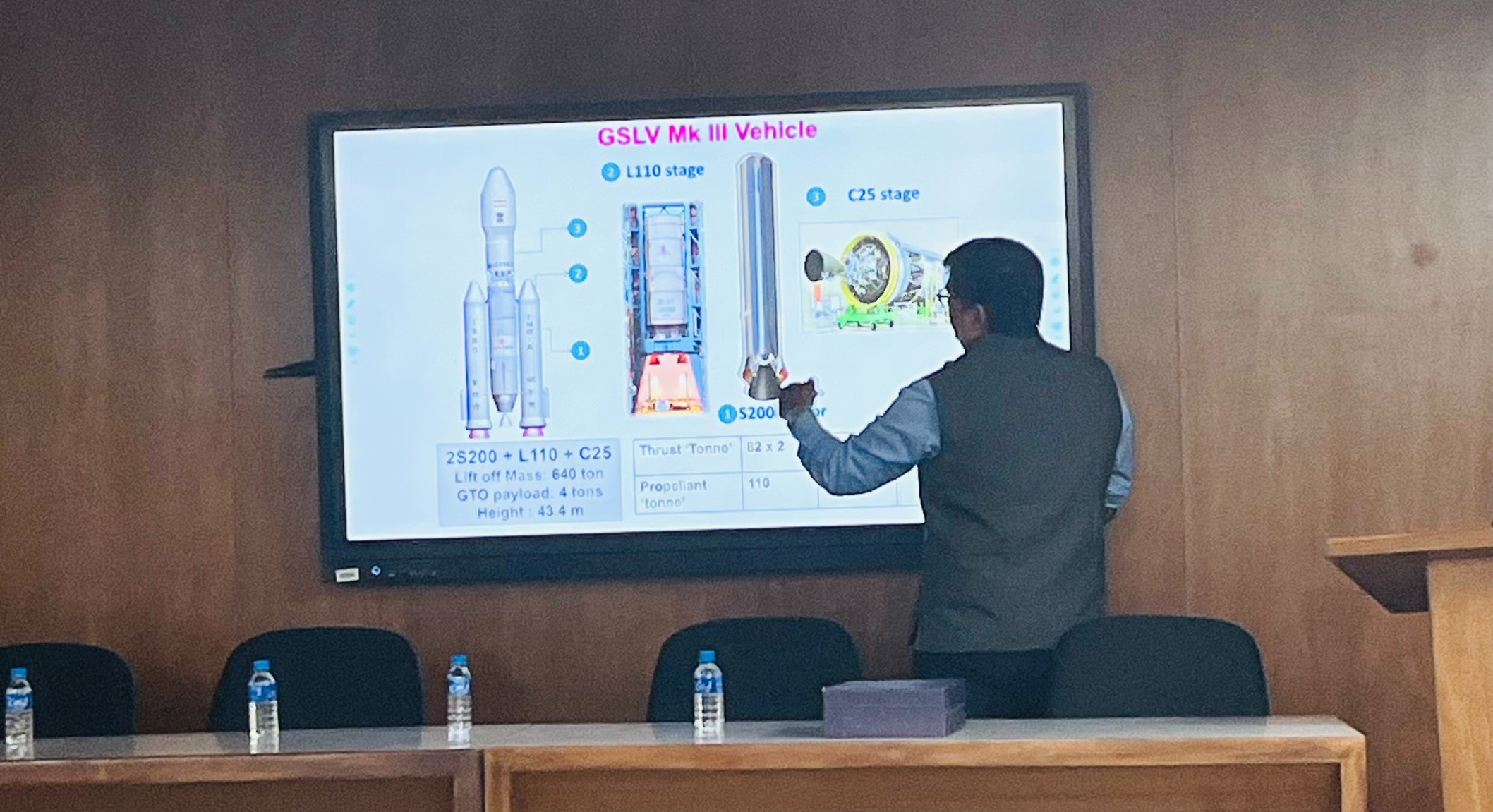
The LVM3 represents India’s highest operational launch capability. It lifts four metric tonnes to geostationary orbit and ten metric tonnes to low Earth orbit. Everything in it, including the C25 cryogenic upper stage, is fully indigenous. The LVM3 carried Chandrayaan-3 to the Moon. In its human-rated variant (HRLV), it will carry India’s Gaganyatris into space under the Gaganyaan programme – India’s first crewed spaceflight mission. At 640 tonnes total weight and the height of a fifteen-storey building, the LVM3 is a machine built to overcome gravity itself.
The Future Fleet: SSLV, Reusable Vehicles, and Scramjet Technology
ISRO’s development pipeline includes three systems that could reshape access to space. The Small Satellite Launch Vehicle (SSLV) is designed for rapid, on-demand launches of small satellites – a market segment growing rapidly as miniaturised satellite constellations become standard for communications, Earth observation, and IoT. ISRO has signed a Technology Transfer Agreement for SSLV, enabling private industry to build and launch these vehicles.
The Reusable Launch Vehicle Technology Demonstrator is India’s step toward vehicles that can fly to space and return to Earth for reuse – dramatically reducing the per-launch cost that currently makes spaceflight prohibitively expensive for most applications.
The Scramjet Engine – a Supersonic Combustion Ramjet – is perhaps the most transformative technology in development. Unlike conventional rockets that carry both fuel and oxidiser, a scramjet draws oxygen directly from the atmosphere during the early stages of flight, dramatically reducing launch mass. ISRO conducted its second experimental flight demonstration on 22 July 2024 using a heavy RH-560 sounding rocket. If scramjet technology matures, it could fundamentally change the economics of reaching orbit within the next decade.
Why Sriharikota: The Science Behind India's Spaceport
Shri Varma asked students why India launches from Sriharikota, and the answers revealed the elegant logic behind the choice. Three factors make it ideal for spaceflight. First, rockets launch eastward from the East Coast, exploiting Earth’s rotational speed to gain additional velocity – reducing the fuel needed to achieve orbit.
Cryogenic Technology: The Engine of High-Energy Missions
Shri Varma guided the audience to the concept of absolute zero at -273.15°C – the theoretical point where all molecular motion stops – and explained through a walking analogy why it can never be reached. Scientists have, however, reached temperatures in the micro-Kelvin range, where atoms stop behaving as individual particles and form Bose-Einstein Condensates: a state of matter that exists at the boundary between classical physics and quantum mechanics.
If you’re equally passionate about creating your career, explore our B.Tech Courses here!
FAQs
What is the difference between PSLV, GSLV, and LVM3?
PSLV is ISRO's most versatile and successful vehicle for Earth observation and navigation satellites. GSLV carries communication satellites up to 2 tonnes with an indigenous cryogenic upper stage. LVM3 is India's heaviest launcher - 4 tonnes to geostationary orbit, 10 tonnes to low Earth orbit - and carried Chandrayaan-3 to the Moon. It will carry Gaganyaan astronauts.
What is a scramjet engine?
A Supersonic Combustion Ramjet that draws oxygen from the atmosphere during early flight instead of carrying it onboard. This reduces launch mass dramatically. ISRO demonstrated scramjet technology on 22 July 2024 - if it matures, it could transform the cost of reaching orbit.