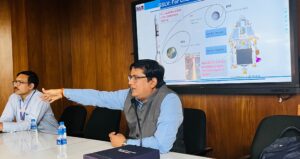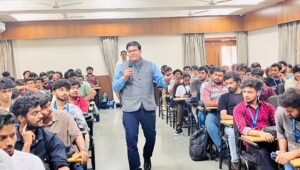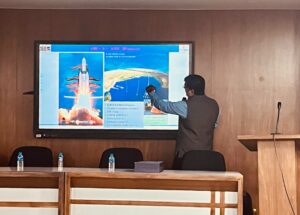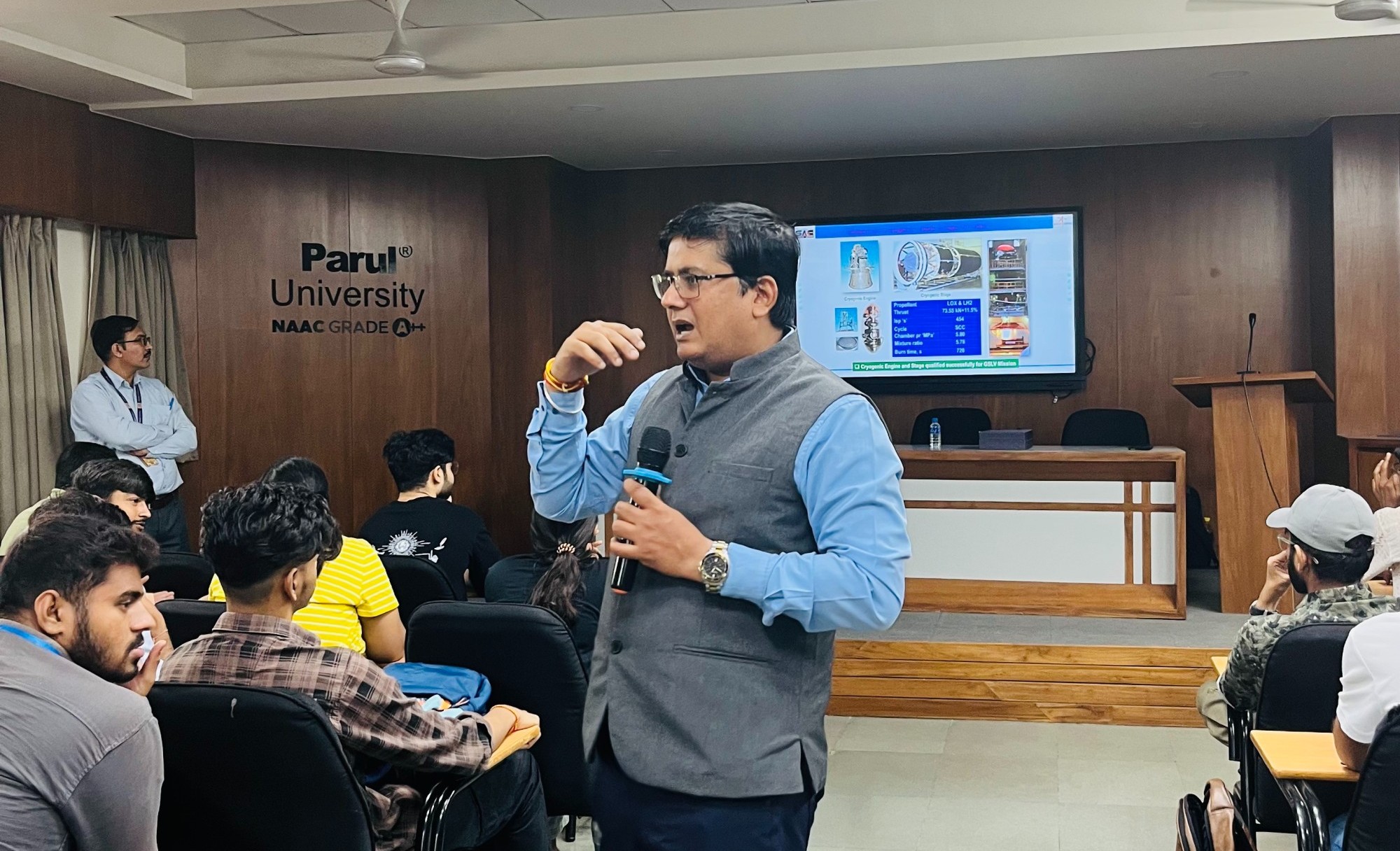
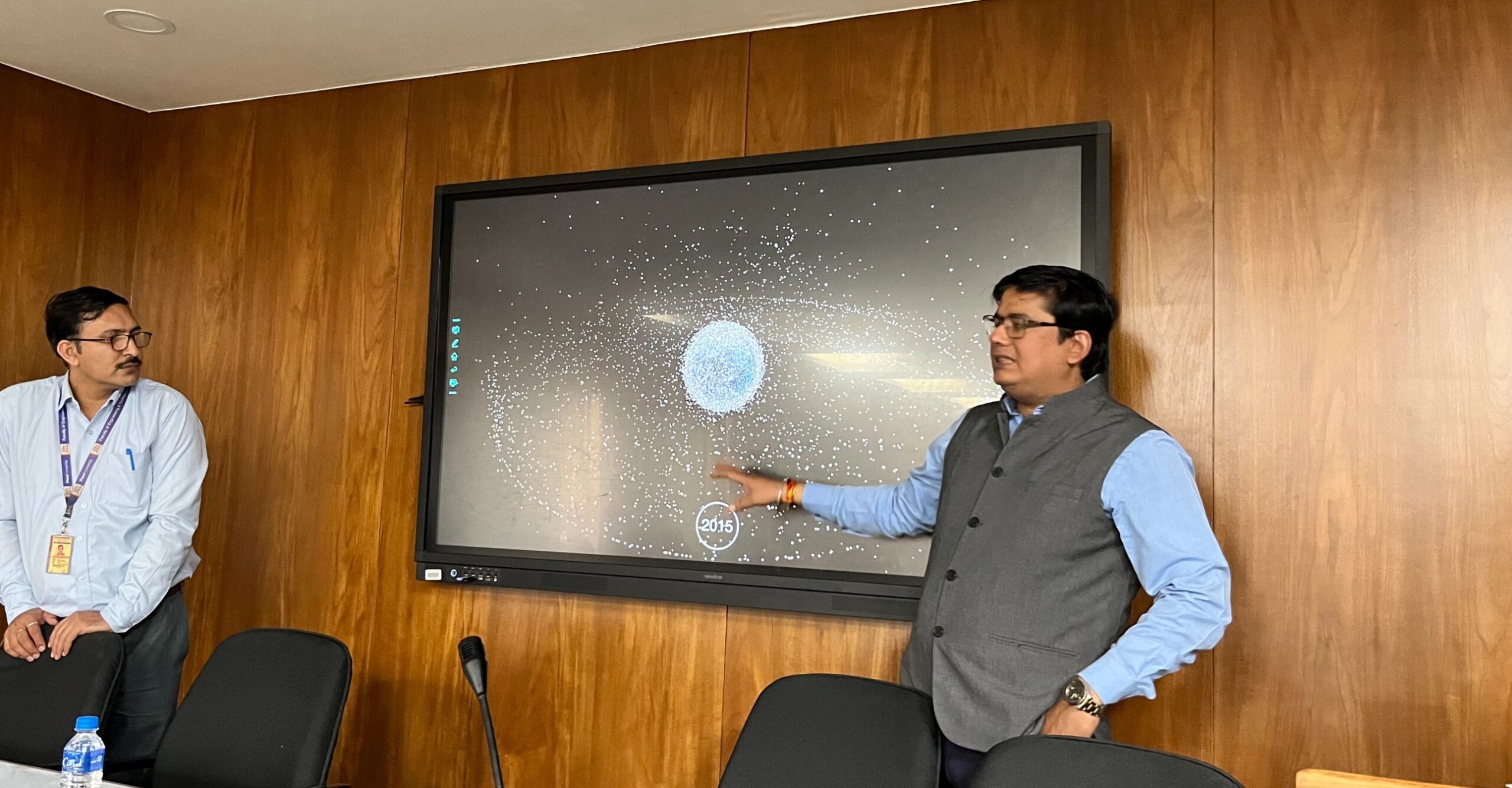
On 16 March 2026, an ISRO Space Scientist, Shri Ravi Kumar Varma, who works out of the Space Applications Centre in Ahmedabad stood in front of a hall full of engineering students at Parul University and said something that changed the temperature in the room. He told them the carbon nanotube research happening inside their own MNRDC lab? It feeds directly into the satellites ISRO builds. Not metaphorically. Not “in the future.” Now.
India’s space programme runs on four pillars, space infrastructure, space transportation, space applications, and capacity building. That fourth one, capacity building, is the one nobody talks about enough. It’s ISRO’s deliberate bet on growing its own people, funding research inside Indian labs, building up homegrown industrial capability so India never has to go begging to another country for a critical component. Shri Varma laid this whole ecosystem out, and when you hear it from someone who actually works there, the career path stops being some fuzzy aspiration pinned to a vision board. It becomes a map. With a “you are here” dot. Here’s what that map looks like in 2026.
Shri Varma didn’t show a slide with four colour-coded boxes and neat bullet points. Thank god. He talked about it the way you’d explain a machine to someone who actually wants to understand how the parts fit, everything tangled together, each piece depending on the others.
Pillar one: space infrastructure. Ground systems. Tracking networks and these are scattered across India and overseas, not just in one place. Testing facilities where they beat the living daylights out of hardware before it’s allowed near a launch pad. Without this backbone, nothing gets off the ground. Literally.
Pillar two: space transportation. India’s active fleet today is the PSLV (the reliable one that’s been launching successfully for decades), the GSLV (carries heavier communication satellites, uses that hard-won indigenous cryogenic upper stage), and the LVM3 (the heavy-lifter that took Chandrayaan-3 to the Moon).
What’s coming next? The SSLV for rapid, on-demand small satellite launches. A Reusable Launch Vehicle demonstrator, ISRO’s crack at the reusability problem. And scramjet-powered systems that breathe oxygen from the atmosphere instead of hauling it along in tanks, which could slash launch costs in ways we haven’t fully wrapped our heads around yet. Each one of these vehicles is a jobs programme unto itself.
Pillar three: space applications. This is the part most Indians bump into without realising ISRO is behind it. Crop monitoring that helps farmers plan their harvests. Weather forecasting. Cyclone early warning systems that have saved lakhs of lives. Oil and gas exploration. Your Tata Sky connection? Satellite-powered. NavIC — India’s own navigation system, the one you probably haven’t heard of but your phone may already be using. All of it rides on satellites that Indian rockets hauled into orbit.
And pillar four, the one Shri Varma kept circling back to, almost like he wanted to tattoo it onto the students’ brains: capacity building. ISRO’s investment in people. In indigenous industry instead of foreign dependency. In research that stays in India and grows Indian capability. In training the engineers and scientists and technicians who keep the whole operation running and push it further every year. This is the pillar that creates your career. Not the rocket. Not the satellite. The institutional decision to invest in you.
The Gaganyaan programme is where all four pillars smash together in one very public, very high-stakes moment. India’s Gaganyatris are deep in training right now. When India sends its own people into space, on its own rocket, built with its own tech, that achievement won’t belong to ISRO alone. It’ll belong to every college, every lab, every professor who trained the human beings who pulled it off.
How ISRO Recruits: Entry Points for Engineering Graduates
Imagine – You’re sitting in an engineering college, maybe Parul, maybe somewhere else and you want in. Not “inspired by space.” Actually, working on missions. Here are the doors that exist, and I’m going to be specific because vague advice helps nobody.
ISRO Centralized Recruitment Board (ICRB), the front door for most engineers. ISRO runs a written exam and then interviews. You need a B.Tech or B.E. in Mechanical, Electrical, Electronics, Computer Science, or something closely related. Thousands of people sit for this thing every cycle. The ones who crack it tend to have genuinely strong fundamentals, not just GATE coaching, but real understanding of their core subjects. If you aced thermodynamics and actually enjoyed it, you’re already ahead of ninety percent of the applicant pool.
ISRO Research Fellowships are for the M.Tech and PhD crowd. If your postgraduate research touches materials science, nanotechnology, propulsion, anything ISRO has skin in the game on you can apply. And frankly, this is where MNRDC students have an edge that most people outside Vadodara don’t appreciate. The research areas line up almost too neatly.
ISRO YUVIKA (Young Scientist Programme) targets 9th-graders, giving them a residential stint inside ISRO centres. Now look, this isn’t a recruitment mechanism. Nobody’s hiring 14-year-olds. But I’ve met people who did YUVIKA as kids and then showed up at ISRO a decade later as engineers with a fire in their belly that you can’t fake. It’s a pipeline builder. The seed gets planted early; the harvest comes later.
ISRO START (Space Science and Technology Awareness Training), open to postgraduate and final-year undergraduate students. Think of it as ISRO pulling back the curtain and letting you see their active research areas up close. It’s exposure, orientation, and a signalling mechanism rolled into one. If you do well, people notice.
Industry partnerships and this is the one most students completely overlook. ISRO doesn’t build everything in-house. It works with over 300 small, medium, and large-scale industries across India. That means there are engineers at private companies right now who’ve never set foot in Sriharikota whose work ends up inside ISRO rockets and satellites. You don’t have to work at ISRO to work for ISRO. Big difference.
IN-SPACe and NSIL are the newer doors. The Indian National Space Promotion and Authorisation Centre (IN-SPACe) and NewSpace India Limited (NSIL) exist specifically to open up space to private players. The SSLV technology transfer is happening through this channel. If you’re the kind of person who’d rather join a startup building satellite components than work inside a government lab, this is where the action is heading.
Skills That Matter: What ISRO Actually Needs From Engineering Graduates
One thing that came through loud and clear in Shri Varma’s session, ISRO doesn’t need generalists who’ve memorised textbooks. They need people who’ve gone deep on specific things. Here’s the rundown, and pay attention to how many of these connect to programmes Parul University already runs.
Propulsion engineering and thermodynamics. If you want to work on launch vehicles and cryogenic systems, this is your bread and butter. The people who design engines that operate at minus 253 degrees Celsius need to understand heat transfer, fluid dynamics, and combustion at a level most engineering graduates frankly don’t reach. It’s hard. That’s the point.
Materials science and nanotechnology. Radiation-resistant composites. Self-healing polymers. Carbon nanotube structures that laugh at thermal shock. This is where MNRDC’s work maps onto ISRO’s needs so directly it’s almost eerie. Shri Varma didn’t dance around it, he said the lab work at centres like MNRDC feeds into the actual hardware orbiting overhead.
Orbital mechanics and mission planning. The mathematics behind getting a spacecraft from Point A to Point B when both points are hurtling through space at thousands of kilometres per hour. If you found the Chandrayaan-3 trajectory discussion fascinating instead of terrifying, this might be your lane.
Electronics and embedded systems. Satellite payloads. Navigation systems. Onboard computers that have to work flawlessly for a decade in an environment that would fry consumer electronics in a week. Rugged, radiation-hardened, tested to destruction and then tested again.
AI and sensor technology. Chandrayaan-3’s Vikram Lander didn’t have a human pilot steering it down to the South Pole. It navigated permanently shadowed craters and boulder fields using AI-driven guidance and sensor arrays that India built from scratch. Autonomous operations in space are only going to get more important, not less.
Communications and signal processing. Telemetry, tracking, and command, the invisible thread connecting ground stations to spacecraft. If that thread breaks, the mission is over. The people who design and maintain those systems don’t get headlines, but nothing works without them.
Parul University’s Space-Relevant Ecosystem
First: The Micro-Nano Research and Development Centre was established in 2024 under the Gujarat Industrial Policy 2020. It’s not a name on a door. The facility houses scanning electron microscopy (SEM), atomic force microscopy (AFM), X-ray diffractometry (XRD), sputter deposition systems for thin film fabrication, and micro-machining capability. Those tools produce the kind of nanomaterials research that doesn’t just sit in journals, it’s the same class of work that goes into qualifying materials for space-grade application. When Shri Varma said MNRDC’s research feeds into satellite construction, he wasn’t being polite. He was stating a technical fact.
Second: the B.Tech programmes. Mechanical, Electrical, Electronics, Computer Science, Aeronautical, and related engineering disciplines. These are the exact branches ISRO recruits from through the ICRB exam. Not “roughly similar.” Exactly. The foundational training you need to be eligible for an ISRO Scientist/Engineer position, it’s available right here.
Third: sessions like this one. Having Shri Ravi Kumar Varma walk into your campus and spend two hours talking about rockets and Moon landings isn’t a brochure photo opportunity. It’s an ISRO scientist telling you, in person, in real time — what skills matter, what problems they’re trying to solve, and where the gaps are that your generation needs to fill. Most engineering students in India will never get that kind of exposure. Parul’s students just did.
And then there’s the geography, which honestly doesn’t get talked about enough. ISRO’s Space Applications Centre (SAC) sits in Ahmedabad, roughly 100 kilometres from Parul University’s Vadodara campus. That’s not across the country. That’s a two-hour drive. The proximity creates real, tangible opportunities: industry visits, collaborative research tie-ups, and the kind of casual exposure to ISRO’s people and work that you simply can’t get from a university in a state that doesn’t have a major ISRO centre nearby.
SAC–MNRDC Connection:
Here’s the overlap in plain English. ISRO’s Space Applications Centre in Ahmedabad works with carbon nanotube composites, radiation-resistant materials, and satellite payload systems. Parul University’s MNRDC researches nanomaterials, nanoelectronics, and MEMS. The two facilities are 100 km apart in the same state. The research areas don’t just overlap — they interlock. That’s not a marketing claim. It’s a geographic and scientific reality that creates a natural pipeline for collaborative research, industry visits, and career connections running straight through Gujarat’s space ecosystem.
FAQs - Career in Space Science India
How can I get a job at ISRO after engineering?
The most common route is the ISRO Centralized Recruitment Board (ICRB) exam. They recruit Scientist/Engineer positions through a written test and interview. You’re eligible with a B.Tech or B.E. in Mechanical, Electrical, Electronics, Computer Science, or closely related branches. If you’re doing postgraduate work - M.Tech, PhD, ISRO Research Fellowships are the other direct way in. Beyond that, remember ISRO partners with 300+ private industries. Getting hired by one of those companies can mean your daily work is contributing to ISRO missions even if your badge doesn’t say ISRO on it.
What engineering branch is best for a space career?
Depends on what you want to do, and that’s not a cop-out answer. Mechanical gets you into propulsion and structural design. Electronics puts you on satellite payloads and communication systems. Computer Science opens up mission software and AI — the kind of stuff that flew Chandrayaan-3’s lander autonomously. Electrical covers power systems. Aeronautical is the obvious one for flight dynamics. And here’s the one most people miss: materials science and nanotechnology is becoming increasingly critical for satellite construction. It’s exactly what MNRDC at Parul University is set up to research.
Is Parul University connected to ISRO?
ISRO’s Space Applications Centre operates in Ahmedabad, roughly 100 km from Parul’s Vadodara campus. That proximity isn’t cosmetic, it creates real access. MNRDC’s nanotechnology and nanomaterials research directly intersects with what ISRO needs for next-generation satellite materials. And ISRO scientists don’t just exist as names in textbooks here, Shri Ravi Kumar Varma physically walked onto campus and spent two hours with engineering students, talking about rockets, the Moon, and what skills the space programme needs from their generation. That’s not a brochure claim. It happened on 16 March 2026.