To understand why this CSIR project matters, three concepts need to be understood: metamaterials, Massive MIMO antennas, and the transition from 5G to beyond 5G communications.
Metamaterials - Engineered Electromagnetic Properties
Metamaterials are engineered structures typically periodic arrays of sub wavelength unit cells that exhibit electromagnetic properties not found in naturally occurring materials. These include negative permittivity, negative permeability, and consequently negative refractive index. By carefully designing the geometry and composition of the unit cell structure, researchers can engineer metamaterials with specific electromagnetic responses: materials that bend electromagnetic waves in unusual directions, suppress certain frequency reflections, or concentrate electromagnetic energy in ways impossible with conventional materials.
The relevance to antenna design is direct. A conventional antenna radiates energy in multiple directions, with significant losses to ground plane reflections and mutual coupling between antenna elements. A metamaterial ground plane or superstrate can redirect this energy, suppress back radiation, reduce mutual coupling between closely spaced antenna elements, and significantly enhance gain and efficiency all critical for the dense antenna arrays required by Massive MIMO systems.
Massive MIMO - The Backbone of 5G and Beyond
MIMO (Multiple Input Multiple Output) antenna technology simultaneously uses multiple antennas at both transmitter and receiver to improve data throughput, spectral efficiency, and link reliability. Massive MIMO as deployed in 5G networks scales this to dozens or hundreds of antenna elements per base station, enabling spatial multiplexing of multiple data streams to multiple users simultaneously. According to IEEE publications, Massive MIMO remains the foundational physical layer technology for 5G and is expected to remain central in beyond 5G and 6G systems operating at millimetre wave (mmWave) and sub terahertz frequencies.
Beyond 5G - The Research Horizon
Beyond 5G (B5G) and 6G systems are currently in the research and standardisation phase globally, with commercial deployment targeted for the early 2030s. The CSIR (Council of Scientific and Industrial Research) is India’s largest R&D organisation, operating 37 constituent laboratories. Its funding of the MNRDC’s B5G antenna project reflects the strategic priority placed on ensuring Indian research institutions contribute to the global 6G standards ecosystem not merely as technology consumers but as active participants in defining next generation communications standards.
The Machine Learning Integration - What Makes This Research Novel
Designing a metamaterial unit cell for a specific electromagnetic response is a computationally intensive optimization problem. The traditional approach iteratively simulating thousands of geometric configurations in full wave electromagnetic simulation tools requires days of compute time for moderately complex structures. Machine learning changes this paradigm.
By training neural networks on simulation datasets that map geometric parameters to electromagnetic properties, the MNRDC’s research enables rapid prediction of metamaterial behaviour without full simulation at each design iteration. Inverse design specifying the desired electromagnetic properties and having the ML model propose the corresponding geometry further accelerates the design cycle. This approach, combining materials science expertise with machine learning, represents the intersection of two of India’s most rapidly growing research areas. At Parul University, students across engineering, pharmacy, biotechnology, and applied sciences benefit from direct access to MNRDC’s 10 instrument facility. So delay no more & enroll into 2026 engineering and Phd Programmes right away!
How MNRDC Instruments Support This Research
RF/DC Magnetron Sputtering - Fabricating Metamaterial Films
The Auto 500 Sputtering System at the MNRDC is central to metamaterial fabrication. Metamaterial unit cell arrays typically require precisely deposited thin films of metals (for conducting elements) and dielectric materials (for substrate layers) at controlled thicknesses in the nanometre to micrometre range. DC sputtering deposits metallic films (copper, aluminium, gold) for the resonant elements; RF sputtering deposits dielectric oxide layers (silicon dioxide, aluminium oxide) for substrates and spacers. The substrate rotation and heating capabilities of the Auto 500 ensure uniform film deposition across the antenna aperture.
XRD - Material Phase and Quality Verification
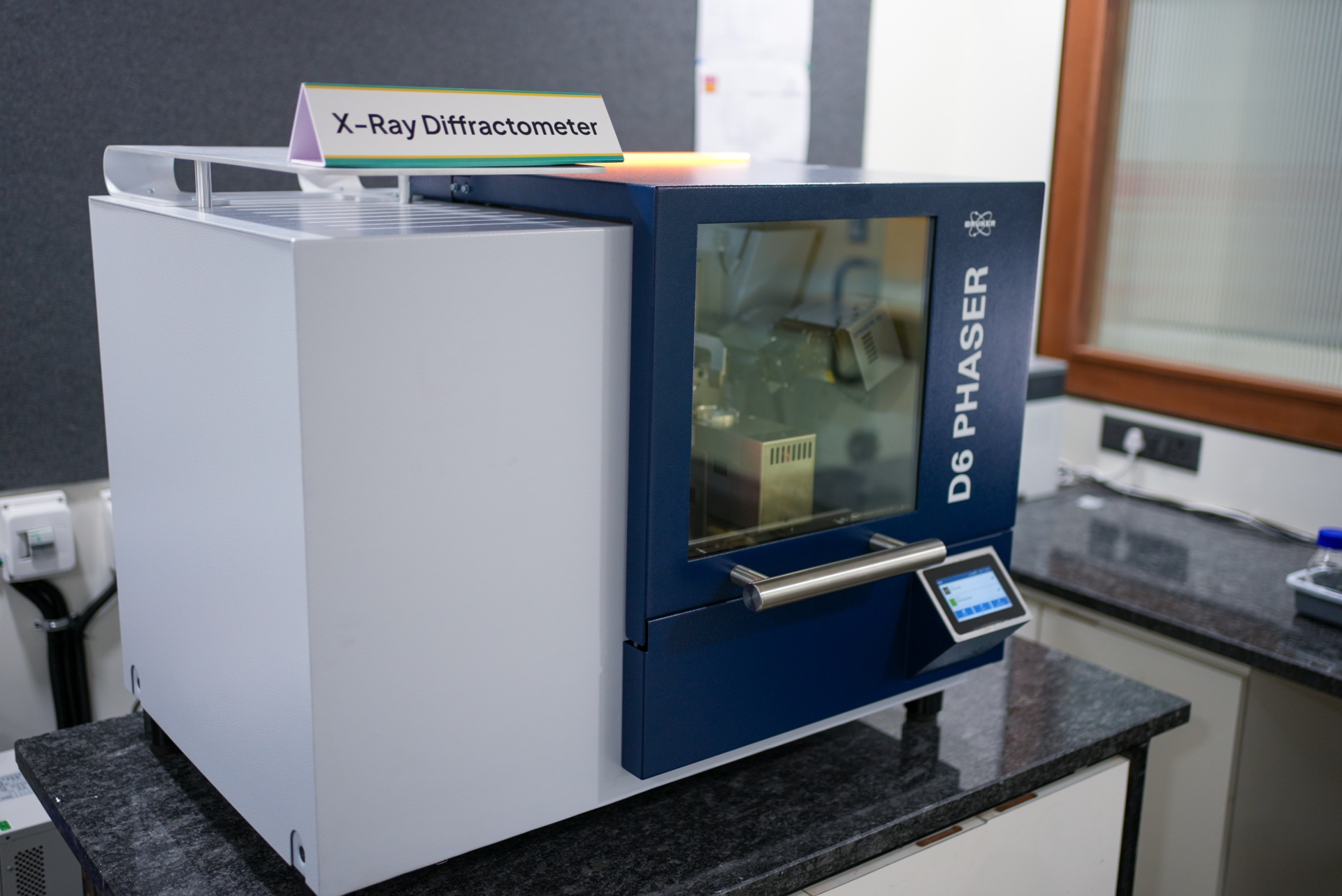
After deposition, the Bruker D6 PHASER XRD verifies the crystal structure and phase composition of deposited films. For metallic antenna elements, this confirms film quality and identifies unwanted oxide phases that would degrade electrical conductivity. For dielectric layers, XRD confirms that the intended amorphous or crystalline phase has been achieved critical because the dielectric constant (which determines wave propagation within the metamaterial) is phase dependent.
SEM - Imaging the Metamaterial Microstructure
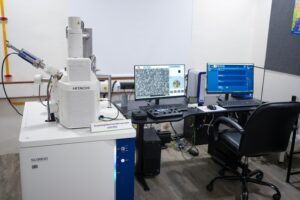
The Hitachi SU3800 SEM images the fabricated metamaterial unit cell arrays with the resolution needed to verify that deposited features match the designed geometry within acceptable tolerances. For sub millimetre wavelength antennas (mmWave and sub THz), geometric tolerances are extremely tight even small fabrication errors can significantly shift the resonant frequency and degrade antenna performance. EDS confirms that the elemental composition of each layer matches the specification.
RF Anechoic Chamber - Planned Antenna Testing Infrastructure
The planned CSIR funded RF Anechoic Chamber at the MNRDC will provide a controlled electromagnetic testing environment for fabricated antenna prototypes. An anechoic chamber absorbs microwave reflections from its walls, simulating free space propagation conditions and enabling accurate measurement of antenna gain, radiation pattern, efficiency, and bandwidth without interference from environmental reflections. This planned addition to the MNRDC’s infrastructure will create a complete antenna research workflow from material fabrication through characterisation to electromagnetic performance measurement within a single facility. Explore PhD programmes at Parul University offer supervised research access to the MNRDC’s CSIR funded project.
Students at Parul University interested in 5G communications research can explore B.Tech Electronics and Communication Engineering a programme that covers signal processing, wireless communications, and antenna engineering. Combined with access to the MNRDC’s fabrication and characterisation infrastructure, this creates a research pathway directly relevant to the CSIR project.
FAQ
What is Parul University MNRDC's CSIR-funded research project?
The project is titled "Design and Development of Metamaterial Based Massive MIMO Antenna Using Machine Learning Beyond 5G Applications," funded by CSIR (Council of Scientific and Industrial Research), India's largest R&D organisation with 37 constituent laboratories. It combines metamaterial design, MIMO antenna engineering, and machine learning optimization for the beyond-5G and 6G communications systems expected in the early 2030s.
What is a metamaterial and why is it used in antennas?
Metamaterials are engineered structures - periodic arrays of sub-wavelength unit cells - that exhibit electromagnetic properties not found in natural materials, including negative refractive index. In antenna applications, metamaterial ground planes and superstrates redirect radiated energy, suppress reflections, reduce mutual coupling between antenna elements, and enhance gain - critical performance improvements for the dense antenna arrays required by Massive MIMO systems in 5G and beyond.
What is Massive MIMO and why is it important for 5G and 6G?
Massive MIMO (Multiple Input Multiple Output) uses arrays of dozens to hundreds of antennas at base stations to simultaneously serve multiple users on the same frequency band through spatial multiplexing. This dramatically improves spectral efficiency and data throughput compared to conventional antenna systems. It is the foundational physical layer technology of 5G and is expected to remain central in beyond-5G and 6G systems operating at millimetre wave frequencies.
How does machine learning improve antenna design?
Machine learning improves antenna design by replacing computationally intensive full-wave electromagnetic simulations with trained neural networks that predict metamaterial electromagnetic properties from geometric parameters in milliseconds. Inverse design models - where desired properties are specified and the ML model proposes the corresponding geometry - enable rapid design iteration. This reduces optimisation cycles from days to minutes, enabling systematic exploration of design spaces too large for conventional simulation-based approaches.