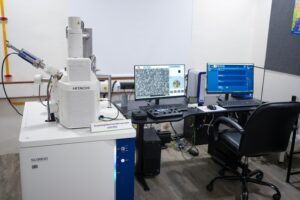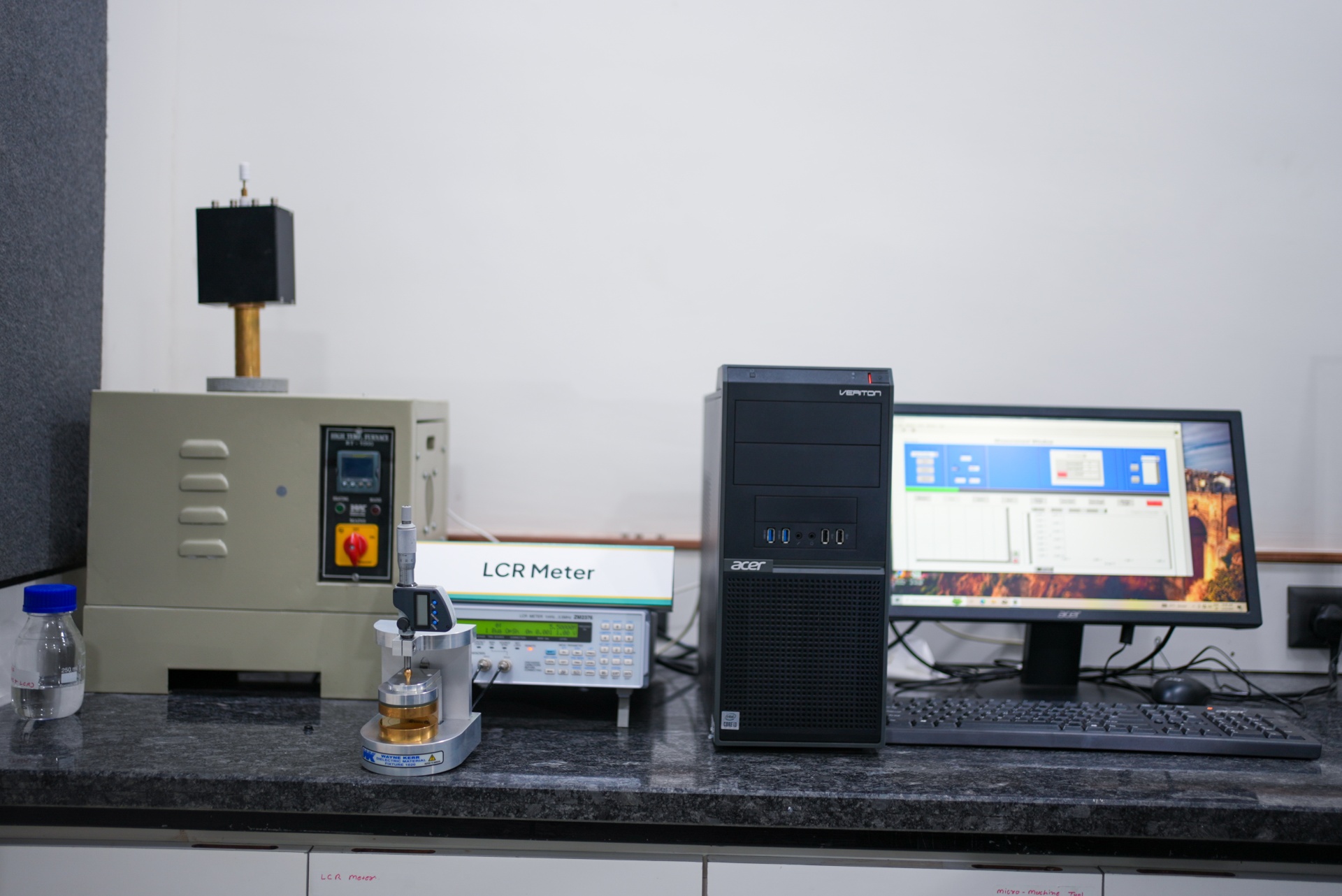
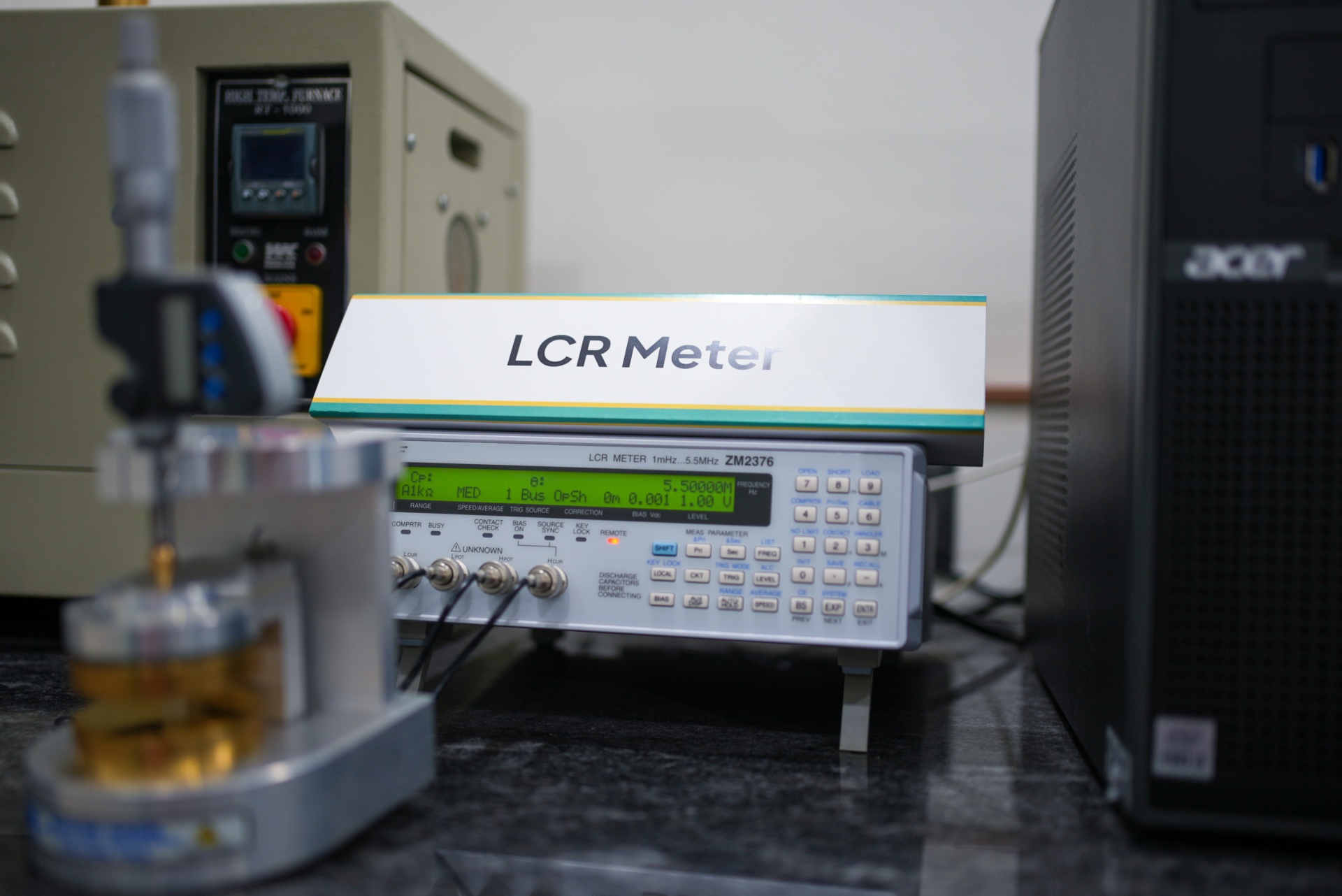
An LCR meter is a precision instrument that measures the fundamental electrical properties of materials and electronic components: Inductance (L), Capacitance (C), and Resistance (R) hence the name. In materials research, LCR meters serve a more specific purpose: they characterise the dielectric properties of solid materials properties that determine how a material stores, dissipates, and responds to electrical energy at different frequencies. These properties are critical for ceramics used in capacitors and sensors, polymers used in flexible electronics, battery electrode materials, and any solid material whose electrical behaviour in AC circuits needs to be understood.
ZM2376 Specifications - The Technical Foundation
The ZM2376 is manufactured by NF Corporation (formerly Wayne Kerr), Japan a precision measurement instrumentation company with decades of history in LCR and impedance analysis. Installed at the MNRDC in 2024 at a cost of Rs.12,86,200, the instrument operates across a frequency range of 1 mHz to 5 MHz one of the widest ranges available in a research grade benchtop LCR meter. Over 61 samples have been analysed: 12 in the high temperature furnace and 49 at room temperature, spanning ceramics, dielectrics, zinc oxide, carbon materials, and polymer specimens.
What the ZM2376 Measures - Complete Parameter Suite
The ZM2376 measures both fundamental and advanced electrical parameters. Basic parameters include Resistance (R), Capacitance (C), Inductance (L), Impedance (Z), Conductance (G), Admittance (Y), and DC Resistance. Advanced parameters include Phase Angle, Quality Factor (Q), Dissipation Factor (D), Reactance (X), Susceptance (B), and Series and Parallel Resistances.
Each parameter reveals a different aspect of material or component behaviour. The Quality Factor Q quantifies how efficiently a component stores energy relative to what it dissipates a high Q material is a good energy store, low Q means significant energy loss. The Dissipation Factor D (the inverse of Q) quantifies energy losses critical for dielectric materials used in capacitors and insulators. Phase angle reveals whether a material is primarily resistive, capacitive, or inductive in character at any given frequency.
The Defining Capability - Wide Frequency Sweep
The ZM2376’s most powerful feature is its ability to sweep the full frequency range from 1 mHz to 5 MHz in a single continuous measurement, generating a complete behavioural profile of the material or component across the entire frequency spectrum. This is not merely a convenience it reveals how material electrical behaviour changes with frequency, a phenomenon that is fundamentally impossible to characterise from single frequency measurements.
For dielectric materials, frequency dependent behaviour is the signature of specific physical mechanisms: grain boundary effects in ceramics, dipole relaxation in polar polymers, charge carrier trapping in semiconductors, and electrode polarisation effects at interfaces. Each mechanism produces a characteristic feature in the impedance spectrum at a specific frequency range. By displaying up to four parameters simultaneously as functions of frequency, the ZM2376 enables comprehensive dielectric spectroscopy in a single measurement session.
At the MNRDC, practical testing is commonly conducted in two frequency bands: 20 Hz to 1,000 Hz for low frequency dielectric behaviour including electrode polarisation and grain boundary effects, and 10,000 Hz to 20,000 Hz for higher frequency bulk material responses. The selection depends on the material system and the physical phenomenon under investigation.
High-Temperature Electrical Testing - Up to 1200°C
Temperature dependent electrical characterisation is one of the most demanding requirements in ceramic and energy materials research and the ZM2376 at the MNRDC supports this through an integrated furnace that can reach 1200°C. For the LCR meter alone (without the furnace), temperature testing extends to 500°C. The furnace uses gold plated electrodes to ensure optimal electrical contact at high temperatures while minimising contact resistance.
High temperature dielectric testing is critical for ceramic capacitor development (characterising temperature stability of dielectric constant), advanced ceramic actuator materials (piezoelectric behaviour under operational temperatures), battery electrode characterisation (ionic conductivity as a function of temperature), and high temperature sensor materials. The ability to correlate electrical behaviour with temperature in a single instrument session rather than requiring separate furnace and LCR systems represents a significant practical advantage for researchers in these fields.
Sample Types and Non-Destructive Nature
The ZM2376 tests solid samples only powders must be compacted into flat pellets before measurement to create a well defined, uniform contact surface. No liquid samples are tested. Sample dimensions are approximately 10 20mm diameter for the room temperature setup. Suitable materials include ceramics and dielectrics (calcium titanate, barium titanate, alumina), carbon based materials, zinc oxide and other oxide semiconductors, polymers and polymer composites, and electronic components (resistors, capacitors, inductors, circuit boards).
The instrument is entirely non destructive: it applies low amplitude AC signals to the sample without generating heat, causing chemical changes, or altering the material structure. Samples emerge from the measurement in exactly the condition they entered available for subsequent testing by SEM, XRD, or AFM. Samples previously tested at the MNRDC include calcium titanate, various ceramics and dielectrics, zinc oxide, carbon, and polymers.
For students in B.Tech Electronics and Communication Engineering and B.Tech Electrical Engineering at Parul University, dielectric property analysis is directly relevant to semiconductor device physics, capacitor design, and sensor development courses. The ZM2376 provides research grade data for these applications.
FAQ
What materials can the MNRDC LCR meter characterise?
The ZM2376 LCR meter at the MNRDC characterises solid materials including ceramics (calcium titanate, barium titanate, alumina), zinc oxide and other oxide semiconductors, carbon-based materials, polymers and polymer composites, and electronic components. Powder samples must be compacted into flat pellets. No liquid samples are accepted. The instrument has analysed over 61 samples to date.
What is the significance of frequency-dependent dielectric characterisation?
Frequency-dependent dielectric characterisation reveals how a material's electrical properties - permittivity, conductivity, loss factor - change across the electromagnetic spectrum. Different physical mechanisms (grain boundary effects, dipole relaxation, charge trapping) dominate at different frequencies. A complete frequency sweep profile allows researchers to identify and quantify these mechanisms, providing deeper understanding than any single-frequency measurement can deliver. This is essential for advanced ceramic, sensor, and energy materials development.
What is the maximum temperature the MNRDC LCR meter can test at?
The MNRDC's ZM2376 LCR meter supports high-temperature testing up to 500°C standalone, and up to 1200°C using the integrated furnace with gold-plated electrodes for improved contact and accuracy. The furnace enables temperature-dependent electrical characterisation - measuring how dielectric properties, ionic conductivity, and impedance change as temperature increases - critical for ceramic capacitors, battery materials, and high-temperature sensor development.
What parameters does the MNRDC LCR meter report?
The ZM2376 reports both fundamental parameters (R, L, C, Z, G, Y, DC Resistance) and advanced parameters (Phase Angle, Quality Factor Q, Dissipation Factor D, Reactance X, Susceptance B, Series and Parallel Resistances). In frequency sweep mode, up to four parameters are plotted simultaneously as functions of frequency from 1 mHz to 5 MHz, providing a complete dielectric characterisation profile.