Dr. Sanjay Agal grew up in rural Rajasthan. After 12th, he thought of going to Kota for engineering. The entrance exam did not go well. He did not know about alternative routes because of his background and his scores. What he did not calculate was the effect of meeting the right people. A few professors at the polytechnic introduced him to coding and software. Something shifted, by the time he graduated, he had come first in his entire batch. He secured admission in his dream engineering college in Kota. And at that college, he met the person who would shape the rest of his career. Dr. C.P. Jain, a professor who became his role model for coding and for teaching. “Three years of my life in engineering college made me what I am today”, he quoted. He gives the credit entirely to that institution and those people. Not to himself, not to some innate gift. That kind of intellectual honesty turns out to be a thread that runs through the entire interview.
Six Years in Udaipur: What Happens When Ambition Has No Infrastructure
After engineering, Dr. Agal spent six years as an Assistant Professor at Pacific College of Engineering in Udaipur. He wanted to do research from the very first day of teaching. The problem was not ambition. It was geography. In a tier-2 or tier-3 city, you do not get the kind of environment that research demands. No funding for journal subscriptions. Limited access to books. Almost no interaction with peers doing serious work. Research needs all of these. He had ideas. He did not have the infrastructure to develop them.
Later, when he was appointed as GTU-endorsed Principal at Dr. V.R. Godhania College of Engineering in Porbandar, the same constraint followed him at institutional scale. He had the authority but not the budget. For research, we need funding, books, different types of subscriptions, many things, which was very costly, which was not possible at that time. Explore the courses in the Faculty of Engineering and Technology at Parul University, where innovation, practical learning, and industry-focused education come together.
22 January 2024: The Date Everything Changed
The move to Parul University was deliberate. Dr. Agal had one specific requirement in mind: research resources. What he found exceeded the requirement in ways he describes with visible specificity. Publishing a single paper in a Q1 journal like Scientific Reports costs approximately 2,800 euros in open-access fees, roughly three lakh rupees. Every single paper he has published since joining Parul has been funded entirely by the university. Not one rupee from his own pocket. That three lakh is invested by Parul University, though the paper is in my name, he says. Without the help of such an institute, you cannot do these things.
The support extends well beyond publication costs. He can check out any book from the Parul University library. If the book is not available, he asks them to buy it and they do. Whatever resources I have requested till now, every resource is granted without a single question asked. Not even a single experience where a request got denied. The Vice Chancellor is accessible on a walk-in basis, not through weeks of formal appointment requests. The Dean of Engineering answers on the intercom for even the smallest question. The day I joined, I got help from every cell, every faculty, every person I met, he says. He contrasts this with his experience at previous institutions where getting in front of a Vice Chancellor was a logistical ordeal. At Parul University, the access is simply there, and that changes how you work. Head here to read Dr. Sanjay Agal’s full research profile at Parul University!
The Paper That Brought MIT to His Inbox
- The paper that changed his trajectory is titled A Machine Learning Approach to Risk Based Asset Allocation in Portfolio Optimization, published in Scientific Reports, a Springer Nature journal ranked Q1 with an impact factor of 3.9 and the third-highest citation count of any scientific journal in the world.
- The co-authors were Krishna Raulji, a faculty member who literally works in the same room as Dr. Agal in the AIDS department at Parul University, and Niyati Dhirubhai Odedra, Head of Department for CS at his previous institution, where the two had worked together for six years.
- The peer review process went through six rounds. The first three were entirely focused on novelty, which is the non-negotiable gateway at Q1 journals. They tolerate issues with English or formatting, but the first three rounds are fully about whether the work is genuinely new. Rounds four through six covered formatting and grammar.
- The full process took approximately one year. The framework itself addresses a real and hard problem: traditional portfolio models assume that relationships between financial assets stay roughly constant. In normal markets, that assumption works. In a crisis, it collapses. The model layers LSTM networks for volatility forecasting, a regime-switching mechanism for detecting market state transitions, a risk-budgeting layer for dynamic portfolio adjustment, sparse attention for computational scalability, and SHAP-based attribution so a risk manager can see exactly why any given decision was made.
- On out-of-sample data from 2017 to 2022, the framework achieved a Sharpe ratio of 1.38, which is a 55% improvement over traditional risk parity strategies and 23% over contemporary machine learning approaches.
- During high-stress periods specifically, the improvement over classical methods was 187%. Maximum drawdown during crises was reduced by 41%. The most striking result: during February and March 2020, the framework began reducing equity exposure two full weeks before the market hit its bottom. On its own. No human override. Nobody designing a portfolio in 2019 would have thought to account for a pandemic. The model did it anyway.
- After publication, something happened that Dr. Agal describes as the real reward. He started receiving emails from researchers at MIT and institutions in California who had read the paper and wanted to collaborate. Not congratulatory messages. He dismisses those. Serious academic contact from people working in the same field. That mail is my self-concept, he says. Citation count does not matter. Even the congratulations on WhatsApp do not matter. But that mail is different.
The Second Paper, the Student Model, and the Rejection Ratio That Tells the Real Story
A second paper in Scientific Reports has been confirmed: A Privacy Preserving Synthetic Learner Dataset for Learning Analytics in Technology Enhanced Higher Education (DOI: 10.1038/s41598-026-44990-8). This work addresses one of the growing challenges in educational technology, which is how to conduct learning analytics without compromising student privacy.
Alongside these, Dr. Sanjay Agal has spent four years building a machine learning model to predict student outcomes. The dataset has 20,000 student profiles, each mapped across 85 individual factors: LMS interaction patterns, assessment performance, attendance, faculty feedback, communication skills, and prior academic records.
- The model was born from a practical problem. His department manages more than 1,000 B.Tech students but has access to only a limited number of high-quality external training resources. Which 250 students should get the best opportunities? That decision, he insists, must come from data, not from any person. The model classifies students at admission and the classification updates every year.
- Every student has a path upward. A B-category student can become A through improved performance. An A-category student who stops working can drop to B. The paper was accepted for publication on 16 March 2026 and is under review at Scientific Reports. He mentions the four-year build cycle almost in passing, as if that amount of patience is ordinary.
- The broader numbers tell a story about persistence and evolution. Dr. Agal has submitted more than 300 items across his career: papers, patents, books, everything combined.
- Approximately 80 have been accepted. Early in his career, 50 submissions would yield one acceptance. By 2026, his acceptance ratio for Q1 journals has improved to approximately 1 in 10, and his target for 2027 is 3 in 1. He has also made a deliberate decision to stop submitting to anything outside Q1.
- Earlier, he was chasing quantity. That phase is over. If one paper gives me so much interaction, what can a good hundred do? His philosophy on rejection is equally specific: every rejection at least gives you reviewer comments. That comment will help you in the next paper. But the work must be genuine. If you copy something, if you do anything which is not yours, do not publish. If you publish one paper in a lifetime, it is okay. But it has to be yours only.
- Join Tech in Artificial Intelligence and Data Science at Parul University and prepare for a career driven by innovation, intelligence, and technology.
4 AM, Every Single Day, for Two Years
The most revealing part of the interview is not about any journal or patent. It is about what happens at 4 AM. For the past two years, Dr. Sanjay Agal has woken at four in the morning every day without exception. Days when his family is still asleep and the rest of the world has not started. He sleeps by 9 PM. Between 4 and 7 AM, he reads for three hours.
The reading is not always technical. If I am not feeling comfortable reading technical things, I can read any Hollywood movie script, he says. But I will read, that for sure I will read. Because the Hollywood script gives me a difficult level of English, some quotations, some kind of imagination power.
Reading is not preparation for writing. He draws a clear distinction between the two. Writing happens when a problem gets solved and he decides the solution is worth sharing. Reading happens every day regardless. His formula for the relationship is precise: if you want to write one page, you have to read 1,000 pages. For an average Q1 paper of 30 pages, that means 30,000 pages of reading behind it.
COVID, he says almost cheerfully, was the best period of his research life. For six months with a good laptop and a good internet connection, nothing else demanded his attention. He read everything available. The Ramayana, three times. He emerged from those months with a research foundation that is still paying returns. Choose from future-focused engineering specialisations and take the next step towards a successful career in technology and innovation by exploring B.Tech programmes at Parul University!
Quantum Computing: India's Model Curriculum, Built at Parul University
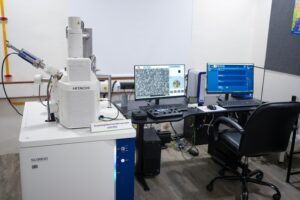
Parul University is launching a full four-year B.Tech programme in Quantum Computing, making it the second university in South Asia to offer such a programme. This is under Dr. Sanjay Agal’s leadership within the AIDS department. The curriculum has been developed and submitted to the Indian government, and is expected to serve as the model curriculum for India. No other institution had fully prepared a four-year quantum computing curriculum before Parul University did. Equipment procurement is underway from US manufacturers including Nvidia and IBM.
On where the field is headed, Dr. Agal is direct: the next five years, quantum will change everything. Because the fast processing of quantum is unmatchable. There is not a difference of 2 or 3 percent. There is a difference of more than 1,000 percent. If any computer today can do a task in a thousand years, a quantum computer will do that task in one day. For students choosing engineering programmes right now, this is the technology that will define the industries they enter.
What His Classroom Actually Looks Like
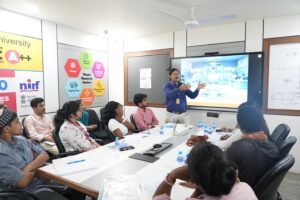
Dr. Sanjay takes first-year B.Tech students for teaching, not final year, not M.Tech. He also recruits all his research team members exclusively from the first year. The logic is straightforward: if he gets a student for two or three years, the shaping can take place. If the student arrives in the final year, there is no time left to develop anything meaningful.
One of those first-year recruits went on to win a PIERC grant and launch a startup called Eternia, built around Dr. Sanjay Agal’s original concept of an offline, anonymous mental health listening model where a person could pick up an intercom and speak to an unknown listener. The students took the idea, developed it into an online platform, and built their own company
His classroom method revolves around team competition. He divides the class into three teams matching the three-bench layout of Parul’s classrooms. Every question a student asks earns their team a five-star point. At semester end, the student with the most five-stars gets formal recognition. The quality of the question does not matter. Only whether the student is asking. If he asks something, then that means he is focusing in class. If he does not ask, I do not know if he is focusing on what he will eat at Greenzy or somewhere else.
When asked about advice for students wanting to enter AI research, his answer goes against most standard guidance. He does not recommend YouTube. He does not recommend Google as a primary source. He is firm about books, specifically standard international textbooks. Suppose I said something on YouTube, verify this with a genuine book. If the book is right, there is no need to waste any time. But if there is a conflict between my word and book, the book is always right. Even if I am a very famous person with 25 million followers on Instagram, the book is always right.
The Larger Goal and the One Thing He Still Wants to Fix
When asked what he is ultimately trying to do, beyond publications and patents, his answer has nothing to do with either. As a teacher, my larger goal is to be a teacher that is irreplaceable. Google cannot be a teacher. YouTube cannot be a teacher. I want to be that role model for every student, that offline Sanjay Agal is far, far, far better than all the tools available in the world. That is my prime goal. I want to make it known that any online content cannot replace me. And to do that I have to do very hard work on myself.
Then he adds something that sits differently from the rest of the conversation. I do not want to inspire anyone. But I want to inspire myself. And that is why I want all 24 hours of the day to be used for myself, either making me administratively good or personally good or something else.
When asked about the one thing that bothers him most as Head of Department, he pointed at his cabin door and said: when anyone comes to this cabin, either a faculty or a student, they come with a hope. Whatever frustration I am in, that hope has to be kept. It has to suppress the frustration. Multiple times I am not able to do that. I scold people. I scold students. The scolding ratio has come down from 100% to somewhere around 40-50% over two years. He wants it at zero. He does not think it is there yet. Discover Bachelor of Technology in Artificial Intelligence and Data Science at Parul University and gain the skills to innovate in a world driven by data and automation
That honesty, from someone with 80 accepted publications, a pipeline targeting 100 Q1 submissions, and India’s model quantum computing curriculum under his leadership, is the detail that stays with you long after the interview ends.
His last message, offered as a special call to anyone who will read about him: do not take the stress of research. That is my special call. Research must not be stressful. No one bounded you to do research. Do not do this to achieve targets. Because when you take stress, you go in the wrong direction.
FAQ: Dr. Sanjay Agal at Parul University
Who is Dr. Sanjay Agal?
Dr Sanjay Agal is a professor and Head of the AI and Data Science Department at Parul University, Vadodara. He grew up in rural Rajasthan, ranked first in his diploma, spent six years researching without infrastructure in Udaipur, and joined Parul University on 22 January 2024. Since then: 60+ papers, 15+ books, 10 patents, publications in Scientific Reports (Springer Nature, Q1, IF 3.9), and leadership of India's second quantum computing B.Tech programme.
Does Parul University fund research publications?
Yes. Every Q1 paper Dr. Agal has published since joining has been funded entirely by Parul University at approximately Rs 3 lakh (2,800 euros) per paper. He has never had a resource request denied. Active project budgets include Rs 1.25 crore (AI for Ayurvedic colleges), Rs 6 crore-plus (approved), and Rs 50 lakh (ISRO). The university's total research funding exceeds Rs 25 crore.