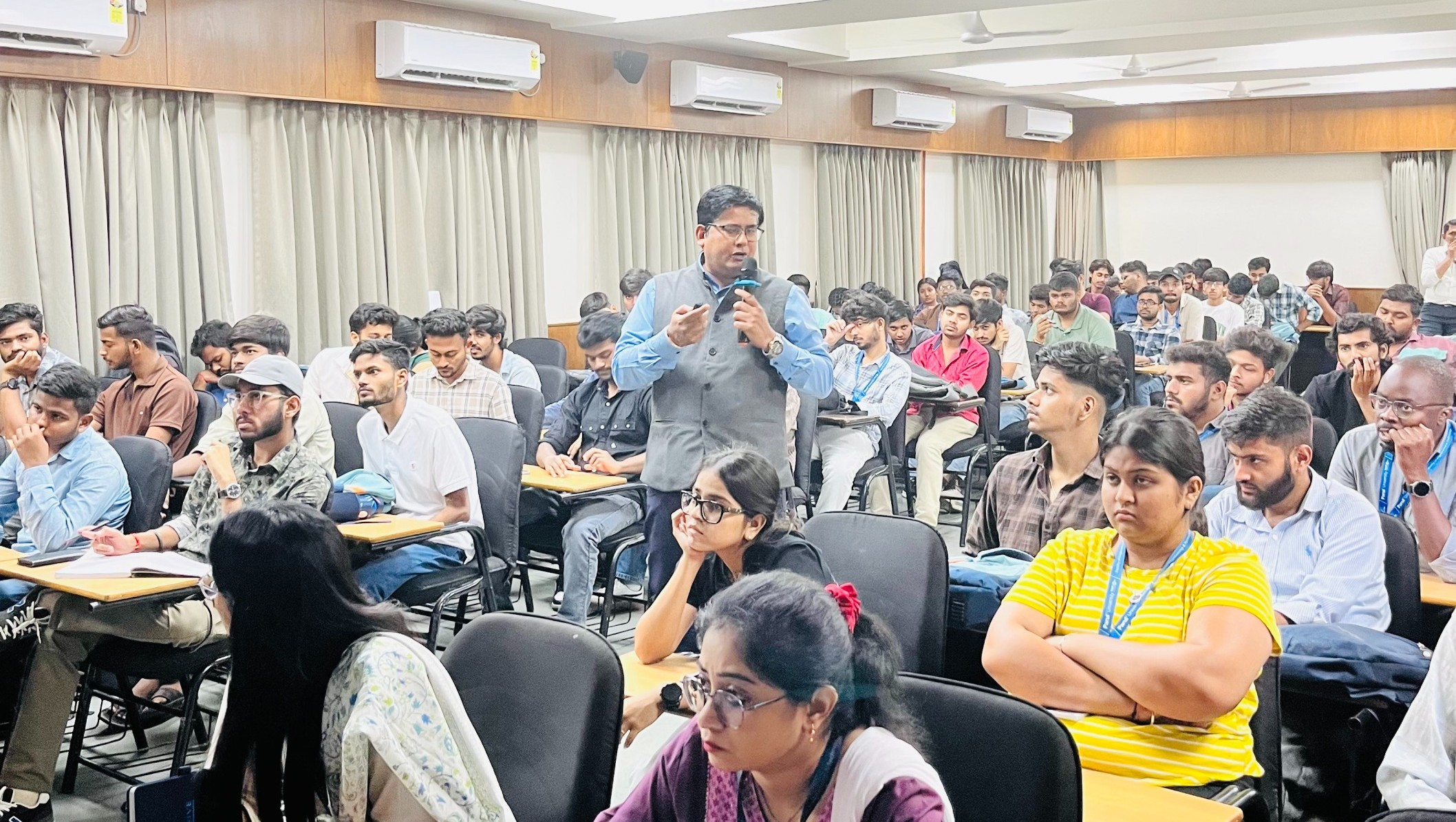
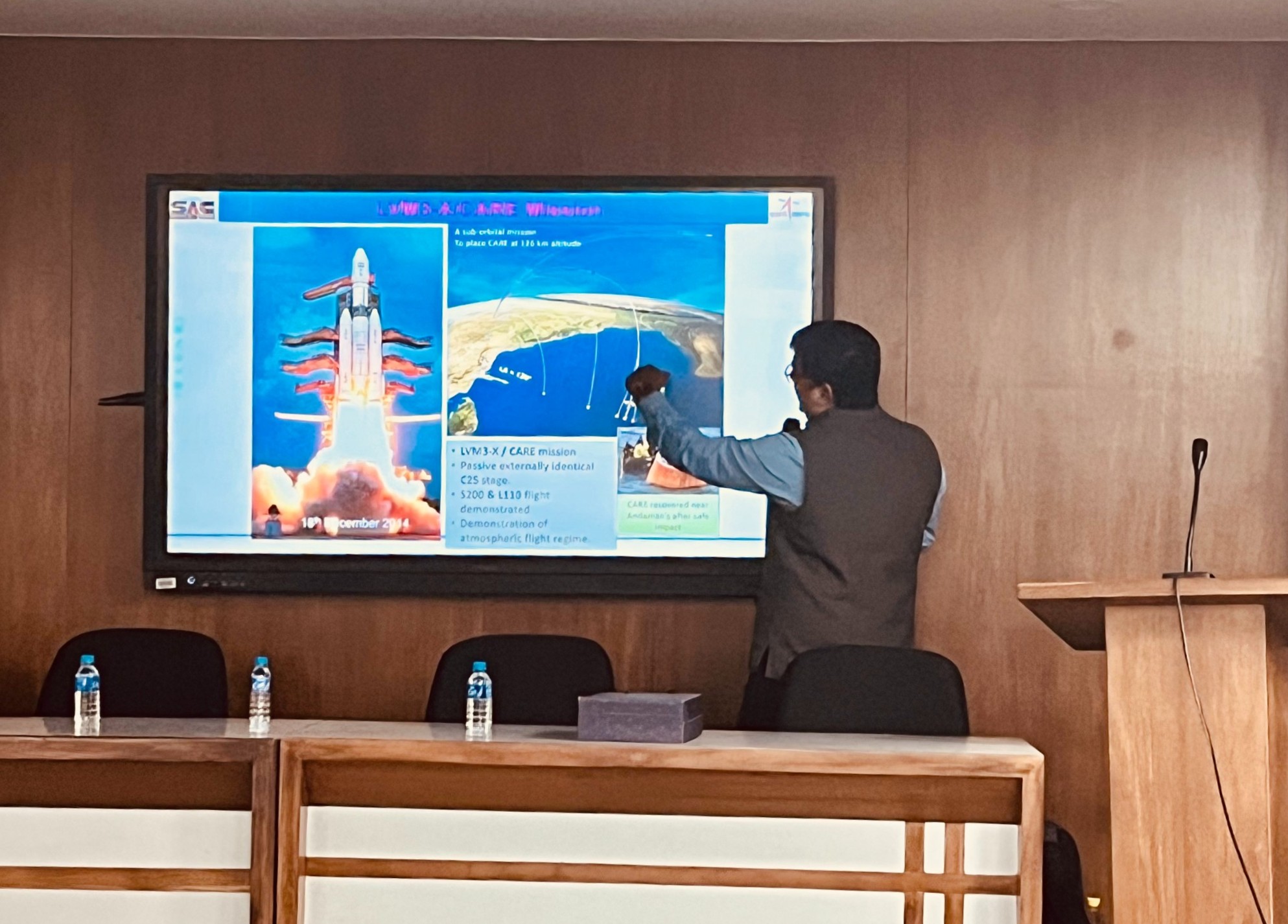
During his session at Parul University, ISRO Space Scientist Shri Ravi Kumar Varma broke down the orbital mechanics behind India’s Moon mission in a way that actually landed with an engineering audience.
Let’s get the obvious comparison out of the way first. The Americans had the Saturn V, the single most powerful launch vehicle humans have ever built, full stop. They had what amounted to an unlimited fuel chequebook, and that bought them a direct three-day transfer to the Moon. Brute force, overwhelming thrust, shortest possible route.
India’s approach came from a completely different school of thought. Not because ISRO couldn’t build bigger rockets but because there’s a smarter way to do it. Shri Varma used a word that stuck with the room: elegant. ISRO’s engineers chose progressive orbit-raising, a technique that trades time for fuel efficiency in a way that’s almost absurdly clever once you see how it works.
After the LVM3 dropped Chandrayaan-3 into its initial elliptical orbit around Earth, the real game started. Picture the spacecraft tracing a long, lopsided oval around the planet. Every time it swung back to perigee – the lowest, closest point in that oval, mission controllers at ISRO fired a short engine burn. Not a massive thrust. A nudge, really. But each nudge bumped the spacecraft’s velocity up by just enough to push the far side of the orbit the apogee, a little further out into space.
Repeat that five or six times over about two weeks, and the math starts doing beautiful things. The orbit stretches and stretches, the apogee climbing higher with every pass, until eventually the spacecraft drifts far enough from Earth that it crosses into the zone where the Moon’s gravity starts pulling harder than the Earth’s. That’s the handoff point. And it’s where things got genuinely nerve-wracking for the mission team.
The Moment Between Two Worlds: Earth’s Pull to Moon’s Pull
This is the part of the session where Shri Varma’s mathematical instincts really came through. He pointed out something that sounds almost too clean to be true: a circle is just a special case of an ellipse. That’s it. And the entire Chandrayaan-3 journey, stripped to its geometric bones, is the story of one elliptical shape gradually warping into another.
Think about what’s happening at the transition point. The spacecraft has been orbiting Earth in an increasingly stretched ellipse. At a certain distance, Earth’s gravitational grip weakens enough that the Moon’s gravity takes over as the dominant force. In that sliver of time, that crossing between one master and another, the trajectory briefly traces a parabolic arc. Not an ellipse. Not a circle. A parabola.
And right there, at that exact moment, Chandrayaan-3 had to fire its braking engines. This isn’t a “whenever you get around to it” situation. The timing window is ruthlessly small. Fire too late or not at all, and the spacecraft doesn’t get captured by the Moon. It sails right past — out into deep space, unrecoverable, gone. Every gram of fuel budgeted for this burn, every millisecond of timing, had been calculated months in advance. And it worked.
Lunar Orbit Insertion and the Historic Landing
Getting grabbed by the Moon’s gravity is one thing. So ISRO’s engineers got to work again, running a new sequence of precisely timed burns that gradually shrank the orbit’s eccentricity, that’s the measure of how squashed or circular an ellipse is, until Chandrayaan-3 settled into a clean circular orbit roughly 100 kilometres above the Moon’s surface.
From that orbit, the Vikram Lander detached and began its powered descent to the South Pole.
Now, why the South Pole? It’s worth pausing on this because it’s not arbitrary. India’s own Chandrayaan-1 mission had confirmed something the global scientific community had suspected but never conclusively proved: water ice exists in the permanently shadowed craters near the lunar South Pole. Shri Varma’s phrase for it was blunt, he called it a gold mine.
But the South Pole is nothing like the flat equatorial plains where Apollo touched down. You’re talking about permanently shadowed craters, violently uneven terrain, and communication dead zones. The navigation challenge is orders of magnitude harder. India built the AI-driven guidance systems and sensor arrays needed to handle all of it, technology that simply didn’t exist during the Apollo era. Chandrayaan-3’s Vikram Lander went where no spacecraft had gone before, and it stuck the landing.
The Numbers That Put It All in Perspective
Shri Varma is clearly someone who believes the right number, placed at the right moment, can hit harder than any metaphor. And he used a few that genuinely landed.
The LVM3 rocket that launched Chandrayaan-3 hit a peak velocity of approximately 36,968 km/h to punch the spacecraft into its initial orbit. Let that register for a second. That’s roughly 30 times the speed of sound.
The other 636 tonnes exist for one reason: to fight Earth’s gravity hard enough, for long enough, to get those 4 tonnes safely into orbit. If you want to understand why spaceflight is still insanely difficult and expensive, that ratio is the entire argument in one statistic.
Then there’s what happened after landing. The Vikram Lander hasn’t communicated since its first lunar day. And this isn’t a malfunction story, it’s a materials science story. The Moon’s surface temperature swings from roughly +250°C in daylight to around –170°C at night. That’s a 400-plus degree thermal swing, every single lunar day-night cycle. No material currently in production can survive that kind of punishment across multiple cycles without degrading beyond function.
And this is where the conversation circled back to something closer to home. Developing materials tough enough to survive the lunar surface is one of the genuinely open problems in space engineering right now. It’s also exactly the kind of nanomaterials research being pursued at centres like Parul University’s MNRDC. The connection between what’s happening in a lab in Vadodara and what’s needed on the Moon isn’t theoretical. It’s direct.
FAQs
Why did Chandrayaan-3 take 40 days to reach the Moon?
Because ISRO deliberately chose a fuel-efficient method called progressive orbit-raising. Instead of blasting straight to the Moon the way Apollo did with the Saturn V’s enormous thrust, Chandrayaan-3 used a series of small engine burns at perigee, each one stretching the orbit a little further until the spacecraft drifted into the Moon’s gravitational field. It takes longer. It also uses dramatically less fuel. And in space mission design, that trade-off matters enormously.
Why did India land on the Moon’s South Pole?
India’s own Chandrayaan-1 mission confirmed water ice sitting in permanently shadowed craters at the South Pole. That water ice is the key to any serious future lunar habitation, crack it into hydrogen and oxygen, and you’ve got fuel and breathable air. The South Pole terrain is far rougher and more dangerous than the equatorial zones where Apollo landed, so India had to develop AI-guided navigation and advanced sensor systems purpose-built for the challenge. Nobody else had attempted it. India did, and succeeded.
What happened to Chandrayaan-3 after landing?
Temperatures on the lunar surface swing from about +250°C to –170°C between day and night, and no material available today can survive that kind of cycling repeatedly. Solving this is an active frontier in materials science, and it’s one of the areas where nanomaterials research, including work at Parul University’s MNRDC, connects directly to what the next generation of lunar missions will need.