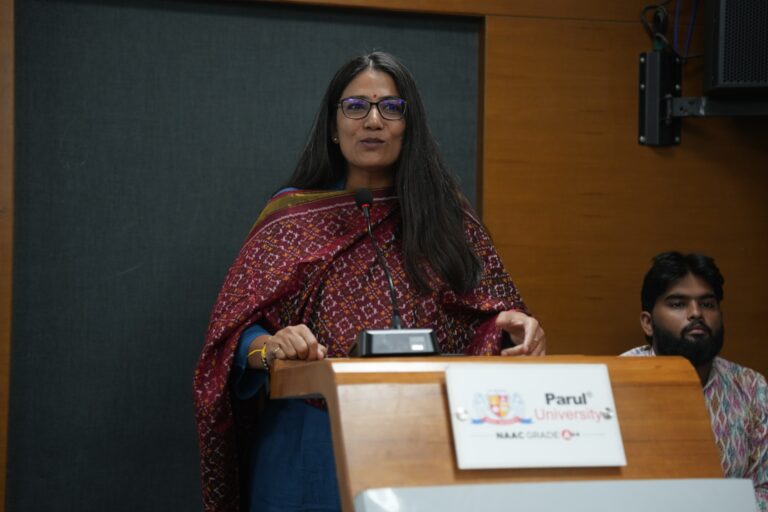
INS Valsura, established on 15 December 1942 during World War II, was originally conceived to train naval personnel in electrical and technical fields required for modern warships. Today it is a premier training establishment for electrical, electronics, and advanced weapon systems. Four sessions across the base covered the spectrum from quantum physics to close-range naval combat.
Commodore J.S. Dhanoa: Electronics, Weapons, and Naval Life
The Commanding Officer shared lived experiences of naval life: the discipline, the responsibilities, the dedication. The session covered the supremacy of technology in contemporary naval operations: electronic superiority, radar precision, and rapid technological adaptation. Modern maritime warfare relies on continuous technical evolution and rigorous training as the bedrock of national security. Students observed electrical systems, radar capabilities, and weapon technologies. Science and technical students were particularly captivated. If you too wish to become an experienced engineer, enrol into Parul University’s Engineering Courses after 12th!
Commodore R. Hari Kumar: Quantum Physics in Defence
The session connected quantum physics to national security. How subatomic particle behaviour (atoms, electrons) is harnessed for secure communication networks, modern sensors, and robust defence systems. Quantum principles are the invisible force behind the Indian Navy’s technological architecture.
“Science and advanced technologies like quantum physics play a vital role in strengthening the defence systems of the Indian Navy and ensuring national security.”
Ship Engineer Arjun Mehta: GEAPMS Module
The motorised cable roller within a GEAPMS module: a vital lifeline for heavy electrical infrastructure. The motor controls rolling speed and precise cable direction, removing human error and physical strain. Preventive maintenance philosophy: smooth cable movement prevents friction, wear, and structural damage. Proper cable management in heavy-duty systems is vital operational security.
“The AK-630 is a vital close-range defence gun that protects the warships of the Indian Navy from enemy missiles, aircraft, and small surface threats during high-stakes naval operations.”
Indian Air Force: Jamnagar
Group Captain A.K. Singh: Fighter Jets, AI, and Field Signal Tower
The station’s critical role in air defence, pilot training, and operational missions. Fighter jets as the nation’s primary shield: engineered for sudden response with speed and precision. The field signal tower is the central nervous system of the airfield, guiding aircraft during high-stakes take-offs and landings. AI integration: revolutionising surveillance capabilities, enhancing radar analysis accuracy, and streamlining aircraft maintenance.
Wing Commander Arjun Singh: Air Traffic Control
ATC as the indispensable framework across civilian airports and air force stations. The control tower is the hub of situational awareness. ATC officers guide pilots during take-off, landing, and spatial separation in flight. Continuous, highly structured radio communications with absolute clarity and brevity. Real-time radar monitoring ensures organised, safe air traffic flow.
“ATC plays a vital role in safely guiding aircraft and managing the complex air traffic operations of the Indian Air Force.”
Flight Lieutenant Rohit Kumar: Sukhoi Su-30MKI
One of the most powerful fighter jets in the Indian Air Force. Multirole combat capabilities: air superiority and ground attack. Advanced payload including state-of-the-art missiles and bombs. Sophisticated radar systems built to detect, track, and neutralise enemy targets. Extraordinary speed and long operational range for dominance in modern combat. Students asked detailed questions about speed metrics, weapon payloads, and radar technologies.
Indian Army: Regimental Heritage and Arsenal
Major Rahul Sharma: The Regimental System
A regiment is a highly cohesive brotherhood of soldiers rigorously trained for complex military operations. Each is a living repository of history. Prestigious legacies discussed: Maratha Light Infantry, Madras Regiment, Rajput Regiment, Sikh Regiment. Each carries unique traditions, battle honours, and chronicles of bravery. Built entirely on absolute discipline, extraordinary bravery, and flawless teamwork.
Lt Commander Aman Verma: War Memorials and Museums
War memorials honouring those who fought in major conflicts are the proud of our nation. Such detailed statues are placed, capturing & reflecting the heroism in such severe moments. Cenotaphs and inscribed plaques ensuring names of fallen personnel are never lost, regimental museums of Maratha Light Infantry and Madras Regiment – captures weapons, uniforms, and operational histories.
Colonel Vikram Singh: Weapons and Firing Ranges
Practical exposure to the Indian Army’s arsenal: standard-issue rifles, heavy-duty machine guns, and mortars. Designated firing ranges as essential training grounds. Weapon safety and control: the immense emphasis on discipline, accuracy, and confidence with different firearms. Readiness broken into components: strict discipline, situational awareness, and ingrained muscle memory under extreme pressure.
Indian Army: Service Before Self. Indian Navy: Sham No Varunah. Indian Air Force: Nabhah Sprisham Deeptam.
PU Programme - Engineering and Armed Forces Preparation
This tour is relevant to students across Parul University’s Faculty of Engineering and Technology and the university’s Beyond Academics programme. Armed Forces Motivation and Training, which prepares students for armed forces careers.
Parul University NDA coaching, or engineering career in defence should note: these students stood inside INS Valsura, operated alongside AK-630 briefings, observed Sukhoi Su-30MKI infrastructure, and walked army firing ranges. NAAC A++ (CGPA 3.55). 250+ technology labs. 2,200+ recruiters. So delay not and explore Engineering Courses at Parul University