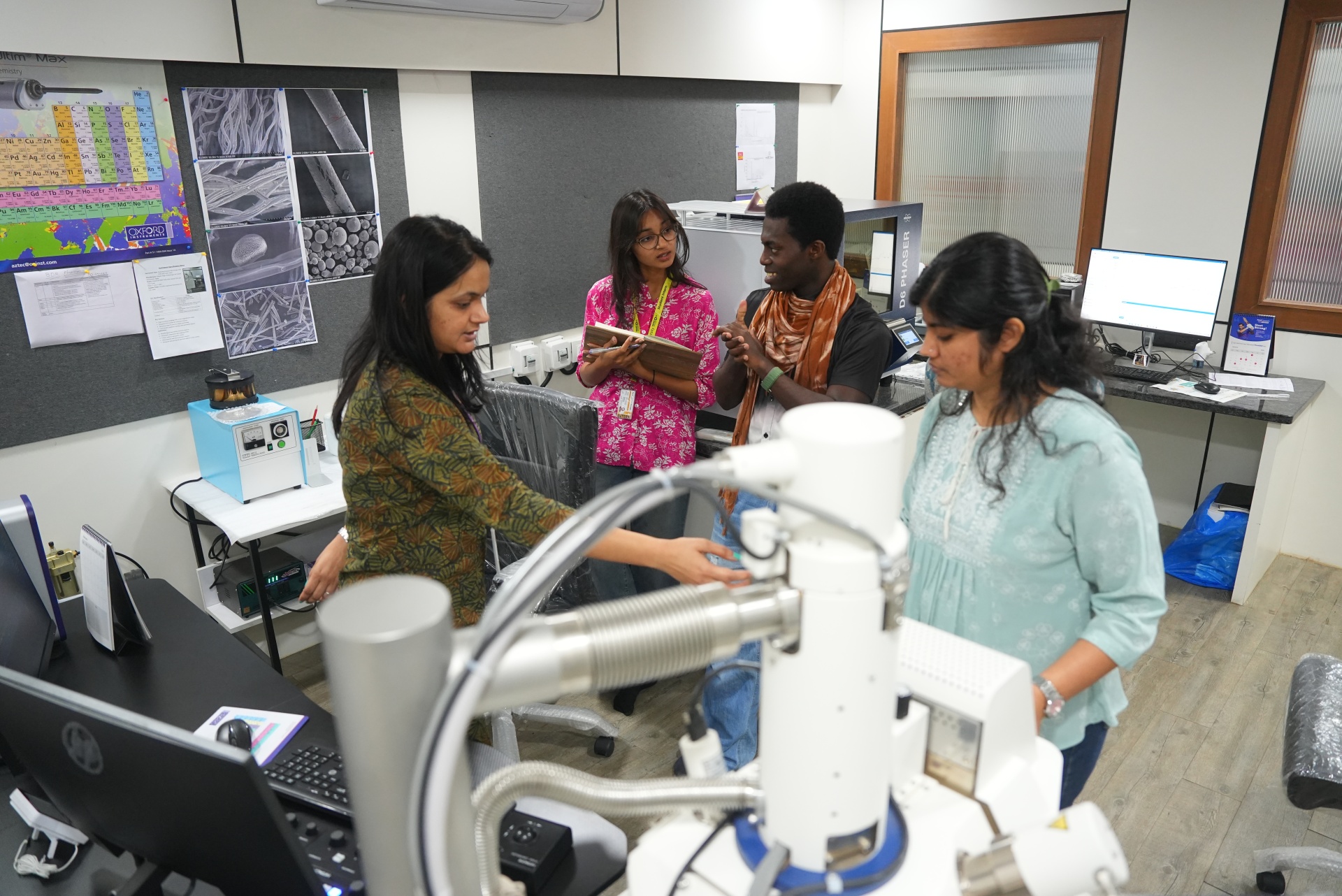
Before the MNRDC opened its doors, researchers and industries across Gujarat faced a structural problem that few outside the scientific community fully appreciated. Advanced material characterisation – the analysis of a material’s surface, crystal structure, mechanical properties, and elemental composition – requires sophisticated instruments that no single university or company can typically justify owning outright.
The result was fragmentation: researchers sent samples to multiple laboratories, often in Mumbai or other cities, coordinating across facilities with different protocols, schedules, and turnaround timelines. The process frequently took up to three months. Results came back without the contextual support to interpret them. Research timelines stretched, doctoral students waited, industry validation projects stalled.
The MNRDC was designed as the solution: a single, comprehensive facility in Gujarat where researchers and industries can access the full spectrum of material characterisation tools under one roof, with a standard turnaround of 10 working days and an urgent option of one business day. If you’re passionate about building a career in this field, consider enrolling in Parul University’s Master of Science in Biotechnology.
Establishment and Governance
The MNRDC was approved in early 2023 under the Scheme for Assistance for Research & Development Activities under the Gujarat Industrial Policy 2020, with funding from the Industries Commissionerate, Government of Gujarat – the state authority responsible for industrial development policy, headquartered in Gandhinagar. Total funding received since inception: ₹1.49 crore, allocated specifically for equipment procurement.
Operations commenced in September 2024. The center was formally inaugurated on 22 February 2025. It operates as a university-level research centre – not linked to any single department – reporting to the Vice President of Quality, Research and Health Sciences at Parul University.
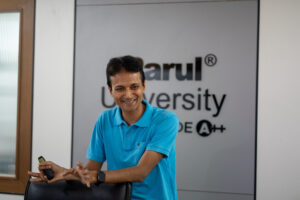
Strategic leadership is provided by Sr. Prof. Dr. Anand Joshi (Chairperson and HAG Professor, Mechanical Engineering; PhD, IIT Roorkee; 23+ years experience; 50+ publications; DST Fast Track Young Scientist recipient) and Prof. Dr. Unnati Joshi (Chief Research Officer; PhD, IIT Roorkee; 21+ years experience; funded projects from GUJCOST, DST, and the Royal Academy of Engineering UK). The 17-member full-time research team supports all instrument operations, sample testing, training, and research activities.
The Instrument Portfolio – 10 Advanced Tools
The Instrument Portfolio - 10 Advanced Tools
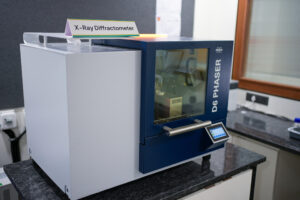
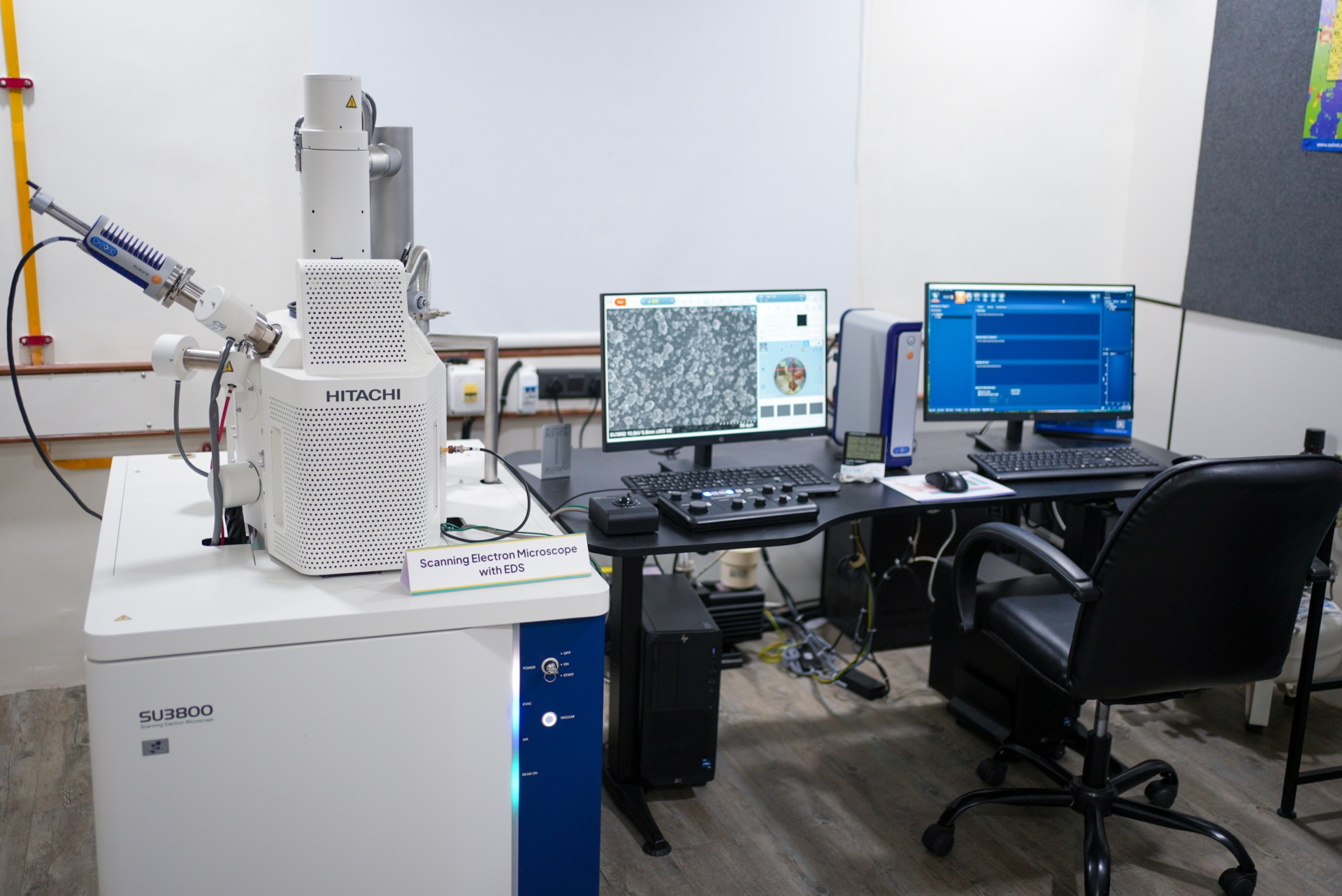
The MNRDC houses ten instruments covering the full range of material characterisation techniques. The Hitachi SU3800 Scanning Electron Microscope with EDS (₹1.9 crore, Japan, 2024) is the center’s most-used instrument, with over 897 samples analysed at a rate of 4–5 samples per day. It provides surface morphology analysis and elemental composition data in a single session. The Bruker D6 PHASER X-Ray Diffractometer (₹1.06 crore, Germany, 2024) has analysed over 600 samples, providing phase identification and crystal structure analysis using Bragg’s Law, supported by ICDD PDF-4 database and TOPAS software. The Nanosurf Core AFM (₹76 lakh, Switzerland, 2024) has characterised over 145 samples, delivering nanoscale surface topography, roughness parameters, and mechanical property data.
The Pin-on-Disc Tribometer (Novus Tribo Solutions, 2024) has tested over 118 specimens to ASTM G99 standard, analysing wear rate and friction coefficient for metals, polymers, composites, and coated materials. The LCR Meter ZM2376 (NF Corporation, Japan, 2024) has characterised over 61 samples for electrical and dielectric properties across a frequency range of 1 mHz to 5 MHz, with temperature testing up to 1,200°C using an integrated furnace. The RF/DC Magnetron Sputtering System Auto 500 (HHV India, ₹41.3 lakh, 2024) combines three deposition techniques – DC sputtering, RF sputtering, and thermal evaporation – in a single chamber for thin film deposition of metals, oxides, nitrides, and organic compounds.
Additional instruments include a Piezo-based Multicomponent Dynamometer for machining force measurement, a CNC Micro Machine Tool for precision micro-machining, a Computerised Bottom Pouring Stir Casting Machine (2 kg, 2025), and a Compression Molding Machine (50-ton, 2025). Instruments in procurement include a Differential Scanning Calorimeter (NEXTA DSC 200, Hitachi Japan) and Simultaneous Thermal Analyzer (NEXTA STA 200, Hitachi Japan).
Funded Research Projects - ISRO, CSIR, and Royal Academy of Engineering UK
The MNRDC’s research credentials are anchored by three externally funded projects spanning India’s most prestigious funding agencies and international bodies.
The ISRO project – Development and Characterisation of Processed Shape Memory Alloy (SMA) Components for Space Applications – positions the MNRDC at the intersection of materials engineering and aerospace technology. Shape memory alloys, which return to a predetermined shape upon heating, are critical for deployable structures and actuators in space missions. Characterising their surface and structural properties under various processing conditions requires exactly the instrument suite the MNRDC has assembled.
The CSIR-funded project on Design and Development of Metamaterial-Based Massive MIMO Antenna Using Machine Learning for Beyond 5G Applications connects the center to one of the most consequential telecommunications engineering challenges of the coming decade. Metamaterials – engineered to have properties not found in nature – require precise thin film deposition and surface characterisation at scales the MNRDC’s instruments are designed for.
The Royal Academy of Engineering UK-funded project on Advancing Green Hydrogen Production through Electrolysis: Optimisation and Renewable Energy Integration links the MNRDC directly to global clean energy research priorities. The center’s most significant publication – “Vertically aligned NiFeP@Ni nanotubes for efficient electrochemical production of green hydrogen and sulfur: Circular economy meets sustainable energy” (Renewable Energy, Impact Factor 9.1, Q1, 2025) – demonstrates the research capacity already being exercised in this domain.
International Partnerships and Recognition
The MNRDC has established a strategic research partnership with IIT Ropar for shared research and resources. International academic collaborations include Penza State University in Russia and the University of Surrey in the United Kingdom – home of Prof. S. Ravi P. Silva (Distinguished Professor, Director of the Advanced Technology Institute, H-index 92, CBE 2021, inventor of 50 patents, £50M research funding), who served as Chief Guest at the MNRDC’s ICSUMMIT 2026 international conference.
The centre has felicitated Parul Univesity to serve as official Knowledge Partner for international conferences in the United Kingdom and Vietnam – a recognition of its research positioning that extends well beyond Gujarat. Its growing publication record – 14 research papers enabled by the centre’s facilities, shared through its official Instagram and LinkedIn channels with QR code links to the full papers – demonstrates the translational value of its instrumentation.
Industry Partnerships and Service Model
The MNRDC actively serves the pharmaceutical, chemical engineering, materials science, and nanotechnology sectors. Industry partners include BDR Pharmaceuticals International, BDR Lifescience, AMI Lifesciences, SEASHORE NANOTECH, Gujarat Metal Cast, Nomisma Healthcare, and 15+ other organisations. External users account for a larger proportion of total usage than internal university users, with approximately 60% repeat client rate – a metric that reflects both service quality and results reliability.
The centre operates as a paid facility with separate pricing tiers for internal university users, external academic users, and industry clients. All instruments are charged per sample or per run – not per hour – with full confidentiality of all user data. NDAs can be arranged for industry projects, and IP protection follows a clearly defined framework based on whether an MoU is in place.
Training and Human Capacity Building
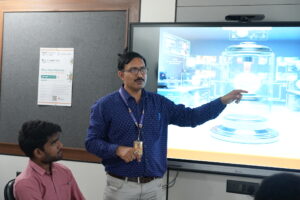
Beyond testing services and research, the MNRDC runs instrument-specific training workshops – one-day, two-day, and three-day formats. The three-day format includes hands-on machine operation rather than demonstration only. To date, 130 participants have been trained, drawn from pharmacy, Ayurveda, biotechnology, civil engineering, mechanical engineering, food technology, electronics, genetics, and more. Participants have come from institutions including Parul University, Sardar Vallabhbhai Patel National Institute of Technology, Vellore Institute of Technology and Sigma University.
Future expansion plans include a Smart Materials Laboratory (ISRO Funded), a Biotechnology Laboratory (SERB-TARE funded), and an RF Anechoic Chamber (CSIR-Funded). The Industries Commissionerate has also awarded a separate grant of ₹1.17 crore to establish a Centre of Excellence in Advanced Manufacturing Research and Technology at Parul University – a direct consequence of the MNRDC’s demonstrated success.
FAQ
What is the MNRDC at Parul University and who can use it?
The Micro-Nano Research & Development Center (MNRDC) at Parul University, Vadodara is a government-supported, university-level material characterisation facility with 10 advanced instruments. It is open to internal university researchers, external academic institutions, research scholars, and industry clients. External users account for the larger share of usage, with 60% being repeat clients. Standard test results are delivered within 10 working days.
What research projects does the MNRDC have with ISRO and the Royal Academy of Engineering UK?
The MNRDC has an ISRO-funded project on developing and characterising Shape Memory Alloy (SMA) components for space applications. Its Royal Academy of Engineering UK-funded project focuses on advancing green hydrogen production through electrolysis and renewable energy integration - the subject of the centre's most cited publication in Renewable Energy journal (Impact Factor 9.1, Q1, 2025).
How does MNRDC compare to sending samples to testing labs in Mumbai?
Before MNRDC opened, Gujarat researchers typically sent samples to Mumbai with turnaround times of up to three months. The MNRDC delivers standard results within 10 working days. All 10 instruments are available in one facility, eliminating the coordination burden of working with multiple specialist labs. The centre maintains 99.9% instrument uptime and has backup arrangements with multipl Labs in Vadodara.
What is the MNRDC's most significant research publication?
The MNRDC's most notable research publication is "Vertically aligned NiFeP@Ni nanotubes for efficient electrochemical production of green hydrogen and sulfur: Circular economy meets sustainable energy," published in Renewable Energy journal with an impact factor of 9.1 (Q1) in 2025. The paper is available at the MNRDC's official website and linked through its Instagram and LinkedIn channels.