Varadkar opened with an observation that reframed how students think about geopolitics. Global power is not fixed. It shifts over time, driven primarily by economic and military strength.
He kept coming back to this idea: what kids learn from textbooks just doesn’t get them ready for the real world, not now and not for what’s coming. Even the maps aren’t right; they mislead and lead you to the wrong directions, so we’re all looking at a skewed picture. He made his point pretty straight: the world order students read about isn’t the one they’ll deal with.
He brought this directly to India. After twenty years, India is considered to be a rising global economy.
And this will continue to grow, indicating opportunities for today’s students. India is not rising toward relevance. It has arrived. The question now is what individuals and institutions do with that position.
I am studying for an MBA at Parul University with cross-cultural experience.
Multilateralism: Why No Country Can Solve Global Problems Alone
Varadkar made one thing clear: the world’s biggest problems are all tangled up together, and no country can tackle them on its own. He used climate change as his main example. It doesn’t care about borders, and you can’t solve it with just two countries talking or a bunch of separate national rules. Countries should come together for a solution. He said the world’s turned into a small village; what happens in one corner affects everyone else.
This idea isn’t just a theory for him. When he was Taoiseach, he dealt with Brexit. That threw Europe’s trade relationships into chaos and forced countries to work together on decisions that were tricky and huge, the kind most leaders never face. He mapped out ways to guide Ireland during COVID-19 while working with other countries on supply chains of vaccines and other health care necessities. His views about international relations are not shaped by academic rules but by experiences.
Democracy, Inclusivity, and Why Leadership Should Reflect Society
One of the session’s most direct statements was about representation. He said half of the world’s population is female, and this gets reflected in the leadership as well. He analyzed this beyond gender, religion, ethnicity, and background. With diplomacy, he said that diversity makes the decision-making process harder, but when the decisions are taken, with all the considerations, they become more resilient and legitimate. Hence, leaders and the government should take everything into account.
When talking about youth and their experiences, he said that experiences bring institutional knowledge, pattern recognition, and steadiness. But fresh ideas come from younger leaders who see problems differently because they have not yet been told that certain solutions are impossible. The combination is what works. Neither alone is sufficient.
BBA at Parul University leads you to management field careers.
Leadership Under Pressure: Brexit, COVID, and Learning From History
Varadkar spoke from experience that most leadership speakers cannot claim. He led a country through Brexit and a global pandemic simultaneously. His observations were specific rather than generic. Big events like COVID-19, Brexit, and financial crises force leaders to come together and act quickly. Sometimes it is the events themselves that create cooperation, not the leaders’ willingness. You are thrown into the trenches together, and over time, people begin to gel. Trust does not happen in one day. You have to allow time for a team to form.
He drew an amazing observation from history. There have been times when people believed that wars would end, but they didn’t, and the time extended until they got independence. This took a toll on their daily lives, with the increasing cost of living. Hence, leaders must think and analyze how to make decisions that don’t affect the public and favor them all.
Teamwork, Communication, and Managing Difference
Successful leadership, Varadkar explained, requires a common goal and the ability to manage differences within a team. The most important thing is to have a shared objective that everyone is working towards. Without that, differences become fractures instead of creative tension. He described how leaders constantly stay in touch, discuss issues, and clear misunderstandings before they grow. A lot of problems are just misunderstandings, he said, and talking regularly helps solve them early. This applies equally to running a country, leading a company, or managing a college project.
India and Europe: Massive Untapped Potential
Varadkar spoke directly about the India-Europe relationship. Together, India and Europe represent a huge population and massive economic potential. There is scope for more trade, more growth, and the exchange of technology and ideas. He observed that when one country steps back from free trade, others move forward and strengthen partnerships. The shifting global trade landscape is creating new openings, and the India-Europe corridor is one of the most promising. For Indian students considering careers in international business, trade, or diplomacy, this is the structural trend to watch.
Professionalism: What Varadkar Told Indian Students Specifically
A significant portion of the session addressed how young Indians can become more professional in a competitive world. Varadkar’s framework was practical: discipline and consistency in work, clear communication skills, accountability and responsibility, and cultivating a global mindset while staying rooted in values. His point was that professionalism is not just about technical skills. It is about attitude and behaviour. How you show up, how you follow through, how you handle setbacks. These define a professional more than any certificate.
The Student Question That Stood Out: Inner Qualities for Leadership
Towards the end, Anurag Nayan, a first-year BBA (Hons) student from the LDM Division at Parul University, asked the question that drew the most substantive response. If a person wants to achieve something significant in life, they must first strengthen their inner core. From your perspective, what are the inner qualities that help when national interest, global pressure, and ethical responsibility arise simultaneously?
Varadkar’s answer was specific and personal:
- Clarity of vision: staying focused on a clear goal is essential during challenging times. Without knowing where you are heading, pressure becomes paralysing rather than motivating.
- Focus: Consistent attention towards priorities helps in navigating complexity. Distractions become twice or more when you are under pressure. Filtering out distractions or negativity isn’t something you are skilled in; it’s something you learn with experience as you grow. Inner drive matters most when no one’s cheering you on. It’s what keeps you going when you’re working hard, and there’s nothing to show for it yet.
- Luck: let’s be real; it plays an important part too. You are doing everything right, but there are times when you just need to be in the right place at the right time. Admitting that doesn’t mean giving up; it just means being honest with yourself so you don’t drift off into wishful thinking.
- His main point boils down to this: Success and good decisions don’t come from one thing. You need vision, focus, inner drive, and the sense to keep yourself grounded when things start getting shaky.
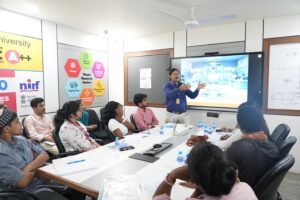
During the session, students got a chance to throw questions at Varadkar without any warning. That put his practical thinking, fast decision-making, and personal take on leadership front and center. It broke through the usual distance of politics and let everyone see the person behind the title, a guy who’s steered through some of the biggest moments in Europe’s recent history
Why Should One Go Abroad?
Varadkar encouraged students to explore opportunities outside their home country. Spending time abroad is a huge advantage. It gives you experience you can bring back. But he added something that echoed what H.E. Rui Duarte de Barros had said in the previous IIMUN session: you start to appreciate your own country more when you see how others work. Going abroad is not about leaving. It is about returning with a wider lens. Other University, with 5,500+ international students from 75+ countries and 120+ global tie-ups, is already building this kind of cross-cultural exposure into the campus experience.
Parul University International Programs lead to careers that are valid across all the countries. To know more, visit the Faculty of Management at Parul University.
FAQ: Leo Varadkar at Parul University
Who is Leo Varadkar?
Former Taoiseach (Prime Minister) of Ireland. A trained doctor who became one of Ireland's youngest leaders. He guided Ireland through Brexit and COVID-19. Known for forward-thinking, people-centric leadership. Spoke at Parul University on 23 March 2026 as part of the PU x IIMUN Global Perspective Series.
Leo Varadkar visited India. What did he say about India?
Leo Varadkar is the former Taoiseach of Ireland. He said India and Europe have huge populations representing massive economic potential. Leading to a scope for trade, technological advancement, growth, and exchange of trade. This shows that India is one of the top global economies in the world.
What is the PU x IIMUN Global Perspective Series?
It is an event where Parul University and IIMUN collaborate, and global leaders come to campus. Guests from Ireland, Africa, and Iran came this year. Students get an opportunity to interact with them and learn about their experiences and culture.