India’s food packaging sector is under growing pressure from three simultaneous directions: consumer demand for longer shelf life without synthetic preservatives; FSSAI regulatory movement toward standardised food packaging material declarations; and global sustainability requirements pushing toward bio-nanocomposite alternatives to petroleum-based packaging. Nanotechnology addresses all three simultaneously. Research published in Discover Nano (Springer, 2025) and reviewed in PMC describes how integrating nanomaterials into biopolymer-based food packaging films significantly enhances functionality, extending shelf life and improving food safety while addressing environmental challenges associated with traditional materials. Parul University’s Master of Technology in Material Engineering (Nanotechnology) is a future-focused postgraduate program designed for students who aspire to be at the forefront of scientific innovation and advanced materials research. The dominant nanoparticle additives in food packaging research are ZnO (zinc oxide), Ag (silver), TiO2 (titanium dioxide), and clay nanoplatelets.
What Was Actually Tested at MNRDC - ZnO in Polyether Ketone
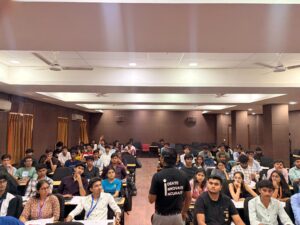
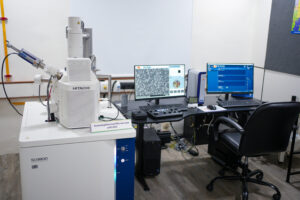
During the MNRDC’s 3-Day Hands-On Training on Electron and Probe Microscopy (25–27 February 2026), one of the three demonstration samples used in the SEM hands-on session led by Dr. Vidhi Pathak (Research Cadre, MNRDC) was specifically ZnO powder in polyether ketone – a polymer nanocomposite powder. The procedure followed was: spread the ZnO/PEK powder evenly across carbon tape on a 51mm SEM disc (to maximise the scan area and avoid agglomeration artefacts); gold-coat the non-conducting polymer matrix; load under vacuum; and acquire SEM images at 30, 10, and 5 µm resolution progressively. To read more about how MNRDC is innovating, head here to explore all the research initiatives.
The EDS analysis of this sample produced a zinc and oxygen elemental spectrum confirming ZnO presence, followed by an area mapping run that colour-coded the spatial distribution of zinc and oxygen throughout the polymer matrix, directly showing where ZnO nanoparticles were sitting within the polyether ketone structure.
The Complete Nanocomposite Characterisation Workflow
SEM + EDS - Particle Distribution and Morphology
SEM micrographs at multiple magnifications directly reveal agglomeration, particle size range, and whether the polymer matrix is continuous or has processing defects. EDS area mapping adds the elemental dimension: which regions of the polymer matrix contain zinc (ZnO), and at what approximate concentration? A well-distributed composite shows zinc signal evenly throughout the mapped area.
An agglomerated composite shows zinc concentrated in isolated clusters with zinc-free zones between them. This data directly informs and confirms whether the nanocomposite processing parameters (mixing energy, temperature, time) are achieving adequate nanoparticle dispersion.
XRD - Crystal Phase Confirmation and Crystallinity
XRD confirms that the ZnO nanoparticles retain their intended crystal structure (hexagonal wurtzite for ZnO, the antimicrobially active form) after incorporation into the polymer matrix. High-temperature polymer processing can potentially cause ZnO phase transformation or sintering, altering nanoparticle size and crystal structure. XRD before and after processing confirms whether the nanoparticle crystal integrity is maintained. Additionally, Scherrer equation analysis of peak broadening provides crystallite size predictions for the ZnO nanoparticles, complementing AFM grain size measurements with a diffraction-based size distribution.
AFM - Surface Roughness of Food Packaging Films
For cast or extruded food packaging films, AFM provides the nanoscale surface roughness data that determines how the film interacts with packaged food surfaces, sealing surfaces, and printing inks. A smoother film surface (lower Ra, Rq) indicates better barrier properties and more consistent heat-sealing performance. AFM also reveals whether nanoparticle incorporation has created surface protrusions or voids, quality defects that could compromise barrier integrity.
Applications Relevant to Indian Food Technology Researchers
India’s Food Safety and Standards Authority (FSSAI) has engaged with nanotechnology in food contact materials as part of its evolving regulatory framework. As regulatory requirements for nanocomposite food packaging characterisation evolve, having instrument access and documented characterisation data will become increasingly important for Indian food packaging manufacturers and researchers. The MNRDC’s combination of SEM+EDS (proven on ZnO/PEK composites), XRD (600+ samples including ZnO), and AFM creates a one-stop characterisation facility for this research agenda. Head here to submit your sample for Parul University’s MNRDC Department!
Sandip Basu, a Food and Dairy Technology researcher at Parul Institute of Technology who attended the MNRDC’s February 2026 workshop, specifically identified the cross-disciplinary applications to bioscience and food technology as the most impactful insight from his attendance. His observation.
“The main thing that didn’t leave me was how we as science professionals can use these machines in bioscience” – is a direct indication that food technology researchers recognise the applicability of MNRDC instruments to their own research questions, even when those questions do not originate in traditional materials science. Read here to know more on what Sandip Basu spoke at Electron & Probe Microscopy Workshop – 3 Day Advanced Learning Hub!
FAQ SECTION
What is ZnO nanocomposite and why is it used in food packaging?
ZnO (zinc oxide) nanocomposite food packaging combines ZnO nanoparticles with a polymer matrix to achieve antimicrobial properties (ZnO generates reactive oxygen species that inhibit bacterial and fungal growth), UV barrier enhancement (blocking photo-oxidative degradation of packaged food), and mechanical reinforcement.
Can MNRDC at Parul University characterise food packaging nanocomposite samples?
Yes. The MNRDC has directly characterised ZnO in polyether ketone composite samples using SEM+EDS, producing elemental area mapping showing zinc distribution within the polymer matrix, which is exactly the characterisation data food packaging nanocomposite researchers need.
What characterisation techniques are used for nanocomposite food packaging research?
The standard characterisation workflow for food packaging nanocomposites in peer-reviewed research is: SEM for particle morphology and distribution; EDS for elemental composition confirmation.