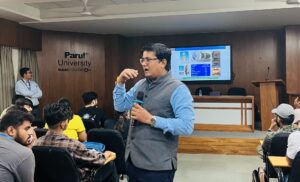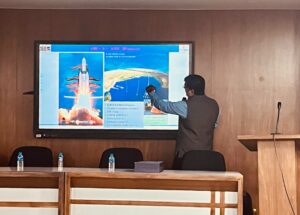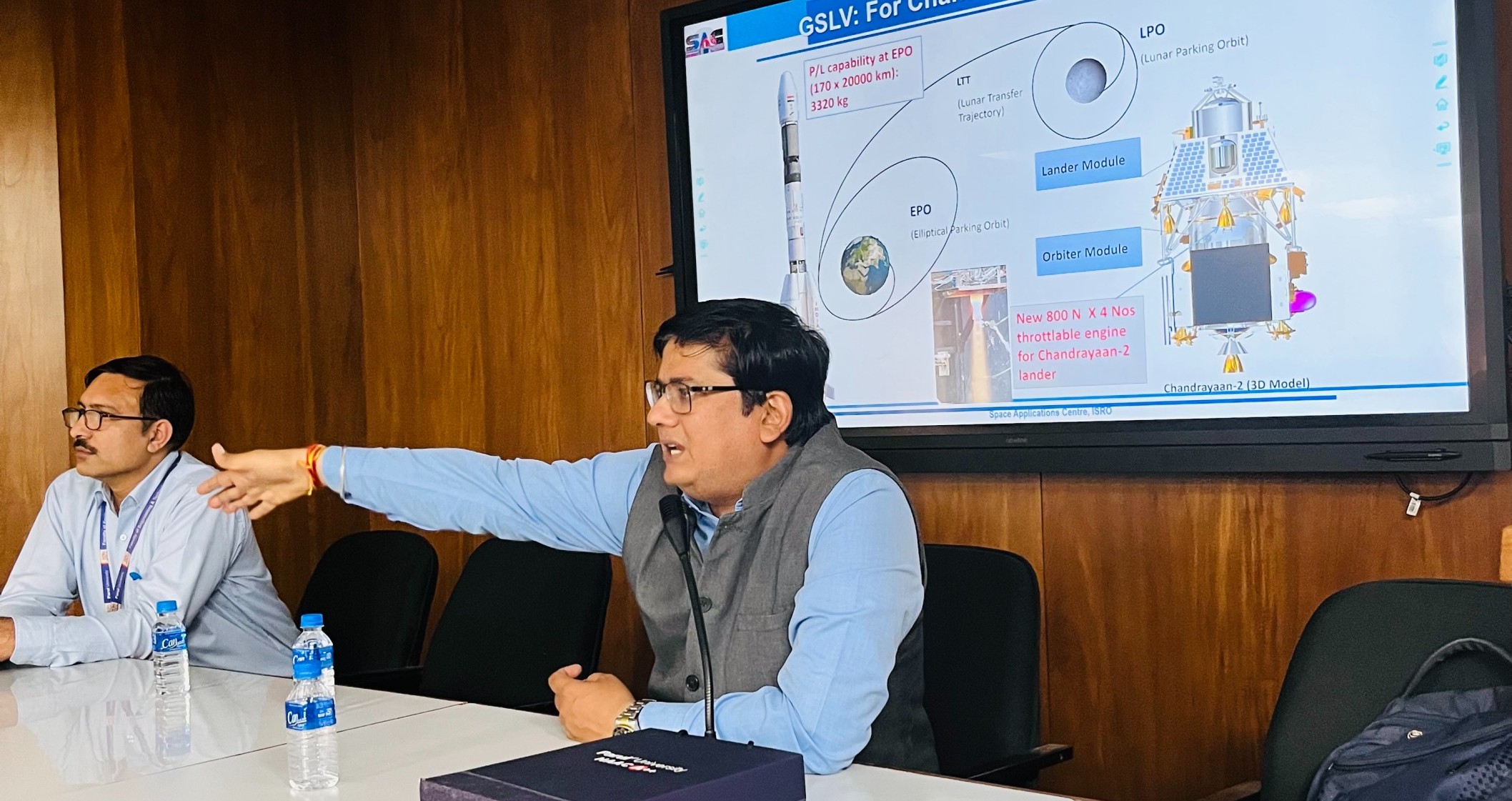
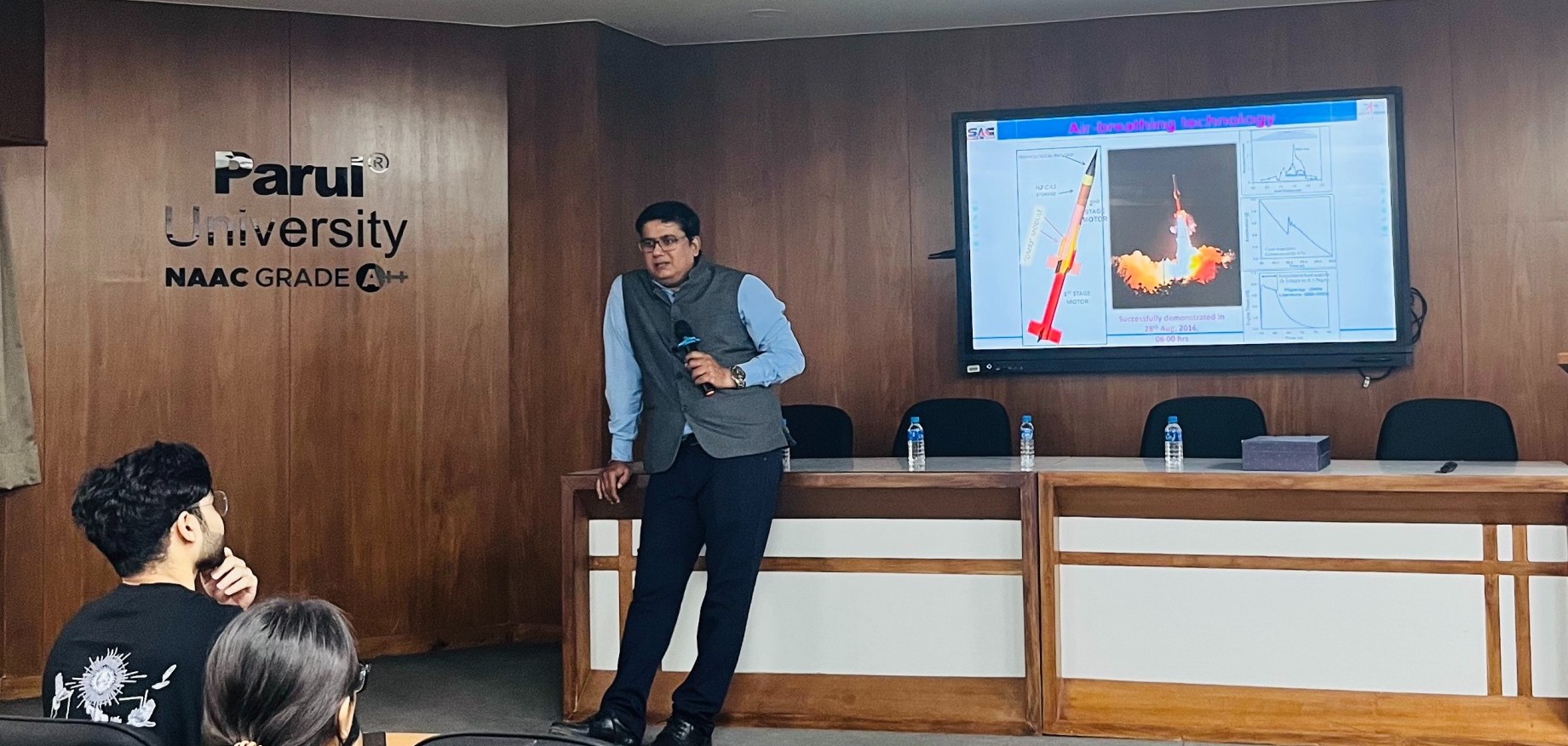
During his session at Parul University’s MNRDC, ISRO Space Scientist Shri Ravi Kumar Varma connected dots that most guest speakers wouldn’t even attempt. He went from carbon nanotube composites and self-healing polymers in satellite construction to the growing nightmare of space debris that threatens every single launch, and then pivoted to something nobody in the room expected what daily life aboard the International Space Station actually feels like when you’re experiencing 16 sunrises before lunch, your blood is flowing the wrong direction, and the water you’re trying to drink is floating in front of your face as a wobbly blob.
India’s Gaganyatris are training for exactly that reality right now. And the throughline of the whole conversation? The distance between a nanotechnology lab bench and a satellite in orbit is a lot shorter than most engineering students realise. That was Shri Varma’s point and he made it stick.
This is the part of the session that hit closest to home for the MNRDC students, and Shri Varma clearly knew it. He wasn’t speaking in abstractions. He was talking about the exact kind of work their centre is set up to do and explaining where it ends up.
Modern satellites aren’t built the way most people picture them. These are polymers engineered to do something almost biological: when a micrometeorite punches a micro-crack into the satellite’s skin, or when thermal stress opens a hairline fracture, the material repairs itself. No human intervention. No spacewalk. The polymer does the work on its own. This isn’t science fiction anymore. It’s becoming standard in how satellites get built.
The punishment these materials have to survive is genuinely brutal. Radiation in orbit creates two distinct kinds of havoc. There are single-event upsets sudden, instantaneous electronic glitches where a charged particle slams into a chip and flips a bit or fries a transistor. And there’s total ionising dose degradation, which is the slow, cumulative poisoning of semiconductor performance over months and years. On top of that, satellites swing between blazing sunlight and pitch-black shadow every orbit, with temperature differentials of hundreds of degrees hitting the structure each time. Any material that can’t absorb that punishment repeatedly, for years on end, has no business being in space.
Shri Varma drew the connection to MNRDC’s four research pillars, nanomaterials, nanoelectronics, MEMS, and biomedical nanotechnology and it wasn’t a stretch. The centre runs scanning electron microscopy (SEM), atomic force microscopy (AFM), X-ray diffractometry, and sputter deposition systems for thin film fabrication. Those aren’t just academic toys. They’re the same categories of tools that go into developing and qualifying materials for space-grade use. His point was blunt: the laboratory work happening at places like MNRDC feeds directly into the vehicles orbiting above us. The pipeline is real.
Space Debris: The Invisible Threat to Every Mission
A student asked about dead satellites, and the room’s energy shifted. This was one of those questions that sounds simple but opens up into something genuinely alarming once you hear the answer.
Space debris. It sounds benign like litter. It is not. We’re talking about defunct satellites that nobody controls anymore, spent rocket stages tumbling through orbit, shrapnel from past collisions, even flecks of paint that have chipped off and are now circling the Earth at 28,000 km/h. At that speed, the physics gets terrifying. A piece of debris the size of a marble carries enough kinetic energy to punch through a satellite’s shielding and destroy it outright.
Before every single launch, ISRO runs what’s called a Collision Avoidance Analysis. The process uses continuous high-precision tracking of every catalogued object in orbit and there are tens of thousands of them to verify that the planned flight path won’t cross paths with any known debris. It sounds routine when you say it quickly. In practice, it’s a massive computational effort that has to account for orbital decay, trajectory uncertainties, and the sheer density of objects in certain altitude bands.
And the problem is getting worse, not better. Commercial mega-constellations, Starlink, OneWeb, and the rest are pumping thousands of new satellites into orbit every year. More objects means more collision risk. More collisions mean more fragments. More fragments mean more risk of further collisions.
Life on the International Space Station: 16 Sunrises Every Day
The session took a hard turn here from engineering abstraction to raw human experience. And you could feel the room’s attention tighten.
The International Space Station is about the size of a regulation football field. It orbits at roughly 400 kilometres above Earth’s surface, hurtling along at 28,000 km/h, and completes a full lap around the planet every ninety minutes. Do the maths on that and you get something surreal: the crew sees 16 sunrises and 16 sunsets every single day. The station rotates a full 360 degrees per orbit to keep its solar panels angled correctly and its instruments pointed where they need to be. Imagine your “window view” cycling through dawn, noon, dusk, and midnight roughly every six minutes.
In microgravity, blood circulation goes haywire. On Earth, gravity constantly tugs blood downward, and your cardiovascular system is built to push against that pull. Remove gravity, and the whole system recalibrates badly. Blood and other fluids shift upward toward the head, causing the puffy “moon face” that every astronaut gets within hours of reaching orbit. Vision degrades, there’s increased pressure on the optic nerve from fluid buildup behind the eyes, and some astronauts come back with permanently altered eyesight. The physical toll is so severe that researchers estimate one day spent in space takes roughly the same toll on the body as fourteen days on Earth.
Crew members rarely manage more than four or five hours of sleep at a stretch, partly because of the disrupted circadian rhythm from those 16 sunrise-sunset cycles, partly because sleeping in microgravity is just deeply strange. You have to strap yourself in. Everything floats. Water doesn’t pour, it hangs in the air as semi-viscous globules that wobble and drift.
India’s Gaganyatris are in intensive training right now under the Gaganyaan programme to prepare for exactly this. Every one of the physiological challenges Shri Varma described, the fluid shifts, the bone density loss, the muscle atrophy, the psychological toll of confinement is something India’s crew will face firsthand.
Shri Varma paused at one point and asked the students to sit with a single thought: imagine waking up and seeing sixteen sunrises before the day is over, after spending your entire life experiencing just one. The room went dead quiet. Nobody reached for an answer. That silence, honestly, said more than any response could have.
Satellite Lifespan: What Determines How Long They Last
Most satellites are designed with an operational life expectancy of roughly 10 years. That’s the target. Whether they actually make it depends on three things, and Shri Varma walked through each one.
Every day a satellite spends in orbit, it absorbs radiation, cosmic rays, solar particle events, trapped radiation in the Van Allen belts. Over time, that radiation degrades semiconductor performance through what’s called total ionising dose effect. Think of it as slow poisoning. The electronics don’t fail all at once; they just get worse and worse until the satellite can’t do its job anymore. And then there are single-event upsets, those sudden, random bit-flips caused by a high-energy particle smashing into a chip at the wrong moment. One glitch in the wrong system and the satellite might lose attitude control or corrupt critical data.
Second: the type of orbit. A satellite in low Earth orbit faces more atmospheric drag (yes, there’s still a wisp of atmosphere up there) and sits in a denser debris field than one parked in geostationary orbit 36,000 kilometres out. But higher orbits come with their own punishment, more exposure to solar radiation and charged particles trapped in Earth’s magnetic field.
Third: the resilience of onboard systems. The quality of the electronics, the robustness of the power supply, and crucially the structural materials that hold everything together. This is where nanomaterials research circles back in. Radiation-hardened electronics and radiation-resistant nanomaterials aren’t luxuries. They’re what determines whether a satellite lasts five years or fifteen. And that’s another area where the kind of research being done at MNRDC connects directly to keeping India’s space infrastructure alive longer.
FAQs - Nanotechnology and Space
How is nanotechnology used in space?
Satellites today are built with carbon nanotube composites and self-healing polymers that can take the beating of radiation bombardment, thermal shock, and micrometeorite strikes without falling apart. These materials weigh less and perform better than the conventional metals they’re replacing. Research centres like Parul University’s MNRDC are working on exactly this kind of nanomaterial development, the same stuff that ends up in space-grade hardware.
What is space debris and why is it dangerous?
Space debris is everything humans have left in orbit that’s no longer doing anything useful: dead satellites, spent rocket stages, shrapnel from past collisions, even paint chips. The danger is speed. At orbital velocity (around 28,000 km/h), even a tiny fragment carries enough energy to destroy a functioning satellite on impact. ISRO runs Collision Avoidance Analysis before every launch to make sure the flight path steers clear of all catalogued debris.
How many sunrises do astronauts see per day on the ISS?
The ISS whips around Earth at 28,000 km/h, finishing a full orbit every 90 minutes. Crew members deal with reversed blood circulation, disrupted sleep patterns, puffy faces from fluid shifting to the head, and a physical toll that’s been estimated at roughly 14 Earth-days’ worth of wear for every single day spent in orbit.