
The Course: Affordability in Innovation and Entrepreneurship
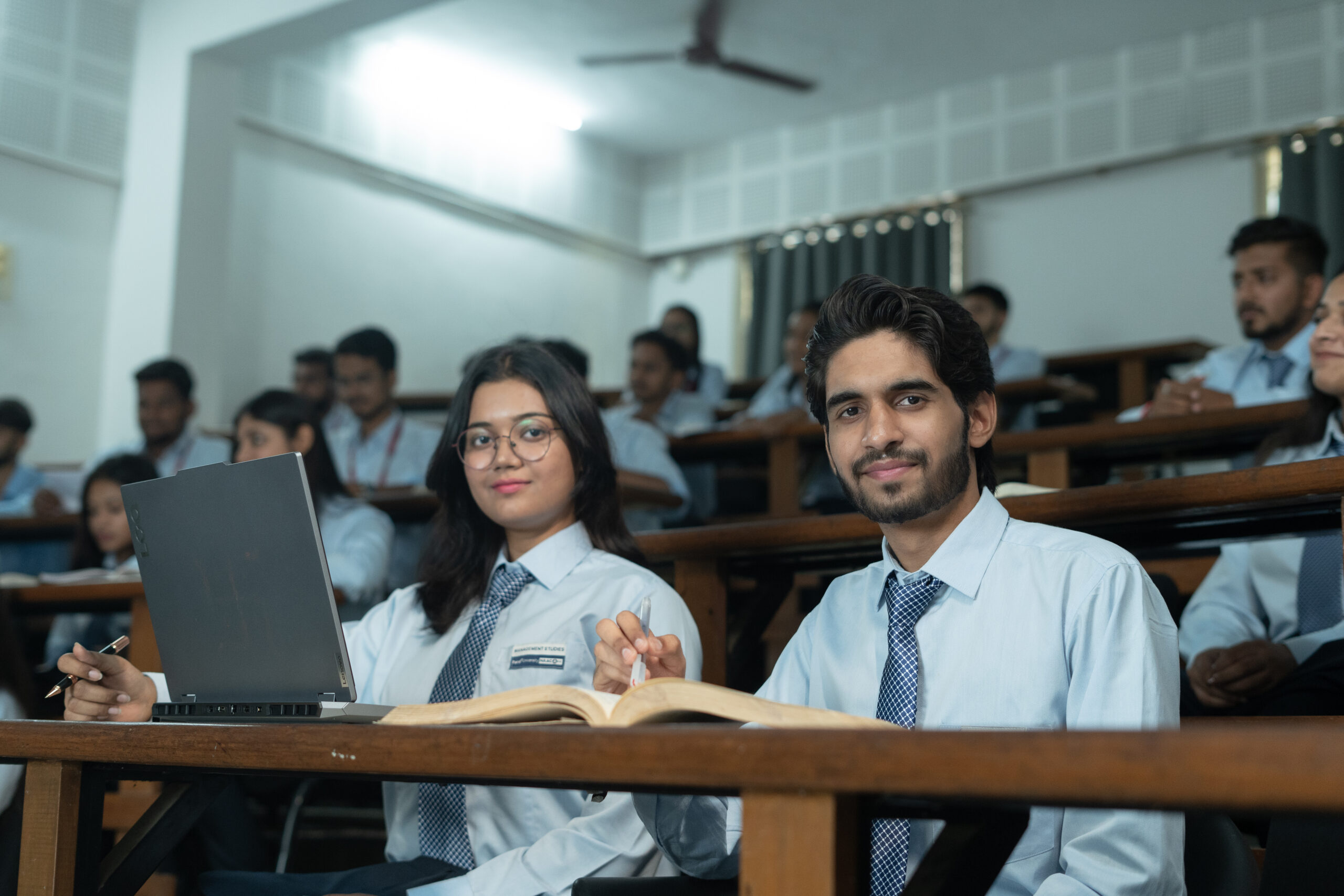
The very first session of the course was held on 21 February 2026 at the Founder’s Studio of Parul University. 20 graduate & postgraduate students from Parul University were present in the room, while BFH students and faculty connected virtually and initiated the fruitful beginnings!
The session was delivered by four lecturers from both institutions. Jay Sudani, CEO of PIERC and Head of the Incubation Centre, a Mechanical engineering Master with 10+ years of faculty experience, leads the PIERC team. Hutesh Baviskar, Senior Manager – Incubation at PIERC, has 14+ years at Parul University, two Best Faculty Awards, an EDC Special Recognition Award, and has mentored 10+ active startups. From Switzerland, Professor Nadine Gurtner and Professor Sebastian Gurtner of BFH Business School bring expertise in entrepreneurship, innovation management, and international collaborative learning.
The Course: Affordability in Innovation and Entrepreneurship
The course – ‘Affordability in Innovation and Entrepreneurship’ – is a Collaborative Online International Learning (COIL) programme jointly designed by PIERC Parul University and BFH Business School, Switzerland It is a credit course for UG & PG students of both universities. The course runs across six two-week learning cycles delivered through Moodle, with three synchronous on-campus sessions connecting both universities in real time via MS Teams.
The three course objectives are: raising student awareness about affordable innovation (a concept often overlooked in traditional business education), helping students identify and create market opportunities that generate both economic and social value, and developing intercultural skills alongside the ability to scale innovative ideas across different cultural and economic contexts
Student Teams and Structure
Students form national teams: 4 teams of 5 students each from Parul University (20 students total) and 4 teams of 4 students each from BFH (16 students total). Each team works throughout the semester on an affordable innovation project – developing a concept that addresses a real problem and demonstrating how it can work in both India and Switzerland.
Six Learning Cycles
Each student completes six individual learning cycles, each two weeks long, through Moodle. The cycles cover:
LC1 – Foundations of Affordability in Innovation,
LC2 – Organisational Capabilities for Affordable Innovation,
LC3 – Innovators’ Motivations (graded, 25%),
LC4 – Innovation Failure (graded, 25%),
LC5 – Impact Creation through Affordable Innovation,
LC6 – Thinking Globally about Affordable Innovation.
All six must be completed to pass the module.
Three On-Campus Sessions
Session 1 (21 February 2026): Welcome and Course Organisation – the session that launched the programme, timed 8:15-11:45 AM Swiss Time / 12:45-4:15 PM Vadodara Time.
Session 2 (20 March 2026): Interim Presentation and Feedback – selected teams present to all students from both universities and exchange feedback.
Session 3 (23 May 2026): Final Group Presentation – all teams present. She noted a time change in Switzerland for Session 3 (timing shifts to 11:45 AM-3:15 PM Vadodara Time). All sessions via MS Teams; attendance at all three is mandatory. Between sessions, students work through learning cycles:
CW 9-10 for LC1,
CW 11-12 for LC2,
CW 13-15 for LC3,
CW 16-17 for LC4,
CW 18-19 for LC5,
CW 20-21 for LC6.
Grading
The grade splits 50/50 between individual and group work. Individual: LC3 assignment (25%) + LC4 assignment (25%). Group: Final team presentation (25%, each team gets 10 minutes to present plus Q&A) + Final team report of maximum 3,000 words (25%), due 7 June 2026. The final presentation requires each team to cover the problem, solution, affordability strategy, business model, and applicability in both India and Switzerland.
The report must additionally cover evidence for the problem, organisational capabilities, interviews with founders and consumers, plans for dealing with resistance, and feedback received from the partner group. A winning team receives a prize.
The PU Advantage for students to grow globally!
From global collaborations to outstanding placements and research strength, these achievements reflect a commitment to holistic growth and innovation.
Expansive Campus – 200+ acre modern, well-equipped campus designed for world-class learning and research.
● Large Student Community – 70,500+ students enrolled across diverse disciplines
● Global Diversity – 5,500+ international students representing 75+ countries
● International Collaborations – 120+ global academic and industry tie-ups
● Strong Industry Connect – 2,200+ recruiters actively hiring graduates
● Outstanding Placements – Highest package reaching 60 LPA
● Wide Academic Offerings – 200+ undergraduate, postgraduate, and doctoral programs
● Recognized Excellence – 175+ national and international awards and accolades
● Innovation & Entrepreneurship – ₹15+ crore in startup funding supporting student ventures
● Research Strength – ₹25+ crore secured in research funding
● Highly Qualified Faculty – 200+ professors from premier institutes like NITs, IITs, IISc, NIDs, and NIFTs
● Global Academic Exposure – 100+ international visiting professors
● Robust Teaching Force – 3,500+ experienced faculty members
● Residential Facilities – 27,000+ in-campus accommodation capacity
How PIERC and BFH Introduced Each Other
Jay Sudani introduced Parul University to BFH students with key numbers: 6,5000+ students, 3,500+ international students, 229 programmes, and a 150+ acre campus. He then introduced PIERC’s process: ideation, design thinking, mentorship, product prototyping, business plan assistance, funding and co-working, and growth and acceleration. He traced PIERC’s journey from its establishment in 2013, through its registration as a Section 8 non-profit company, SSIP grants from the Government of Gujarat, establishment of the Vadodara Startup Studio, and the FABLAB. He also described PIERC’s sustainable mindset in action, explaining how applied data science, digital technology, innovation and strategic entrepreneurship, marketing, new work, public sector transformation, and sustainable business are integrated into the centre’s goals.
Nadine Gurtner introduced BFH Business School’s three transversal focus areas: entrepreneurial thinking and acting, circular economy, and digital technologies. She outlined BFH’s study programmes: 3 bachelor’s degrees (B.Sc. Business Administration, B.Sc. International Business Administration, B.Sc. Digital Business and AI), 6 master’s degrees (including M.Sc. Entrepreneurship and Business Innovation, M.Sc. Circular Innovation and Sustainability in cooperation with HAFL and AHB, and M.Sc. Digital Government from PS 2026), and extensive continuing education (9 EMBA programmes, 2 MAS, 7 DAS, 52 CAS). She highlighted the M.Sc. Entrepreneurship and Business Innovation specifically, explaining that graduates can run their own business or pursue intrapreneurship projects, identify and utilise funding opportunities, and understand how entrepreneurship works at micro, meso, and macro levels. She noted that 28% of first-year bachelor students choose English-medium business administration, and BFH has double-degree partnerships in Sweden, Finland, Belgium, Australia, South Korea, and French-speaking Switzerland.
Affordable Innovation Examples Shared in the Session
To ground the concept of affordable innovation, the lecturers shared five real-world examples spanning healthcare, eyewear, aviation, agriculture, and energy:
• Sysmex Partech Flow Cytometry Machine – a medical lab device for checking and counting blood cells, made affordable enough for smaller hospitals and clinics in resource-limited areas.
• OneDollar Glasses Bending Machine – a simple wire-bending machine that produces eyeglass frames for approximately $1, making vision correction accessible globally.
• IndiGo Airlines as a Low-Cost Carrier – smart cost-cutting that made air travel affordable for millions of Indians who previously could never afford to fly.
• Yield Pro Earth Pvt. Ltd. (PIERC-incubated, patented) – an agri-tech startup that developed affordable flexible irrigation pipes for small and marginal Indian farmers who could not afford existing systems.
• Energy Vault Gravity Energy Storage Systems (Switzerland) – energy storage using gravity at 5-7x lower cost than competing solutions, making renewable energy storage affordable and reliable 24/7.
The Warm-Up: Two Truths and a Lie Across Two Countries
After team formation – teams were given 15 minutes to register on Moodle with team names like ‘Parul 1_TheChangeMakers’ or ‘BFH 1_AffordNerds’ – students participated in a cross-cultural ice-breaker. Each team submitted a slide with photos, member names, and three statements – two true and one lie. Teams from the other university had to guess the lie.
BFH Group 2 (Sirine Amri, Ilona Zielinska, Minohasina Rabemanantsoa) presented three statements: one of us is a coach, we all love pizza, and one of us has visited 18 countries. The actual lie was the third statement – but the Parul students guessed it was the first, getting it wrong. Parul team Sparks Minds (Sanskruti Mahurkar, Siddhi Thakar, Khushi Choudhary, Mansi Prajapati, Harshad Bane) presented: we all love to play Garba, we are all from the same city, and we are all foodies. The lie was that all members are from the same city – and BFH students guessed it correctly. The activity was a simple but effective way to break the ice between students meeting for the first time across 6,000 kilometres.
FAQ - PIERC × BFH COIL Course
What is the COIL course between Parul University and BFH?
A joint credit course on 'Affordability in Innovation and Entrepreneurship' using Collaborative Online International Learning (COIL). UG & PG students from Parul University and BFH (Bern University of Applied Sciences, Switzerland) work in parallel national teams across 6 learning cycles to develop affordable innovation concepts.
Who teaches the course?
Jay Sudani, CEO of PIERC and Head of the Incubation Centre, a Mechanical engineering Master with 10+ years of faculty experience, leads the PIERC team. Hutesh Baviskar, Senior Manager – Incubation at PIERC, has 14+ years at Parul University,Professor Nadine Gurtner (BFH Business School, Switzerland), and Professor Sebastian Gurtner (BFH Business School, Switzerland).
How are students graded?
50% individual (LC3 + LC4 assignments, 25% each) and 50% group (final presentation 25% + final report 25%). Final report deadline: 7 June 2026.