According to the ICH Q6A guideline, Specifications: Test Procedures and Acceptance Criteria for New Drug Substances and New Drug Products is the foundational regulatory document that defines what must be characterised and controlled for any API or drug product before it can be registered. The commercial stakes of getting this wrong are severe. The most cited example in pharmaceutical solid-state chemistry is ritonavir (Norvir), where an unexpected polymorphic transformation, the spontaneous appearance of a less soluble Form II crystal – as caused the drug product to fail bioavailability requirements and was withdrawn from the market, causing hundreds of millions in losses. This event directly drove the FDA to mandate comprehensive polymorphic characterisation for all APIs. Every Indian pharmaceutical company submitting an ANDA, NDA, or dossier to CDSCO must now demonstrate control of polymorphic form.
Stage 1: XRD for API Polymorphism Identification - The Regulatory Cornerstone
Powder X-Ray Diffraction (PXRD) is listed by ICH Q6A, the FDA’s guidance for ANDAs on pharmaceutical solid polymorphism, and every major pharmacopoeia as the primary technique for polymorphic characterisation. Each polymorphic form of a drug substance has a unique crystallographic structure and therefore a unique XRD diffraction pattern – functioning, as the MNRDC describes it for its industrial clients, as a “molecular fingerprint.” Regulatory submissions at the FDA, EMA , and CDSCO require that the polymorphic form of the API be identified, monitored throughout development and scale-up, and confirmed at batch release.
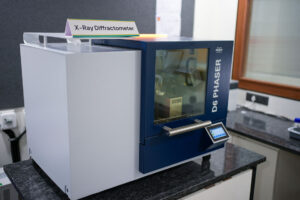
The MNRDC’s Bruker D6 PHASER XRD (Germany, ₹1.06 crore) with CuKα radiation, LYNXEYE XE-T detector, and access to the ICDD PDF-4 database (one million+ reference patterns) is fully equipped for this workflow. TOPAS Rietveld refinement software enables quantitative phase analysis, not just identifying which polymorphic form is present, but determining the proportion of each form in a mixture, critical when an API partially converts between forms during processing or storage. The instrument operates in a 10°–80° 2θ range covering the full diagnostic region for pharmaceutical organic solids. GIXRD mode is available for thin film or coating characterisation. The instrument is non-destructive; samples are returned in the same condition as submitted, retaining their regulatory chain of custody integrity.
Pharmaceutical sample requirements at the MNRDC: powder minimum 800mg, finely ground to pass 125 µm sieve (standard pharma practice); solid forms maximum 30mm × 5mm. Standard turnaround: 10 working days; urgent: 1 working day. All data delivered with full metadata embedding (instrument settings, 2θ range, scan time, CuKα wavelength) for direct inclusion in Module 3.2.S submissions. Explore industry-aligned pharmacy education and unlock real-world healthcare opportunities at Parul University’s Faculty of Pharmacy!
Stage 2: SEM + EDS for Particle Morphology, Size, and Elemental Purity
- XRD tells you what crystal form an API is in. SEM tells you what the particles look like and how large they are, information equally critical to bioavailability, processability, and regulatory compliance. ICH Q6A specifies that particle size distribution should be included in the specification when particle size has an impact on dissolution rate, bioavailability, or content uniformity of the drug product.
- SEM provides direct visualisation of particle shape, size range, surface texture, and degree of agglomeration, all of which affect downstream processing (blending, granulation, tableting, capsule filling) and in vivo performance (dissolution rate, absorption). A needle-like crystal morphology behaves differently in granulation from an equidimensional blocky crystal, even at identical particle size. SEM makes this distinction visible and documentable.
- EDS (Energy Dispersive Spectroscopy), paired with the MNRDC’s Hitachi SU3800 SEM, adds elemental purity verification – confirming the presence of expected elements (e.g., zinc and oxygen in ZnO APIs, or the correct metal cation in a salt form) and detecting any unexpected elemental impurities or contaminants at the surface. EDS area mapping shows the spatial distribution of elements across the particle surface – relevant when checking whether a coating is uniformly applied or whether an excipient is well-distributed throughout a formulation.
- The MNRDC’s SEM has analysed pharmaceutical samples from BDR Pharmaceuticals, AMI Lifesciences, and Nomisma Healthcare. It delivers 8 SEM images per sample from multiple magnifications and orientations, plus 2 EDS spectra, with optional full elemental area mapping. Standard session: 60 minutes for SEM+EDS combined. All images carry embedded scale bars, magnification, accelerating voltage, and working distance regulatory-grade image documentation.
Stage 3: DSC for Thermal Stability, Phase Transitions, and Polymorphic Transformation Temperatures
Differential Scanning Calorimetry (DSC) is the third instrument in the pharmaceutical characterisation triad, and it answers the question that XRD and SEM cannot: at what temperature does my API transform, melt, decompose, or change crystal form? DSC measures heat flow as a function of temperature detecting melting points, glass transitions, crystallisation, dehydration, polymorphic solid-solid transitions, and decomposition events with precise temperature and enthalpy data. The ICH Q1A stability guideline requires thermal stability data for all APIs; DSC is the primary technique for this.
Parul University MNRDC is receiving the Hitachi NEXTA DSC 200 (Japan, high-precision calorimeter) as an incoming instrument. This instrument measures heat flow over the full pharmaceutical-relevant temperature range, identifying melting points with ±0.1°C precision, detecting polymorphic transition temperatures (the temperature at which a metastable form converts to a more stable one during storage or processing), and confirming hydration and solvation states (pseudopolymorphs) that affect stability and solubility. For SMA (Shape Memory Alloy) research, DSC also characterises the austenite-to-martensite transformation temperatures critical to the MNRDC’s ISRO space applications project.
The combination of XRD (crystal form identification), SEM (morphology and elemental composition), and DSC (thermal behaviour) provides the complete physicochemical characterisation package that ICH Q6A, FDA ANDA guidance, and CDSCO dossier requirements collectively specify. All three instruments are housed under one roof at the MNRDC eliminating the coordination delays, chain-of-custody complications, and result interpretation inconsistencies that arise when samples must be sent to three different testing facilities across India.
The Full Pharma Characterisation Workflow at MNRDC
Step 1: Submit the API powder sample (minimum 800mg for XRD, any quantity for SEM).
Step 2: XRD analysis – crystal form identification and quantification, 2θ diffractogram with ICDD reference match, Rietveld quantification if multiple phases are present.
Step 3: SEM + EDS – particle morphology imaging at multiple magnifications, particle size range estimation, elemental composition and purity confirmation, area mapping if distribution data is needed.
Step 4: DSC – melting point, glass transition temperature, polymorphic transition temperatures, enthalpy of fusion.
Step 5: Data delivery – all raw and processed files, instrument metadata, and report formatted for direct inclusion in CTD Module 3.2.S or in-house QC specifications. Timeline: 10 working days standard; 1 working day urgent.
For pharmaceutical companies requiring ongoing batch release testing, repeat characterisation of development batches, or scale-up monitoring (where polymorphic transformation risk is highest), the MNRDC offers NDA-protected data arrangements and IP frameworks for industry partners. Approximately 60% of MNRDC industry clients are repeat users, a direct indicator of the reliability of results and consistency of service.
FAQ SECTION
What is API polymorphism and why does it matter for pharmaceuticals?
API polymorphism is the ability of a drug substance to exist in more than one crystalline form (polymorph). Different polymorphs of the same API can have dramatically different solubility, dissolution rate, stability, and bioavailability.
Can MNRDC at Parul University provide pharmaceutical characterisation data for regulatory submissions?
Yes. The MNRDC delivers XRD, SEM, and EDS data with full instrument metadata (2θ range, CuKα wavelength, accelerating voltage, working distance, scale bars) formatted for direct inclusion in CTD Module 3.2.S regulatory submissions. NDA arrangements are available for industry clients requiring data confidentiality.
What pharmaceutical companies use the MNRDC at Parul University?
Famous industry clients at the MNRDC include BDR Pharmaceuticals, BDR Lifescience, AMI Lifesciences, and Nomisma Healthcare, among 15+ total industry clients. Approximately 60% of industry clients are repeat users.