What Is Tribology and Why Does It Matter?
Tribology from the Greek tribos, meaning rubbing is the science of friction, wear, and lubrication at interacting surfaces in relative motion. It is one of the most economically significant areas of engineering: by some estimates, approximately one third of the world’s total energy consumption is influenced by tribological phenomena in engines, manufacturing machinery, transportation systems, and industrial equipment. Material wear failure the gradual loss of material from surfaces in contact costs industry billions of dollars annually in premature component replacement and downtime. The ASTM International standard G99 for Pin on Disc wear testing is the globally accepted protocol for measuring material wear resistance and friction under controlled laboratory conditions.
Instrument Specifications - NTS-R&D Version-03
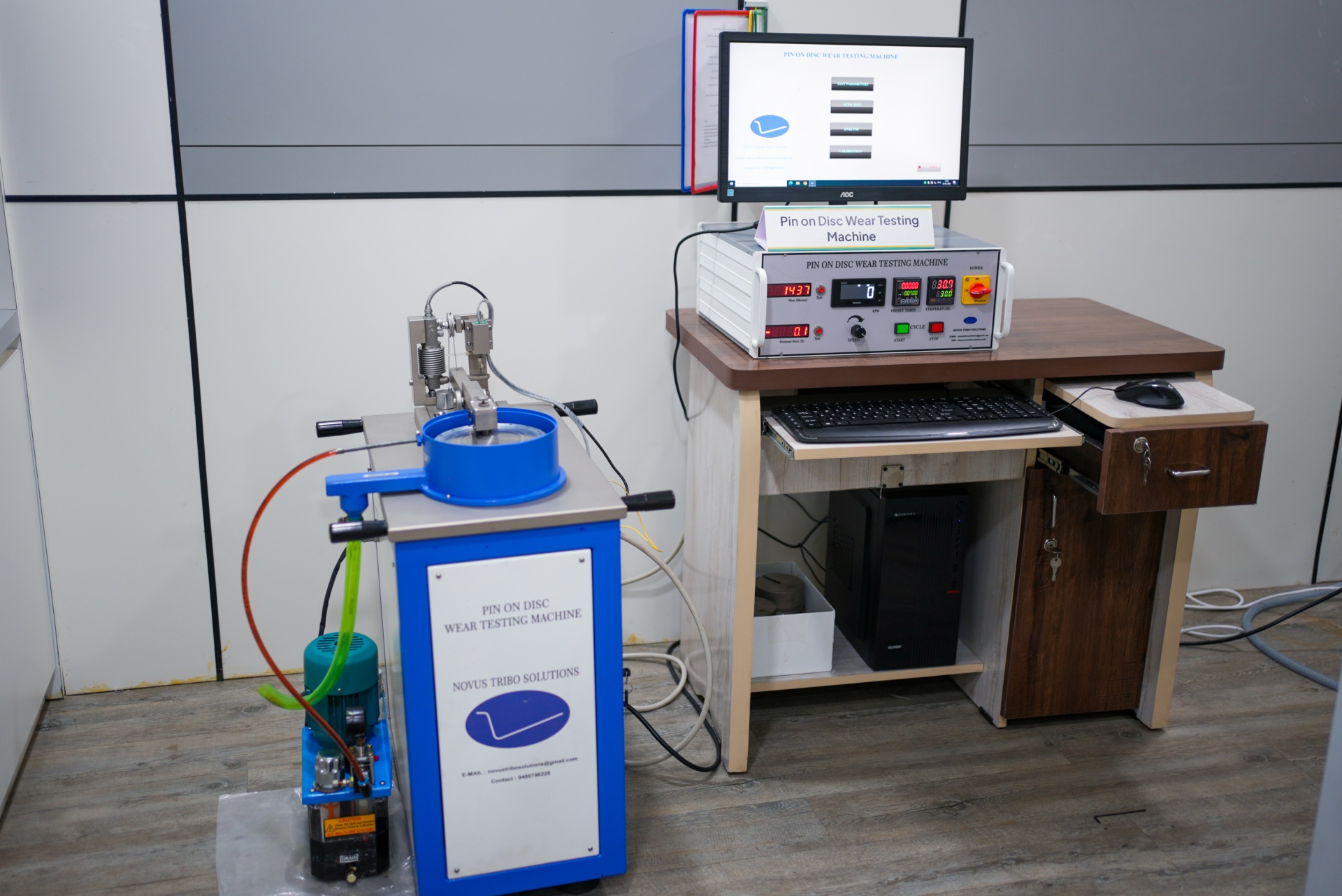
The MNRDC’s Pin on Disc Tribometer is the NTS R&D Version 03, manufactured by Novus Tribo Solutions, Bengaluru, India, at a cost of Rs.7.08 lakh. It has tested over 118 specimens (45 machine runs) since installation in 2024. All tests are conducted to ASTM G99 standard, ensuring that results are comparable with published literature and internationally recognised for industrial and research applications.
The instrument supports specimens in the 6 12mm diameter range (using three pin holder sizes: 6 8mm, 8 10mm, and 10 12mm) with standard pin lengths of 25 30mm. Test parameters load, sliding speed, test duration, and environment are fully programmable, and the data acquisition system records friction force at one second intervals, producing datasets of up to 120+ time resolved readings for a standard 120 second test.
How Pin-on-Disc Wear Testing Works
A Pin on Disc test recreates the fundamental tribological interaction between two surfaces in controlled, reproducible conditions. A stationary cylindrical pin specimen is pressed onto a rotating disc under a precisely defined load using dead weights. As the disc rotates at the programmed speed, the pin’s contact face slides against the disc surface along a circular track the same surface interaction that occurs in brake pads, bearings, gear teeth, and cutting tools during service.
Sensors continuously measure the friction force generated at the contact interface. The coefficient of friction (COF) is calculated at each time point by dividing the measured friction force by the applied normal load. After the test, the pin is removed, cleaned with IPA, and reweighed. Wear rate is calculated from the mass loss per unit sliding distance the standard ASTM G99 wear rate metric that allows comparison across different materials and test conditions. The MNRDC provides users with an Excel file containing raw and processed data friction force, COF over time, and sliding distance for independent analysis.
Three Test Modes Available at the MNRDC
Dry Wear Test
The basic tribological test pin sliding against disc with no lubrication. This evaluates material performance in its most demanding state: direct metal on metal or polymer on metal contact without the assistance of oil films or cooling. Dry wear data is essential for materials intended for applications in dry or high temperature environments where lubrication is impractical, such as high speed cutting tools, ceramic coating applications, and high temperature bearing materials.
Lubricated Wear Test
The disc is submerged in a liquid medium engine oil, synthetic lubricant, water, or process specific chemical and the test proceeds with the pin sliding through the lubricant film. This mimics the operating conditions of engine components, industrial bearings, and hydraulic systems. Lubricated wear data validates whether a specific lubricant genuinely reduces friction and wear for a given material pair a common question in lubricant development, coating evaluation, and material selection for wet running applications.
Pin Heating Condition Test
A resistive heater raises the pin temperature to specified levels during testing, simulating the thermal environment experienced by components in high temperature applications: brake pads in hard braking, cutting tools during machining, and turbine blade coatings during operation. This test reveals whether a material’s tribological performance degrades significantly with temperature a critical parameter for materials selection in aerospace and automotive thermal systems.
Sample Types and Industrial Applications
The MNRDC’s tribometer tests metals (steel, aluminium, titanium), polymers (nylon, PTFE, UHMWPE), composites (carbon fibre composites, metal matrix composites), and coated materials (PVD coated tools, plasma sprayed coatings, surface treated metals). All specimens must be cylindrical with flat contact faces to ensure uniform contact during testing.
In the automotive sector, tribometer testing validates brake pad materials, engine component alloys, and bearing materials precisely the application described by Aaftabsha Diwan in the workshop review: verifying that manufacturing materials will perform reliably before large scale production begins. In aerospace, lightweight alloy wear characterisation and hard coating validation (including TiN coatings produced by the MNRDC’s Magnetron Sputtering System) are routine applications. In medical devices, UHMWPE hip and knee joint wear testing under simulated physiological conditions is critical for implant lifetime prediction.
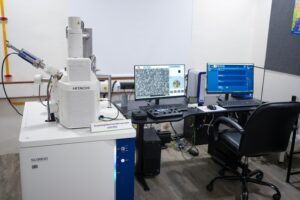
Research in tribology also connects to the MNRDC’s SEM capability: after tribometer testing, worn pin surfaces and disc wear tracks can be examined under the Hitachi SU3800 SEM to identify wear mechanisms (abrasive, adhesive, fatigue, or oxidative), measure wear track geometry, and characterise transferred material and debris morphology. This SEM tribometer workflow is particularly powerful for developing new materials and surface treatments.
Students in B.Tech Mechanical Engineering and B.Tech Chemical Engineering at Parul University works with materials science and manufacturing process courses that directly connect to tribological testing. Research oriented students can access the tribometer through MNRDC testing services and workshops.
FAQ
What is ASTM G99 and why is it important for wear testing?
ASTM G99 is the international standard published by ASTM International for Pin-on-Disc wear testing. It specifies the specimen geometry, preparation procedure, test conditions (load, speed, temperature, distance), and measurement methodology required for producing wear data that is reproducible and comparable across laboratories. All tribometer testing at the MNRDC is conducted to this standard, ensuring results are publishable and industrially applicable.
What sample types does the MNRDC tribometer accept?
The MNRDC tribometer accepts cylindrical solid specimens with flat contact ends, in diameters of 6-12mm and lengths of 25-30mm. Suitable materials include metals (steel, aluminium, titanium), polymers (nylon, PTFE, UHMWPE), composites (carbon fibre, metal matrix), and surface-coated materials. All specimens are tested to ASTM G99 standard.
What outputs does the MNRDC provide from tribometer testing?
The MNRDC provides a detailed Excel file containing time-resolved friction force, coefficient of friction, and sliding distance data at one-second intervals. Wear rate is calculated from mass difference before and after testing. For tribometer tests combined with SEM analysis of the worn surfaces, a complete wear mechanism characterisation report can be provided.
How does tribometer testing complement SEM analysis?
Tribometer testing measures friction coefficient and wear rate - macroscopic tribological performance. SEM analysis of worn surfaces after tribometer testing reveals the underlying wear mechanisms: whether material is lost by abrasion, adhesion, fatigue, or oxidation; the geometry and depth of the wear track; and the morphology of transferred material and debris. The SEM-tribometer workflow provides both quantitative performance data and mechanistic understanding - essential for materials development.