
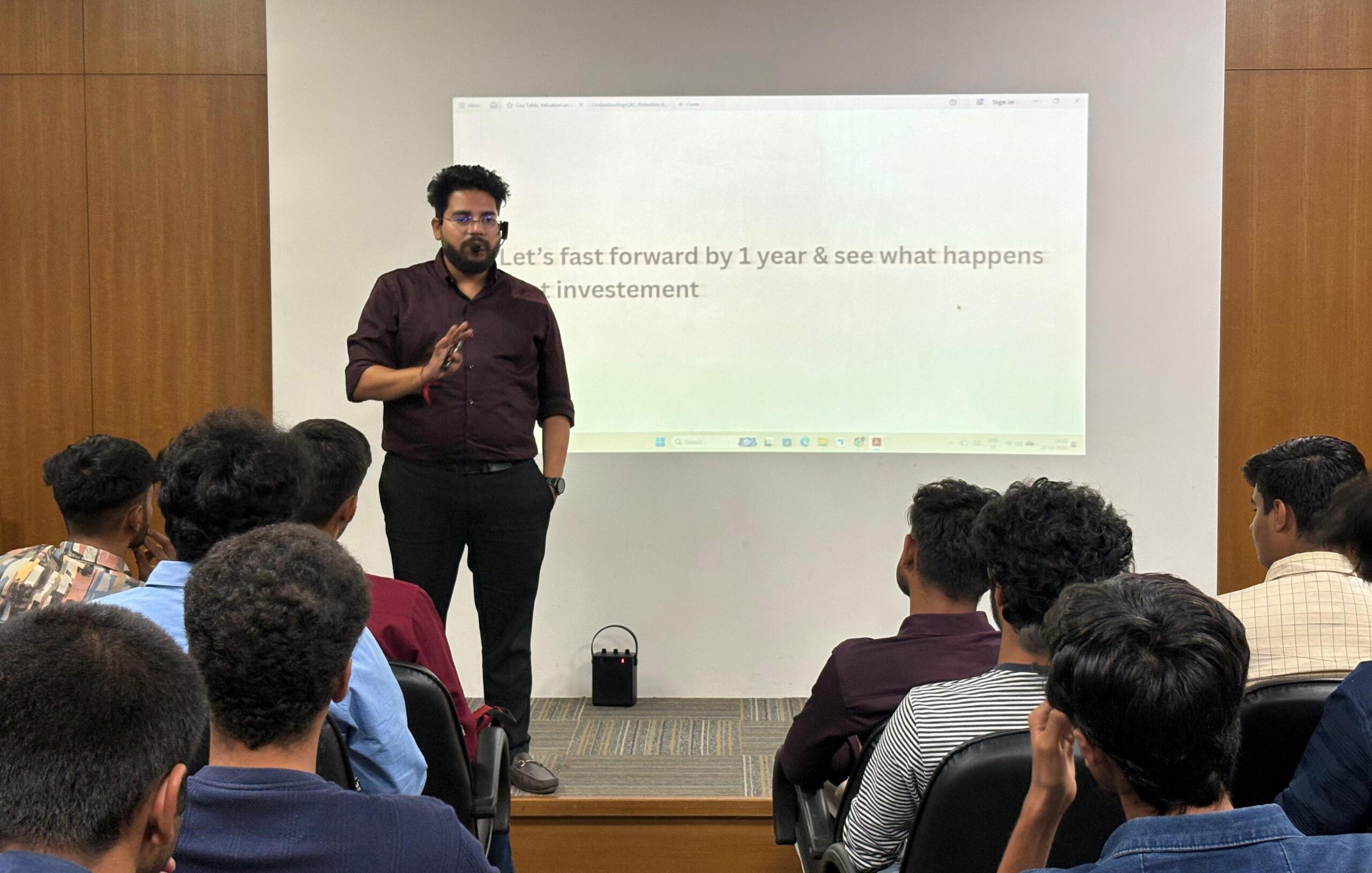
Hardik Kharva asked: for every single thing you sell, do you actually know how much money you are truly making after all costs are removed? The room went silent. He then broke down five critical metrics:
- Contribution Margin revenue minus direct costs per unit. If this number is negative, your business is broken at its core you are paying people to use your product.
- Customer Acquisition Cost CAC how much it costs to convince one person to become your customer. If CAC exceeds what the customer ever spends with you, you are converting investor money into losses and calling it growth.
- Lifetime Value LTV total money a customer brings over their entire relationship. The rule: LTV must always be significantly higher than CAC. If not, fix it before anything else.
- Break Even Point the day total revenue equals total costs. Every founder must know when this day is coming because investors always ask and survival depends on reaching it before money runs out.
- Burn Rate how fast you are spending money. Divide total cash by monthly loss. This is your countdown clock how many months you have left to survive.
Cap Table, Valuation, and Deal Structure
Hardik Kharva shared a warning: he had personally seen founders sign away enormous chunks of their company because they did not understand the documents. The cap table is a pie every slice is a piece of your company, and the document tracks who owns which slice. Keep it clean, accurate, and updated from Day 1.
Every time you raise money, you give up a slice permanently. Pre money valuation is what your company is worth before investment; post money valuation is after the money arrives. Understanding these determines the investor’s ownership percentage. Term sheets are the rulebook of the deal no founder should sign without reading and understanding every line.
Convertible instruments convertible notes let early stage founders raise money without the pressure of agreeing on a valuation when the company is too young to be valued accurately. At PIERC, your entrepreneurial ideas are nurtured with the right guidance, resources, and ecosystem to help them grow into reality.
Legal Structure: Choosing the Right Foundation
CS Prachi Prajapati Lad FCS, B.Com, LLB explained that when your business is legally compliant, everyone trusts you more customers, investors, partners. She said, the structure you choose determines how you pay taxes, what annual filings are required, how you raise money, and how personally protected you are. Private Limited Company is often the best early choice because it is easy to raise funding through and allows clean cap table management.
Day-to-Day Accounting: The Founder's Survival Engine
CA Rachit Anjaria told the cohort that accounting is the storybook of everything that happens in your business. He covered the four financial elements income, expense, assets, liabilities, the 12 month rule for distinguishing expenses from assets, the double entry system every action has an equal financial reaction, the illusion of revenue selling ₹100 does not mean making ₹100 subtract materials, overhead, and founder’s time, the deadly trap of being profitable on paper but bankrupt in cash, the three cash flow streams operating, investing, financing, the maker checker security rule the person who spends should never be the person who records, and the 30th of the month health check protocol.
His golden rules: Cash is King paper profits are dangerous if the bank is empty, Record Everything a business without a ledger is a hobby, and Know Your Margins never subsidise the customer with your own unpriced time. If you want to grow in the same manner as he said, wait no more and Apply for Incubation PIERC!
FAQ
What is unit economics for startups?
Unit economics measures whether your business makes money on each individual transaction. Key metrics: Contribution Margin (revenue minus direct costs), CAC (cost to acquire one customer), LTV (total revenue from one customer over time), Break-Even Point (when revenue equals costs), and Burn Rate (monthly cash consumption).
What is a cap table?
A cap table (capitalisation table) tracks who owns what percentage of your company. Every time you raise funding, the investor receives a slice of ownership. Keeping it clean and updated from Day 1 is critical - a messy cap table can derail funding rounds.
Which legal structure is best for a startup in India?
Private Limited Company is the most popular choice for startups - it is easy to raise funding, allows multiple shareholders, and provides limited liability protection. Sole Proprietorship is simplest but carries unlimited personal liability. LLP provides partner-level protection without the full company structure.