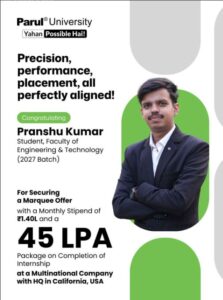
Most placement preparation guides focus on what to study. Pranshu Kumar‘s US based MNC experience is not a story about the right answer, it’s the combined efforts of T&P Cell & his intelligence.
It is a story about what happens when the question is not what you expected and the interviewer does not speak your language, literally. From being a nervous fresher to cracking a 45 LPA package, head here to read Pranshu Kumar’s Story
The Microsoft Lesson: What Rejection Actually Taught
Before the US based MNC, there was Microsoft. Pranshu cleared the first DSA round in under thirty minutes and advanced to the final stage with confidence. The hiring manager asked for research papers backing his AI project and testing reports documenting the model’s performance metrics. These were personal learning projects. Built to grow skills, not to ship products. He had not written formal documentation.
The rejection stung, but the lesson was precise. Two things needed to change before the next high-stakes interview:
- Documentation: every project needed professional-grade evidence. Not just code, but architecture decisions, testing methodology, and performance benchmarks.
- Conversational control: the ability to steer a discussion toward strengths without confrontation. Not denying a gap, but reframing the conversation so the gap becomes irrelevant.
Both lessons paid off within months at US based MNC. Head here to read how Two Colleges, One Student, 80 Placement Drives and still PU’s Training & Placement Cell successfully managed 3500+ Placements
Round 1: BFS Tree Traversal (30 Minutes)
Standard introduction followed by a Breadth-First Search problem on a tree data structure. Pranshu cleared it in 30 minutes. He was the first in his group to finish. This round is the gate. It confirms that the candidate has the algorithmic foundation to proceed. For preparation, Pranshu credits the Smart Interviews 40-day DSA programme, which he completed during a semester break. His LeetCode count at the time of placement was 396.
Round 2: The Java-Python Redirect (60 Minutes)
This is where the interview became extraordinary. The interviewer opened by stating that he knew Java and core Java, but not Python. How could they work this out? A direct confrontation (I only know Python) would have ended the conversation. Pranshu waited ten seconds. Then he asked: Sir, tell me what you work on. What does your role involve?
What followed was a redirection masterclass. The interviewer saw the facial recognition project on the resume and asked about it. Pranshu walked him through every folder, every line of code, live on camera, for 60 uninterrupted minutes. He explained architectural choices, demonstrated how Python’s logic maps directly to the engineering patterns the interviewer would recognise from Java, and turned a language mismatch into a demonstration of thinking process. The interviewer who started the round saying he could not evaluate Python ended the round having evaluated Python for an hour, willingly.
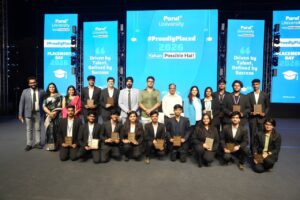
Pranshu’s reflection: “In my entire three processes, it was about that one project. 60 minutes explaining it so well that he said, “next time I press the first punch, I will remember you.” Head here to watch how the Placement Day 2026 looked like at Parul University!
Round 3: The LLD Surprise (Hiring Manager)
Nobody had told the candidates to prepare for Low Level Design. It was not on any checklist. It had never been asked for interns before. The hiring manager joined late, was interrupted by three phone calls during the session, and asked Pranshu to build an HR management system live: given an employee ID, traverse and display the full reporting hierarchy beneath them.
Pranshu was blank for ten to twenty seconds. Then he asked for one minute to do rough work. While the manager attended calls, Pranshu continued coding, commented every line, explained every step aloud, and wrote up the solution for multi-level hierarchy. By the end, he asked the manager for specific feedback. The response: you can do wonders in your life.
The T&P Cell had prepared him for exactly this kind of disruption. Managing 80-90 placement drives means managing chaos: last-minute schedule changes, companies shifting their process hours before arriving, coordinators needing direction across a hundred concurrent tasks. The LLD surprise was, for Pranshu, another moment where the plan changed and composure mattered more than the plan. Head here to read how wholeheartedly he has shared his experience on Linkedin – Pranshu Kumar Got Placed at a US Based MNC!
What Actually Separates 45 LPA From the Rest
When asked what separated him, Pranshu is precise:
- Communication over syntax: the ability to redirect a conversation, hold ground without confrontation, make a Java interviewer evaluate Python by demonstrating that the thinking behind the code is language-agnostic
- Preparation for the unexpected: T&P Cell experience managing real chaos under real stakes
- Project depth over project count: one facial recognition project, explained thoroughly for 60 minutes, outweighed candidates with more projects explained superficially
- Consistency: “You need to live the same boring life again and again on a loop until you get success. Everyone knows what to do. The question is whether you will keep doing it when it feels pointless.”
- 396 LeetCode, not 1,100: numbers open the gate. Communication decides who stays in the room.
- 3500+ offers, 459 multi-offers by Placement team of Parul University.
FAQ
How many rounds does US based MNC have for campus placements?
Three rounds at Parul University: Round 1 DSA (BFS, 30 minutes), Round 2 technical (project deep-dive, 60 minutes), Round 3 hiring manager (LLD, system design). Total duration: 80-90 minutes. This was the longest on-campus interview in the entire 3,500-placement drive.
What LeetCode count is needed for a 45 LPA placement?
Pranshu Kumar had 396 solved problems, competing against candidates with 1,100+. He credits the Smart Interviews 40-day DSA programme for targeted preparation. His view: LeetCode count is an entry gate. Communication, project depth, and composure under pressure decide the outcome inside the interview room.