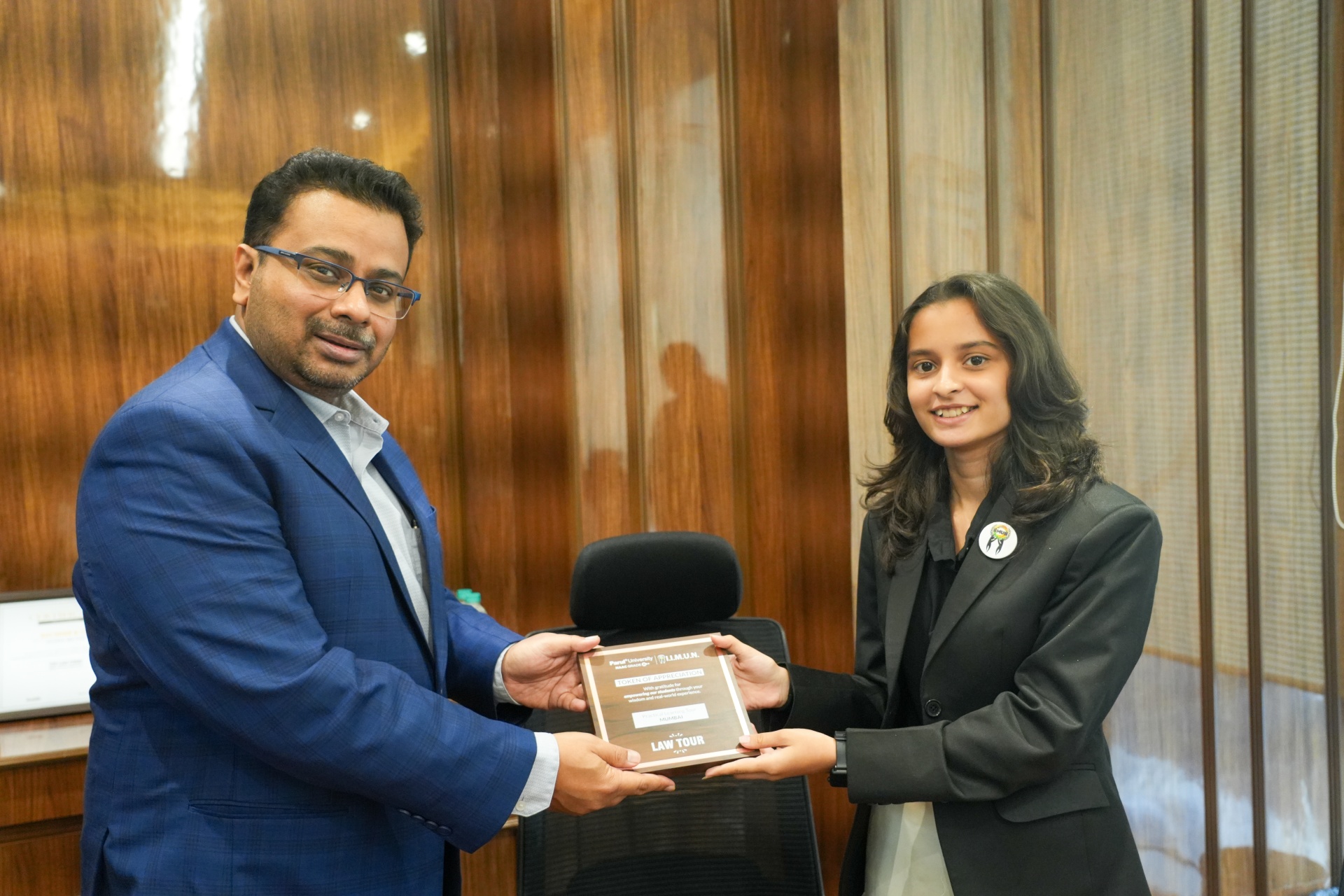

Mr. Anand Desai, Managing Partner of DSK Legal, was the most direct: Everyone should adapt to AI, but if you do not know the law, then AI is dangerous and not useful. His argument is that AI is a power multiplier. If the user understands law, AI accelerates their work. If the user does not understand law, AI generates plausible-sounding nonsense that the user cannot identify as wrong. A junior lawyer who uses AI to draft a contract without understanding the contractual principles is not being efficient. That junior lawyer is being reckless.
Anand Desai says that you should learn the basics of the law first. Like an athlete, you can build your skills by reading and solving problems all the time. Then use AI to make that mastery even better. The order is important. The tool does not take the place of the skill. The tool is useful because of the skill. Turn your passion for law into a profession with Parul University, apply after 12th.
Position 2: AI Cannot Replace Judges
Mr. Ritesh Khosla, General Counsel and Executive Director at Sony Pictures Networks, addressed the judicial backlog argument directly: AI must not be that much effective to reduce the pendency of the case. For that, more judges and courts are required. His position separates two problems that are often conflated. The first problem is legal research and document processing, where AI clearly helps. The second problem is case pendency, which is a structural issue of insufficient judges and courtrooms, not an information processing problem.
Mr. Ritesh Khosla also brought up the question of who owns the AI: the person who gave the prompt. This makes human agency very important, even in work done by AI. In media and entertainment law, where he operates, the ownership and IP implications of AI-generated content are not theoretical. There are ongoing business disputes.
Position 3: Leverage AI for Efficiency
Mr. Sandeep Rathod, Global General Counsel at Piramal Pharma Ltd, represented the pragmatic corporate view: use AI tools for streamlining tasks like summarising complex agreements. In a General Counsel’s office, where the volume of contracts, regulatory filings, and compliance documents is enormous, AI is not a philosophical question. It is an operational tool. The question is not whether to use it but how to integrate it without compromising accuracy. Build a future in law with Parul University’s industry-focused programmes
Sandeep Rathod’s main point was about the gap between business and academia: Lawyers are paid more for their knowledge and less for their skills at the start of their careers. In business, it’s the other way around. Being good at AI is a skill. The lawyer who can use AI to turn a 200-page contract into a 3-page summary in 10 minutes is more useful to the company than the lawyer who reads every page by hand and gives the same summary in two days.
Position 4: The Human Element Cannot Be Removed
Rukmini Roychowdhury, Heading Partner at Krishnamurthy & Co (K Law), took the broadest view: Law is a human being profession. The human element cannot be removed. Her argument is not anti-technology. She told students to view technology as a friend that enhances rather than replaces legal work. But she drew a line: judgment, empathy, and the ability to understand what a client needs beyond what they say they need are human capabilities that no AI model replicates. Become a corporate business lawyer by enrolling into (LL.M) in Constitutional and Administrative Law.
Every litigation lawyer in the room agrees with this point of view. A person who goes to a law office isn’t just bringing up a legal issue. They are showing an emotional problem, a financial problem, a family problem, or a business relationship that is falling apart. The lawyer who only knows the legal side of things and not the human side will solve the wrong problem. AI knows about the law. The human aspect is still only human.
Prof Deepak Nayyar on AI: will help top 10%, what about other 90%?
Position 5: AI + ADR = The Future of Case Disposal
Adv. (Dr.) Ashok Yende, Founder and CEO of Yende Legal Associates, took a systemic view: the future lies in AI, arbitration, and mediation for efficient case disposal. His argument combines three separate solutions into one framework. AI handles legal research and document analysis. Arbitration provides a faster, private alternative to overburdened courts. Mediation resolves disputes before they become adversarial. These three mechanisms can work together to solve the problem of too many cases that the current court system can’t handle on its own.
This goes against what Khosla said, which is that AI can’t speed up the process. Yende is not saying that AI can take the place of judges. He says that AI and alternative dispute resolution together make a second system that cuts down on the number of cases that need judges in the first place.
Position 6: Use AI but Never Rely Blindly
Mr. Rajarshi Chakrabarti, Senior Resident Partner at Kochhar & Co, took the middle ground: treat AI as a helpful tool for efficiency, but never rely on it blindly for accuracy. This is the most practically useful position for a law student. It avoids both the fear (AI will replace us) and the hype (AI solves everything). AI is just a tool. There are limits to tools. Be aware of those limits. Use the tool inside of them.
Mr. Rajarshi Chakrabarti’s main ideas were about communication. He said that communication is the key. This is the same bridge that connects time and accuracy. AI can speed up the timeline, but only human communication can check the accuracy and then pass on the judgment. These two skills work well together, not against each other.
What This Means for Law Students
Across six distinct positions from practicing lawyers, three themes emerge:
- AI proficiency is now a required skill, not an optional one. Every speaker who mentioned AI treated competence with these tools as a baseline professional expectation.
- AI without legal knowledge is worse than no AI at all. The DSK Legal position (dangerous without fundamentals) was echoed in some form by every speaker. The tool amplifies whatever the user brings to it, including ignorance.
- The human elements of law, judgment, empathy, communication, advocacy, ethical reasoning can’t be automated. These skills require human talent and skills leading to a sucessful career trajectory and this is what Parul University’s moot courts, mediation competitions and tours teaches.
Parul University’s Faculty of Law operates a fully equipped Moot Court, hosts national mediation competitions, and sends students on practical learning tours including the Law Tour Mumbai. BA LLB alumnus Jaydeep Findoria was appointed Law Clerk at the Supreme Court of India.
FAQ
Will AI replace lawyers in India?
No practicing lawyer at the Law Tour Mumbai said AI will replace lawyers. The consensus: AI replaces tasks (research, summarisation, document review), not roles (judgment, advocacy, client empathy, ethical reasoning).
What do the best lawyers think about AI in the law?
There are different positions. DSK Legal (Anand Desai): AI is a threat if you don't know the law. Ritesh Khosla from Sony Pictures says that AI can't replace the need for more judges. Piramal Pharma (Sandeep Rathod): use AI to summarize contracts. K Law (Rukmini Roychowdhury): You can't take the human part out. Kochhar (Rajarshi Chakrabarti): Use AI, but don't trust it completely. Agreement: You need to know how to use AI, but the basics come first.