Dr. Sanjay Agal’s first six years of trying to do research were spent at Pacific College of Engineering in Udaipur. The problem was never a lack of ideas. It was a lack of everything else. Journal subscriptions cost money. Books cost money. Publishing in a Q1 open-access journal costs approximately Rs 3 lakh per paper. In a tier-2 city at an institution without a dedicated research budget, none of this is possible. He later became Principal of a small engineering college in Porbandar, and the same constraints followed at institutional scale.
This is a pattern that thousands of researchers across India will recognise. The ambition exists. The intellectual capacity exists. The ideas exist. What does not exist is the system that converts those ideas into publications, patents, and funded projects. Dr. Sanjay Agal’s story is worth telling precisely because it shows, with specific numbers, what happens when the system finally arrives.
The After: What Changed When Every Request Was Granted
On 22 January 2024, Dr. Sanjay Agal joined Parul University with one requirement: research resources. He found them. Every single paper published since that date has been funded entirely by the university. The cost per Q1 paper is approximately Rs 3 lakh. Not one rupee from his pocket. That three lakh is invested by Parul University, though the paper is in my name, he says. Without the help of such an institute, you cannot do these things.
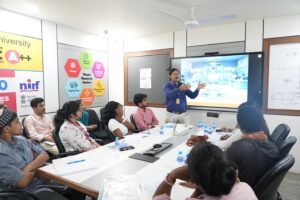
The support goes deeper than publication fees. He can check out any book. If the library does not have it, they buy it. Whatever resources I have requested, every resource is granted without a single question asked. Not even a single experience where a request got denied. The Vice Chancellor meets faculty on a walk-in basis.
The Dean of Engineering answers on the intercom. For someone who spent years at institutions where reaching the VC required formal appointments and bureaucratic navigation, this openness is transformative. It removes friction between having an idea and pursuing it, which is exactly the point where most promising research dies in India’s tier-2 and tier-3 institutions.
The numbers since 22 January 2024 speak for themselves: three Scientific Reports outputs, 6 new Parul-supported patents (10 total), 14 Q1 papers under review, 60+ papers across all journals, a Rs 1.25 crore AI project for Ayurvedic colleges, a Rs 6 crore-plus proposal submitted and verbally approved, a Rs 50 lakh ISRO application, and India’s model curriculum for quantum computing. The research funding at Parul University overall exceeds Rs 25 crore. Dr. Sanjay Agal’s trajectory is one data point within that larger ecosystem, but it is a particularly telling one: the constraint was never talent. It was always an environment.
His Message to Young Faculty Who Want to Publish
When asked what he would tell a young faculty member at Parul who says they want to publish in a Q1 journal within two years, Dr. Agal’s first response is not about technique. It is about motivation. First of all, I will ask that person the reason why they want to publish a paper. Q1 or not is a different thing. Research should always reflect in the betterment of society. If someone is doing it for the title or the recognition, then there is no point. And setting a timeline of two years is not realistic. The paper, titled A Privacy Preserving Synthetic Learner Dataset for Learning Analytics in Technology Enhanced Higher Education (DOI: 10.1038/s41598-026-44990-8), proposes a method for generating synthetic datasets that retain the statistical properties necessary for research while ensuring that no individual student can be identified.
From someone who has 300+ total submissions, wakes at 4 AM every day, and has never had a resource request denied at Parul University, this is not casual advice. It is the distilled principle of someone who tried the quantity-over-quality approach in his early career and found it empty. One Q1 paper that brings collaboration emails from MIT carries more weight than a hundred publications nobody reads. Do not take the stress of research, he says. Research must not be stressful. No one bounded you to do research. Do not do this to achieve targets. Because when you take stress, you go in the wrong direction. This work connects directly to Dr. Sanjay Agal’s broader educational AI research and the student prediction model that forms the third output. Join a new era of engineering with B.Tech in AI & Data Science (Quantum Technologies) from Parul University!
FAQ: Research Programmes at Parul University
How much does Parul University invest per research paper?
Approximately Rs 3 lakh (2,800 euros) per Q1 open-access publication. Every paper by Dr. Sanjay Agal since 22 January 2024 has been funded entirely by the institution. Active project budgets include Rs 1.25 crore, Rs 6 crore-plus, and Rs 50 lakh (ISRO). Total university research funding exceeds Rs 25 crore.
Can faculty access university leadership easily?
Yes. Dr. Sanjay Agal describes walk-in access to the Vice Chancellor and intercom access to the Dean of Engineering for any question, no matter how small. Every resource request in two years has been granted without a single denial.