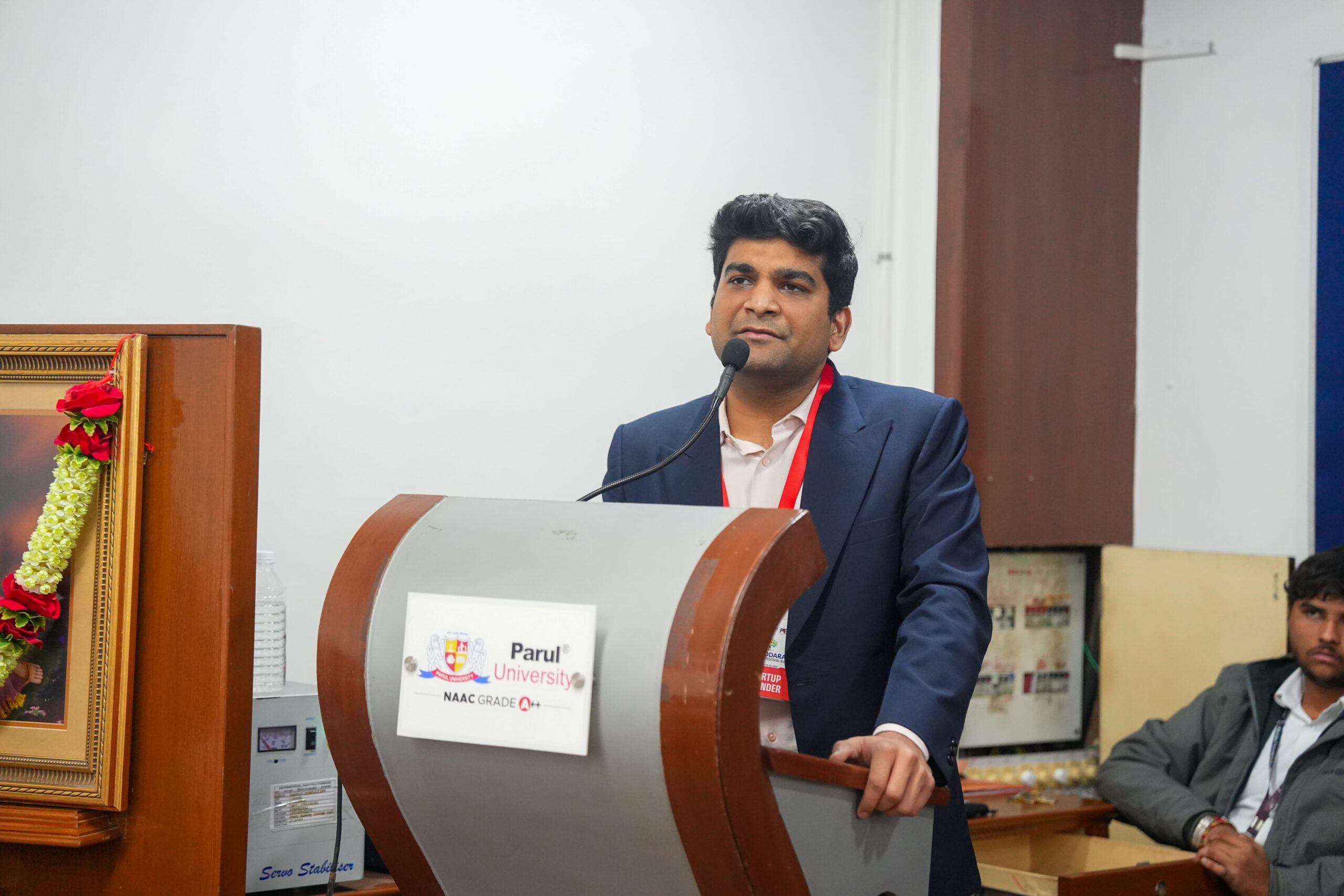
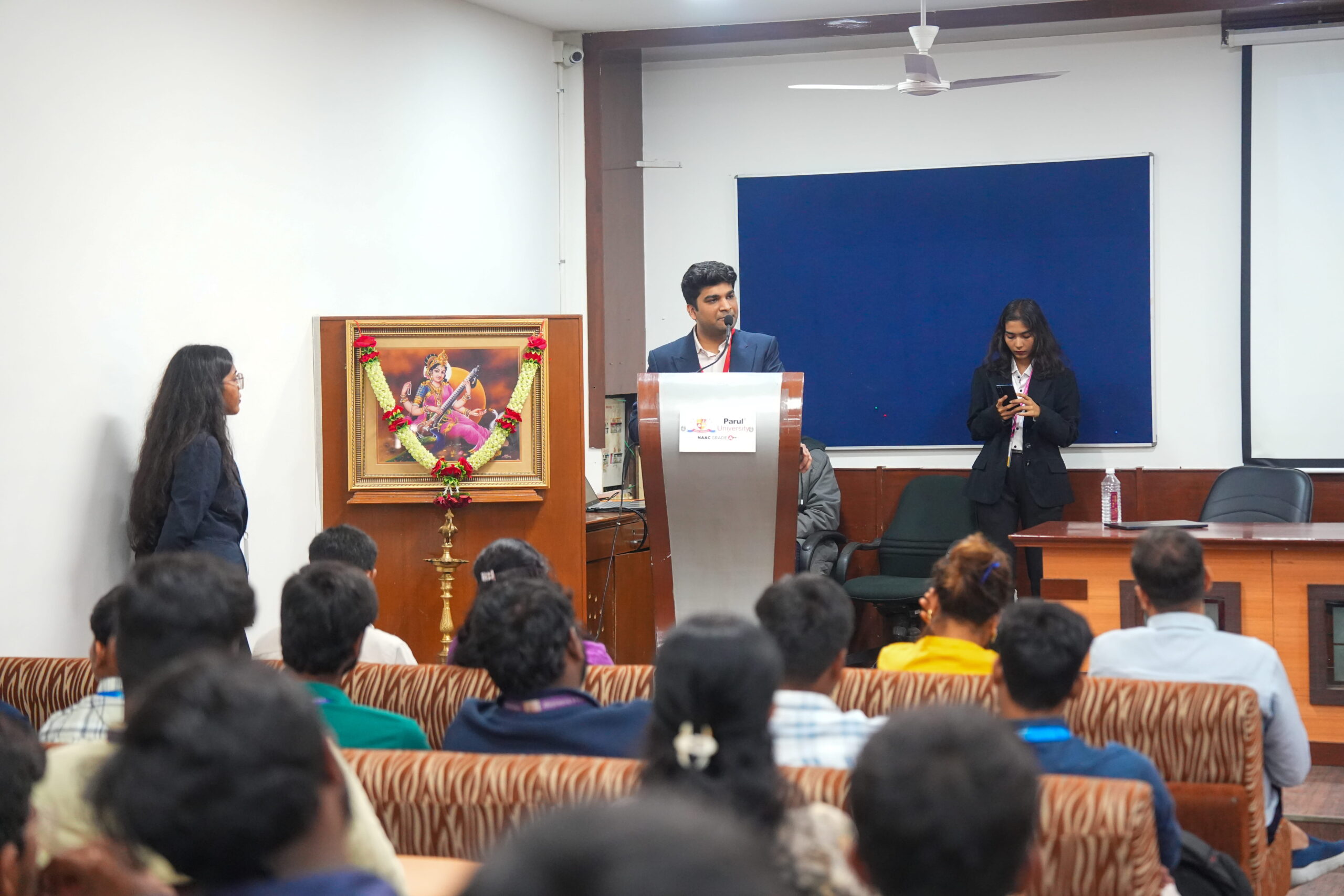
“Saralife made ₹20,000 in total. That’s everything, not monthly,” he said, drawing nervous laughter. “Then we tried crackers. Also failed. Then I couldn’t even get my book published.”
What happened next is why VSF – Vadodara Start-up Festival 6.0 mattered. Between January 21-23, 2026, seven student-founded companies showcased at Parul University had collectively generated over ₹50 crore in actual revenue. Not projections. Not valuations. Real money from real customers.
This wasn’t a demo day where prototypes pretend to be products. This was proof that campus entrepreneurship works when infrastructure supports it.
Anurag Sundarka couldn’t get his book published. Normal people move on. Anurag got suspicious.
If he, educated, resourceful, determined, couldn’t navigate publishing, how many other authors were stuck? Turns out: thousands.
ZebraLearn.com emerged from that frustration. They built a platform where authors don’t need finished manuscripts, they need ideas and willingness to talk.
“One client came with just an index,” Anurag explained at the Central Seminar Hall at Parul University during Vadodara Startup Festival 6.0. “We mapped chapters in two days. He narrated content for two and a half days to our writers. That book was an Amazon bestseller with 4.5 stars.”
The revenue curve tells you when they cracked it:
● 2022: ₹10 lakh
● 2023: ₹3.05 crore
● 2024: ₹10.7 crore
After Shark Tank India Season 4, Ritesh Agarwal invested ₹1 crore for 1.6% equity. The company now employs 38 people and moves 10,000-20,000 books monthly.
They didn’t accidentally stumble into children’s books; they strategically pivoted when visual learning materials sold better. “Visual Books became our hero product,” Anurag noted.
The broader Zebra Learn ecosystem has evolved into a ₹40 crore publishing house focusing on finance, marketing, career development, and AI. Books average ₹1,000 each. Customers aren’t buying paper, they’re buying learning experiences.
The Travel Startup That Made Honesty Profitable
Three Parul University students tried booking flights. The price kept changing not because of demand, but because of fees materializing at checkout.
“The industry runs on confusion,” they explained during the Vadodara Startup Festival 6.0 at Parul University during the presentation. “Confusion maximizes profit per transaction.”
AnyTrip India Pvt. Ltd. launched in 2024 with a radical tagline: “Pay What You See.”
Revenue started March 2025. By January 2026 ten months later they’d hit ₹2.8 crore. The team grew from three founders to 30 people. Gujarat recognized them as one of the state’s top 15 travel-tech startups.
What makes their story compelling? They openly discussed struggling with B2B.
“Corporate travel operates differently,” they acknowledged on VSF – Vadodara Start-up Festival’s main stage. “We’re facing partnership and scalability issues in B2B. But we view these as learning opportunities, not failures.”
That honesty captures what makes campus startups different from venture-backed hype machines. Students building companies haven’t learned to bullshit yet.
Their B2C focus has been deliberate: build consumer trust first, enter corporate markets from strength later. Twenty full-time employees and ten interns, all committed to treating customers honestly. Turns out that’s a viable business model.
When Chemistry Class Leads to Solar Innovation
Yash Tarwadi‘s entrepreneurial journey started in a Surat chemistry lab with a desalination project. SSIP gave them ₹2 lakh for a prototype. It worked. The Gujarat government added ₹30 lakh.
Then they needed sustainable power. Enter solar panels.
Tarwadi discovered something strange: despite 25-30% ROI, customers weren’t buying solar installations. The economics made perfect sense. The adoption didn’t.
The problem wasn’t technology, it was process. Getting solar meant multiple company representatives visiting, checking roof space, assessing usage, returning with quotes varying wildly based on location and arbitrary charges.
Exhausting. Confusing. Time-consuming.
Solnce Energy introduced India’s first online bidding platform for solar installations. Customer uploads electricity bill photo. The system calculates consumption. Verified installers bid. Customers see optimized pricing immediately.
No site visits. No confusion. Just transparent pricing.
The platform also solved something clever: Virtual Net Metering. Customers without roof space can invest in shared solar parks, own a percentage of generated power, receive virtual credits on monthly bills. Everything is managed through Solnce’s app.
Started in government co-working space. First office: 300 square feet. Current office: 2,000 square feet in Vadodara.
Achievements: $5,000 UNDP grant, UN Office invitation, Piyush Goyal award for renewable energy, GITEX Global 2023 Dubai presentation, UK company licensing interest.
“The solar market can support ₹10,000 crore companies,” Tarwadi told students. “We bridge customers and thousands of installers. Small commission per transaction, no heavy assets. It’s scalable by design.”
The Rug Company Built on Irritation
Samrath Singh Nagpal and Harnaam Kaur went to a décor exhibition expecting inspiration. They found expensive rugs and zero innovation.
“Despite ridiculous pricing, people crop rugs out of interior photos,” Samrath observed. “They’re integral to living spaces but rarely noticed when present.”
That contradiction bothered them enough to do research. Rugs weren’t pet-friendly, weren’t washable, caused slipping, stained easily, required constant maintenance.
EasyRugs emerged from that frustration. Development took 8-9 months because manufacturers didn’t understand their vision.
Rather than competing on price, they positioned themselves as “affordable luxury.” Let customers compare everything.
The real learning? Logistics.
“We completely underestimated shipping,” they admitted. Oversized packages didn’t fit standard delivery vehicles. Weight created handling nightmares. Even perfect dispatch from EasyRugs meant delayed delivery because agents lacked appropriate transport.
Their website took 2-3 months to build. “Broken buttons or slow loading destroys trust,” they emphasized.
Branding obsession paid off. People frequently said EasyRugs “doesn’t look homegrown” intended as a high compliment. On Shark Tank India Season 4, they secured ₹35 lakh for 5% equity from Aman Gupta and Vineeta Singh.
Their advice: “If you don’t use your own product, nobody will. Start small, validate thoroughly, then diversify.”
The Common Infrastructure: PIERC's Role
Here’s what connects these seven companies: they all benefited from the same ecosystem.
PIERC (Parul Innovation & Entrepreneurship Research Centre) started in 2013 as Entrepreneurship Development Cell. Since formal incubator registration in 2015:
- 250+ startups incubated
- ₹14.53 crore distributed in funding
- ₹100+ crore raised by supported startups
- 1,400+ jobs generated
- ₹40+ crore in startup revenue
- 110+ IP filings
But numbers only tell partial stories. Real value lives in infrastructure:
- Co-working space – shared, flexible workspace built for founders to work, collaborate, and grow with a like-minded community.
- Structured programs – cohort-based tracks (Incubation, Growthpad, Need-Based Support) that guide founders with step-by-step support, validation, product build, go-to-market, and funding based on their stage and needs.
- Networking events – VSF – Vadodara Start-up Festival, demo days, pitch sessions. A place where founders meet mentors, investors, and peers turning ideas into collaborations, customers, and capital opportunities.
- Mentor access – Direct access to experienced entrepreneurs who provide practical guidance, honest feedback, and introductions that help founders move faster and avoid costly mistakes.
- Long-term support – End-to-end backing from idea to scale with continuous help in funding, compliance, hiring, partnerships, and growth as the startup evolves.
During her January 19 masterclass, Poyni Bhatt (Founding Member & Ex-CEO of SINE, IIT Bombay) emphasized why campus works: “You can observe people over time, not just through interviews. Commitment, compatibility, chemistry, shared vision all naturally assessed during college life.”
She cited Zepto, Meesho, PhysicsWallah, and Flipkart as examples where college co-founders built strong foundations.
PIERC created exactly that environment at Parul University.
The Patterns That Matter
Walking through VSF – Vadodara Start-up Festival 6.0 across three days, certain patterns emerged:
- Failure precedes success. Anurag failed twice before ZebraLearn worked. AnyTrip struggles with B2B despite B2C success. EasyRugs underestimated logistics completely. None let challenges define trajectory.
- Campus provides unreplicatable advantages. Co-founder relationships tested over years. Freedom to experiment without financial desperation. Support infrastructure that would cost lakhs externally.
- Purpose-driven beats profit-driven. Every successful VSF – Vadodara Start-up Festival startup emerged from personal frustration. Tarwadi’s solar journey began with desalination needs. EasyRugs started from exhibition annoyance. AnyTrip emerged from booking confusion.
- Revenue validates faster than pitch competitions. None built credibility through business plan awards. They built it through customers paying money for solutions.
What VSF - Vadodara Start-up Festival 6.0 Actually Proved
India’s startup ecosystem obsesses over Bangalore, Gurgaon, Mumbai. Tier-1 cities with venture capital density and co-working spaces everywhere.
The model works. Students are choosing entrepreneurship as a legitimate career path rather than placement backup.
When Shri Yogesh Brahmankar (Innovation Director, Innovation Cell, AICTE) distributed SSIP grant certificates, seven startups received recognition:
- Rideaway Solutions – Affordable two-wheeler rentals for students
- Eternia – Anonymous mental health platform (founded by Priyanshi Rathore)
- Destinofy.ai – AI-powered space measurement for construction
- Mastiskya Yantra – Dementia cognitive assessment
- Ayurnidra – Stress and insomnia relief products
- Guddamrit Beverages – Traditional Indian drinks revived
- SmartHomie – Privacy-focused voice-command automation
Each solving real problems. Each building has actual products. Each generating revenue or strong user traction.
Anurag Sundarka ended his session with simple advice: “Your job is to try. And you try it well.”
Not “try and succeed.” Not “try without failing.” Just try, and try properly.
College provides the best environment for that. Financial pressure is minimal. Time flexibility is maximal. Support infrastructure exists. The peer community shares the journey.
The seven companies generating ₹50+ crore from campus prove that trying done properly, with support, over time produces results.
VSF – Vadodara Start-up Festival 6.0 proved what happens when universities treat entrepreneurship as a core mission, not a side activity; the next wave of Indian startups won’t come only from Bangalore’s co-working hubs, but from campuses nationwide where students build companies between lectures.
PIERC demonstrated the model. Now it’s about replication and scale.
Your campus might be next.
FAQs
1. What is Vadodara Startup Festival (VSF - Vadodara Start-up Festival) 6.0?
Vadodara Startup Festival 6.0 (VSF - Vadodara Start-up Festival 6.0) was a three-day entrepreneurship event held from January 21–23, 2026, at Parul University. It showcased student-founded startups that collectively generated ₹50+ crore in real revenue, highlighting the strength of campus-based incubation and innovation.
2. How did student startups at Parul University generate ₹50+ crore in revenue?
Seven student-founded startups incubated under PIERC (Parul Innovation & Entrepreneurship Research Centre) built real, revenue-generating businesses across publishing, travel-tech, renewable energy, home décor, AI, health-tech, and consumer products. Their success came from structured incubation, mentorship, funding access, and long-term ecosystem support.
3. What is PIERC and how does it support student entrepreneurs?
PIERC is Parul University’s official startup incubator. It provides co-working space, structured incubation programs, mentor access, networking opportunities, funding assistance, IP support, and long-term business guidance from idea validation to scaling.
4. Can college students really build profitable startups?
Yes. VSF - Vadodara Start-up Festival 6.0 demonstrated that with the right ecosystem, students can build profitable companies even before graduation. The showcased startups generated actual revenue (not just valuations), proving that campus entrepreneurship can translate into sustainable business models.
5. How can I apply for startup incubation at PIERC?
Students and aspiring founders can apply for incubation support through PIERC year-round. Applications can be submitted via www.pierc.org or by contacting pierc@paruluniversity.ac.in to access mentorship, funding guidance, and structured startup programs.
Vadodara Startup Festival 6.0 occurred January 21–23, 2026, at Parul University.
PIERC accepts startup support applications year-round:
pierc@paruluniversity.ac.in | www.pierc.org


