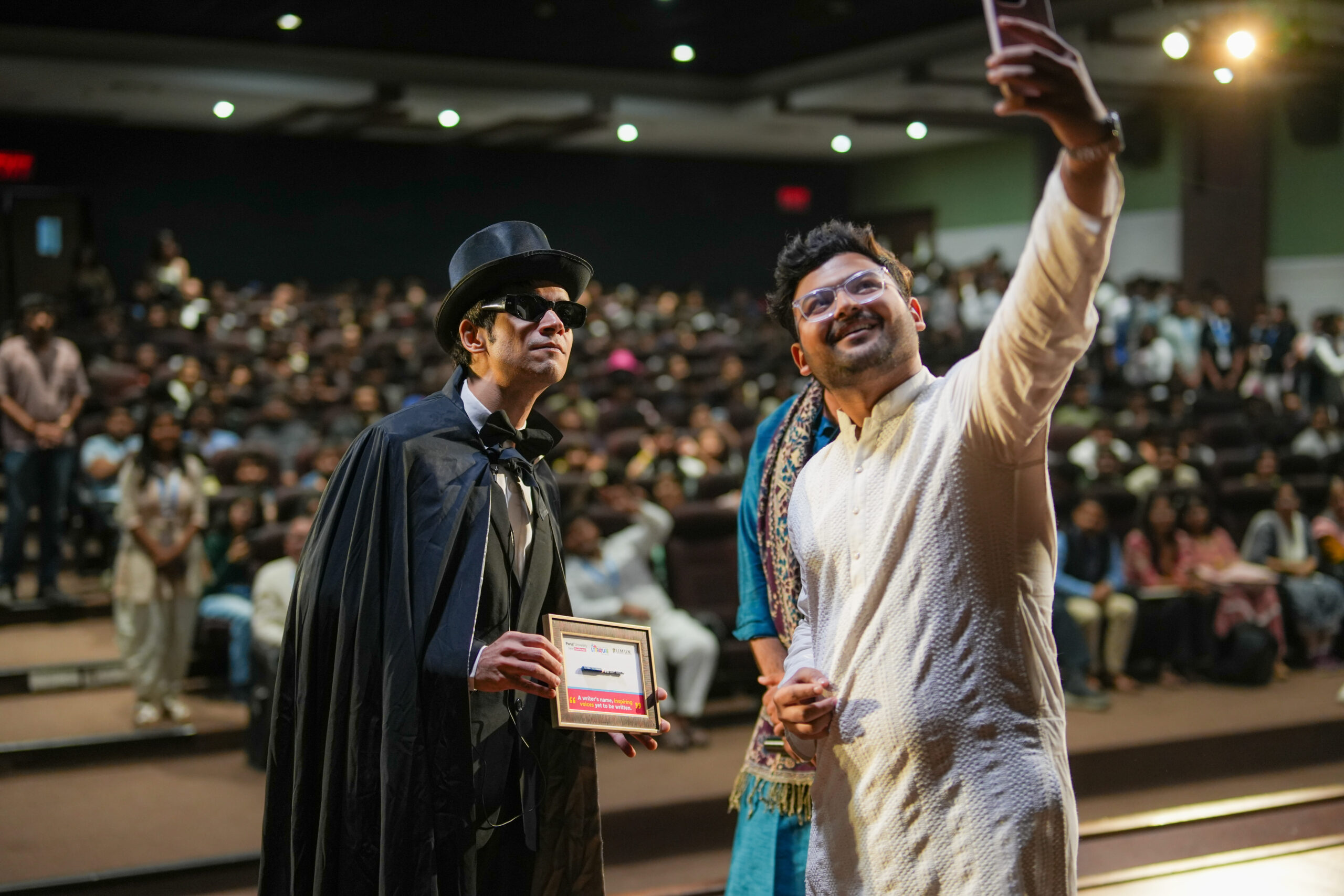
It is 3:00 PM on January 27, 2026, at Kabir’s Lokmanch in Parul University’s Central Auditorium. Students of the Institute of Liberal Arts, IIMUN delegates, and festival attendees have gathered for what the programme describes as a ‘solo theatrical performance.’ Most of them do not yet know what they are about to witness.
Vivaan Shah enters dressed in a black tuxedo with white collar and white tie, a black cloak lined with silver on the inside, and black sunglasses. The costume is deliberate: it suggests illusion and transformation – the magician who will make reality shimmer and then reveal that the shimmer was the reality all along. He addresses the audience before he begins and tells them that Edgar Allan Poe is his favourite writer. He describes the story he is about to tell – The System of Doctor Tarr and Professor Fether – as both comic and disturbing. Set in a mental asylum. Poe’s strength, he says, is turning serious and uncomfortable subjects into irony and absurdity.
Then he begins.
The Story: What Poe Wrote in 1845
As the visit continues, the narrator notices that many of the patients behave strangely. Some believe they are animals, while others think they are powerful or important figures. Despite this, they are treated as respected guests, and the narrator is invited to join them for dinner. During dinner, the atmosphere becomes chaotic. By the end of the story, the real doctors escape and regain control of the asylum. Although order is restored, the story leaves the reader questioning the meaning of sanity and authority.
This is what Poe published in a literary magazine in 1845. The question Vivaan Shah brought to the VLF – Vadodara Literature Festival stage in 2026 was simple: what does this story mean to students who inhabit institutions where authority is routinely accepted on the basis of presentation rather than competence, and where the line between the people giving orders and the people following them is thinner than anyone is supposed to say aloud?
The Performance: One Body, One Chair, Every Character
Vivaan Shah narrated the story almost word for word while performing every character himself. The technical demands of this are extraordinary: the narrator, the director of the asylum, the ‘guests’ at dinner, the imprisoned doctors, the patients – each had to be distinct enough that the audience could follow who was speaking, without the assistance of costume changes, lighting shifts, or other performers.
He did it through changes in accent, tone, and body language. Subtle hints of French accent differentiated characters. His cloak was deployed symbolically to represent changes in power, identity, and control.
As the story moved toward chaos, his voice, movement, and physical energy became increasingly exaggerated. He enacted characters who believed themselves to be animals – flapping imaginary wings, voicing a cock and a hen, using exaggerated gestures that added humour while reinforcing the story’s disturbing themes. He enacted drunkenness, falling, hiding, and physical struggle. He kicked the floor to suggest chaos and disorder, kissed his own hand to show exaggerated self-admiration.
The audience responses at each stage of the performance, as recorded by observers:
- Initial attentiveness – Shah’s confident introduction and mystical costume drew immediate focus
- Amusement mixed with unease – laughter at exaggerated characters, discomfort because the setting was a mental asylum
- Sustained concentration – the auditorium became noticeably silent midway through; an hour of unbroken attention from a young audience
- Moment of surprise – a sudden shift from medium to high-pitched voice caught the audience off guard and intensified the scene
- Anticipation without certainty – as the narrative approached its conclusion, the unpredictable flow prevented any clear expectation of how it would end.
The Themes Poe Encoded and Vivaan Unlocked
What Poe’s story does – and what Vivaan Shah’s performance made viscerally clear to an audience of students who study, live within, and are assessed by institutions – is dramatise the fragility of authority.
The director of the asylum is not, in the end, the director of the asylum. He is a patient who has assumed the role of director with sufficient confidence that everyone who encounters him, including the narrator and the audience, accepts his authority without question. The real doctors are in the basement, covered in tar and feathers. Order, in the story, is not a stable condition that authority maintains. It is a performance – and when the performance is convincing enough, the audience cannot distinguish the performer from the legitimate holder of the role.
This is what appearance versus reality means when applied to institutional authority. Poe asked for it in 1845. The question is, if anything, more urgent in 2026.
Why Literature Does Not Have to Stay on the Page
The performance was, by every account available from VLF – Vadodara Literature Festival observers, one of the festival’s most sustained and focused experiences. A young audience, in an era when sustained focus is often described as the scarcest resource in education, sat in complete attention for nearly an hour while one actor on a nearly empty stage told a story with his body and voice.
The lesson for students thinking about creative careers was embedded in the experience itself: this is what literature can do when it is performed rather than only read. The complex ideas about institutional authority, sanity, and the performance of legitimacy – ideas that might require three academic papers to unpack from the page – were made felt in under an hour through physical performance, with no special effects, no technical production support, no elaborate set.
As Vivaan Shah had told students in the morning workshop: literature only needs a pen, paper, and a study table. Theatre only needs a body, a voice, and a story worth telling. VLF – Vadodara Literature Festival 4.0’s choice to include both – the workshop and the performance – on the same day, by the same artist, was a demonstration that the two forms of knowledge are inseparable, and that the best education in either requires experience of both.


