The Walkman Of India- Dr. Raju M. Thakkar received this title because of his dedication and lifelong commitment to walking, wellness, and grassroots agricultural advocacy. To bring out the results and identify the issues, he had worked with farming communities across Gujarat and India, promoting natural farming methods as an alternative to chemical-heavy farming.
His deep knowledge lies in organic farming practices. He also works in farmer training programs and national-level initiatives started by the Government of India. To lead India’s farming ecosystem in a sustainable manner.
His session at Agri Fest 2026 at Parul University became an impactful session filling the academic agricultural education with real-world farming practice.
The Core Message: Nature Is Pure, So It Cures
Dr. Thakkar’s session was built around a central argument: India’s increasing chemical dependency in agriculture is unsustainable economically, ecologically, and culturally. He said that natural farming is not an alternative; it is the return to the original farming style that India had practiced for generations, a concept often explored in a Bachelor of Agricultural Science programme.
His key messages were direct and memorable. He believed in yoga as the natural essence of living, organic food as the nectar of life, and how environmental conservation is deeply connected to Indian heritage. He stressed that nature itself is powerful, and consuming and cultivating in its pure form has the ability to heal both people and the planet, principles that are also emphasized in this course!
Hence, the shift to natural farming is a necessity and not an option, a perspective increasingly discussed within the field of Bachelor of Agricultural Science as India rethinks the future of sustainable agriculture.
The Lakshpati Farming Model: Making Natural Farming Economically Viable
One of the most practical takeaways from Dr. Thakkar’s session was the Lakshpati Farming Model – a framework demonstrating that farmers can generate income up to ₹1 lakh through natural farming practices. The model addresses the most common objection to organic and natural farming: that it is not financially competitive with chemical agriculture.
When we combine the natural input preparations, such as Jeeamrut and Beejamrut, with multi-crop planning, it reduces the raw input cost and gives a premium price for a chemical-free product. The Lakshpati model gives more stable income options to small and marginal farmers without relying on chemical fertilizers.
This model connects directly to the Government of India’s National Mission on Natural Farming – Government of India (PIB), which envisions 15,000 natural farming clusters across the country – each covering approximately 50 hectares and 125 farmers – supported by 10,000 bio-input resource centres.
Why AgriFest Is the Right Platform for This Message
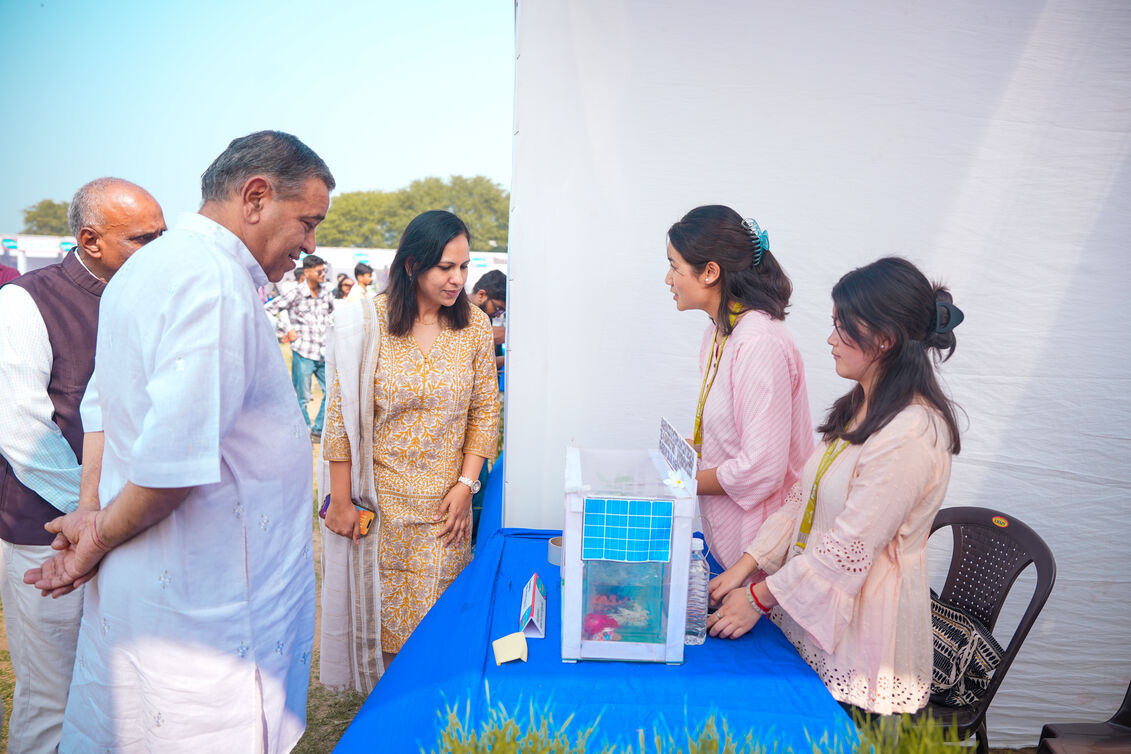
Dr. Thakkar’s session was not delivered to a passive audience. At AgriFest, students are already demonstrating organic pest control formulations like Neemastra and Brahmastra, educating farmers about beneficial versus harmful insects, and developing products that use no chemical inputs. The Soil Science department was testing farmer soil samples on-site. The Extension Education initiative sends students to villages to identify grassroots challenges and connect farmers with solutions.
In this context, Dr. Thakkar’s message about natural farming was not aspirational – it was actionable. At Parul University, students are getting the right exposure because of the updated curriculum in M.Sc and B.Sc. (Hons.) Agriculture. This ties them with natural farming and with soil science too.
| Program Connection:
Parul University’s B.Sc. (Hons.) Agriculture is a 4-year programme covering soil science, horticulture, plant biotechnology, agri-business, and sustainable farming. The Faculty of Agriculture is designated as a Centre of Excellence by the Government of Gujarat and is Gujarat’s first private agricultural college. Students gain practical experience through instructional farms, greenhouses, R&D labs, and industrial visits to organisations like Amul Dairy and honey processing units. |
Industrial Exposure That Feeds Back Into AgriFest
AgriFest also reflects the broader agricultural ecosystem that students at Parul University are exposed to through industrial visits and field experiences as part of their academic journey, which also attracts interest during BSc Agriculture admission. These include visits to institutions such as Amul Dairy, Anand Milk Union Limited, flower shows in Ahmedabad, honey processing units like Sahyadri Honey, and cold storage and frozen food facilities.
The knowledge gained from these visits is brought back and integrated into AgriFest making the event a reflection of both local practices and larger industry trends, and highlighting the kind of experiential learning students can expect when applying for this course at the university.
FAQ - Dr. Raju M. Thakkar at AgriFest 2026
Who is Dr. Raju M. Thakkar?
Dr. Raju M. Thakkar is a national resource person in natural farming, widely known as the 'Walkman of India.' He advocates for natural farming practices as an alternative to chemical-dependent agriculture and has worked extensively with farming communities across Gujarat and India.
What is the Lakshpati Farming Model?
The Lakshpati Farming Model is a natural farming framework that demonstrates income potential of up to ₹1 lakh for small-scale farmers through chemical-free practices, multi-crop planning, natural input preparation, and premium pricing for organic produce. It was discussed by Dr. Thakkar at AgriFest 2026.
What is the National Mission on Natural Farming?
The National Mission on Natural Farming (NMNF) is a Government of India initiative that aims to establish 15,000 natural farming clusters across the country, each covering approximately 50 hectares and 125 farmers, supported by 10,000 bio-input resource centres.


