The Constitution of India is often encountered first as text. Articles to memorise. Doctrines to interpret. Judgments to cite. But every so often, it leaves the pages and enters conversation.
The Constitution is viewed as more than just an abstract document stored in a law library at Samvidhan Pe Charcha 3.0, at Parul University's Faculty of Law. It is recognized as a living document that is continuously contested, debated, and understood through dialogue. The conclave brings together law students, scholars, advocates, and members of the judiciary to examine what the Constitution means in a country that is constantly evolving. For many students in the audience, it is the first time constitutional ideas are encountered not through textbooks, but through the voices of those who interpret them in courtrooms.
And that difference matters. Because the Constitution, as many speakers remind the audience, was never meant to remain static. It lives through interpretation.
Law Beyond the Classroom
Samvidhan Pe Charcha has gradually positioned itself as more than a law festival. It functions as a meeting point where academia and the judiciary briefly occupy the same space.
The third edition continues that tradition. Over five days, the campus hosts a mix of keynote sessions, technical discussions, workshops, and competitive moot court rounds, drawing more than 500 participants from over 30 law schools across India. Students from National Law Universities, independent law colleges, and academic research institutions arrive with one shared intention, to understand the Constitution beyond theory. The event itself is designed around a simple premise.
Legal education becomes sharper when students are able to question those who practice the law daily. Through open discussions, debates, and intensive Q&A sessions, the distance between judicial reasoning and classroom learning briefly narrows.
Voices From the Judiciary
Among the most anticipated moments of the conclave is the inaugural keynote delivered by Hon’ble Ms. Justice Indira Banerjee, former Judge of the Supreme Court of India. Her remarks do not attempt to simplify the Constitution. Instead, they remind the audience of its complexity. Referencing a famous observation on constitutional interpretation, she reflects:
“The Constitution is not a mere lawyer’s document, it is a vehicle of Life, and its spirit is always the spirit of Age.”
The message resonates deeply with the audience. A constitution cannot remain static. It has to change with the times in the society that it governs. Justice Banerjees speech is instrumental in setting the stage of the sessions dialogues that are equal parts of law and the ever, transforming society in which law is practiced. Alongside her, Dr. Vikas Divyakirti, founder of Drishti IAS, and Dr. Devanshu Patel, President of Parul University, address students on the responsibilities that accompany legal knowledge.
Dr. Patel offers a reminder that legal education carries an ethical dimension. “Law students must not just read the law; they must breathe the Constitution to protect the common man.”
For many in the audience, the line captures the spirit of the event. Law, after all, is rarely just about rules. It is about people.
Learning the Constitution Through Practice
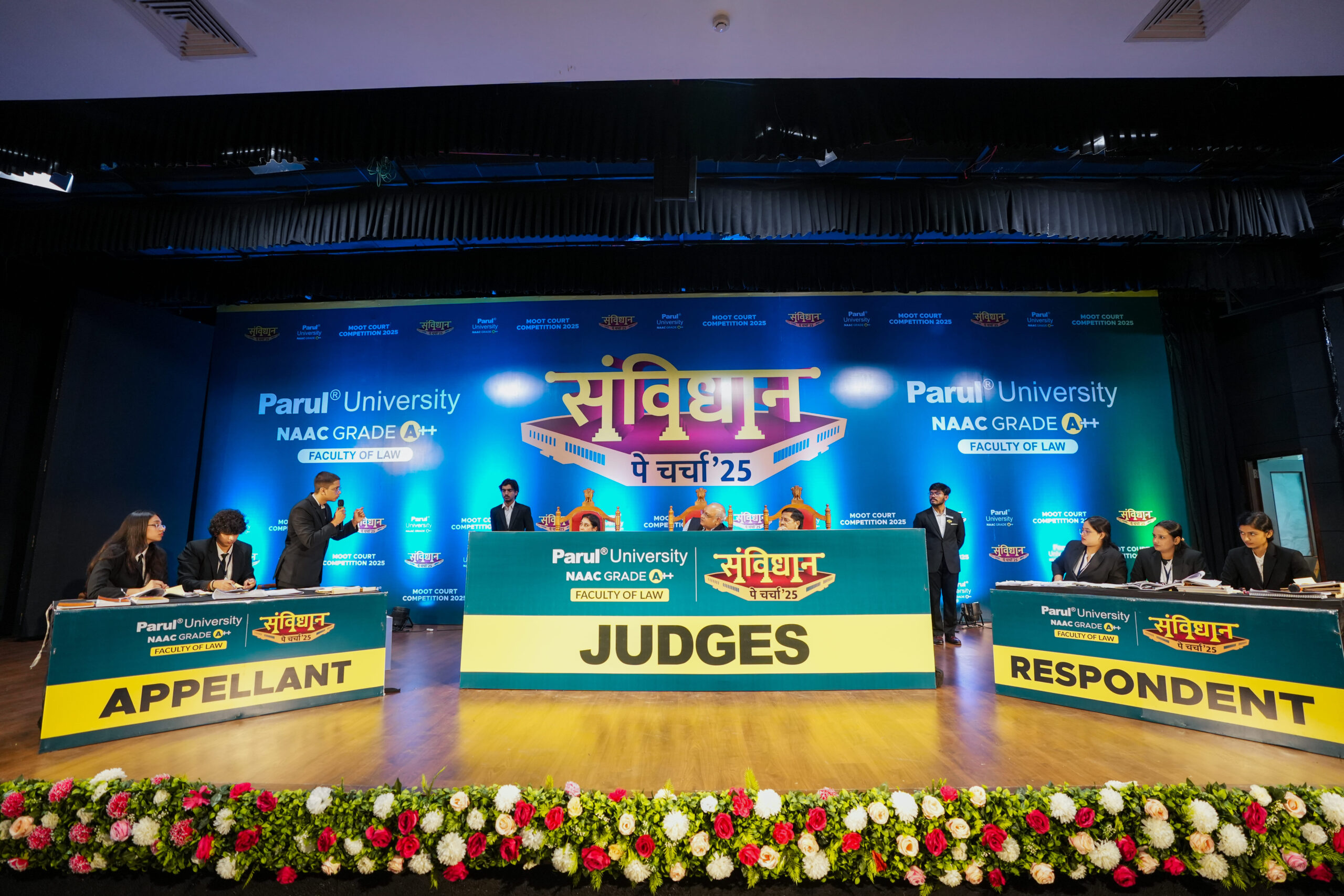
Though the opening keynote sessions bring in a range of perspectives, the National Moot Court Competition turns out to be quite another thing practice. The tournament with a prize pool of 2.5 lakh, recreates the intensity of a courtroom drama. Participants are required to argue complex constitutional questions before panels that include sitting and retired High Court judges.
In those moments, theoretical understanding meets practical scrutiny. Every argument has to withstand questioning. Every interpretation has to be defended. For students accustomed to reading judgments in silence, standing before a judicial bench and defending a constitutional argument introduces an entirely different dimension to learning. Law becomes something active. Not just something studied, but something argued.
Understanding Law in a Changing India
Beyond the courtroom simulations, several sessions focus on one of the most immediate developments in India’s legal landscape, the introduction of new criminal laws. Workshops on Bharatiya Nyaya Sanhita (BNS), Bharatiya Nagarik Suraksha Sanhita (BNSS), and Bharatiya Sakshya Adhiniyam (BSA) give students a chance to learn about the changes in Indias criminal justice system.
The debates are, at times, quite technical. But they are also indispensable. For aspiring lawyers, judges, and legal scholars, it is not just an abstract academic exercise when they learn how new statutes reshape the criminal law system. Rather, they are getting ready for the legal environment that will soon be their reality.
Further sessions on white, collar crime and cyber law broaden the discourse, showing that legal quandaries nowadays are ever more closely connected with technology and the financial world. Law, like society, keeps on evolving. Legal education has to keep up with it.
Questions That Defined the Dialogue
Some of the most engaging conversations emerge not from prepared speeches, but from the questions that follow them. Students raise issues that continue to shape modern constitutional discourse.
Where should the line be drawn between constitutional morality and social morality? How far can judicial activism extend without disturbing the balance of democratic institutions? Does the basic structure doctrine remain sufficient to protect constitutional identity in a rapidly changing society?
And as courts increasingly engage with digital evidence and algorithmic systems, what role will technology and artificial intelligence play in the judiciary of the future? None of these questions have simple answers. But the value of the discussion lies in the attempt.
A National Platform for Young Legal Minds
By the end of the five-day conclave, one fact becomes evident. Samvidhan Pe Charcha grows beyond a campus event
With 500+ participants, representation from more than 30 law schools, and over 10 technical sessions, the conclave evolves into a national forum where young legal minds interact directly with the institutions that shape Indian law. The event combines two environments that rarely intersect so closely.
The rigour of a courtroom and the curiosity of a classroom. And in that intersection, something valuable emerges. Perspective.
When the Constitution Feels Alive
For many students, the Constitution exists first as a subject. Articles to remember. Cases to cite. Principles to analyse. However, events such as Samvidhan Pe Charcha help to break down that barrier of perception. They uncover the Constitution as it really is not a dead letter but a living charter, constantly being reshaped, reinterpreted, and evolved by judiciary, debate, and reasoning.
At Parul University, programmes running under the Samvidhan Pe Charcha banner keep the dialogue going. By involving the judiciary, legal scholars, and law students in one forum, the university aims to ensure that the constitutional discourse will be a living, widespread, and relevant tradition for the future generation.
Because the vitality of a democracy depends not only on the Constitution it supports, but also on the minds that keep questioning, interpreting, and defending it.


