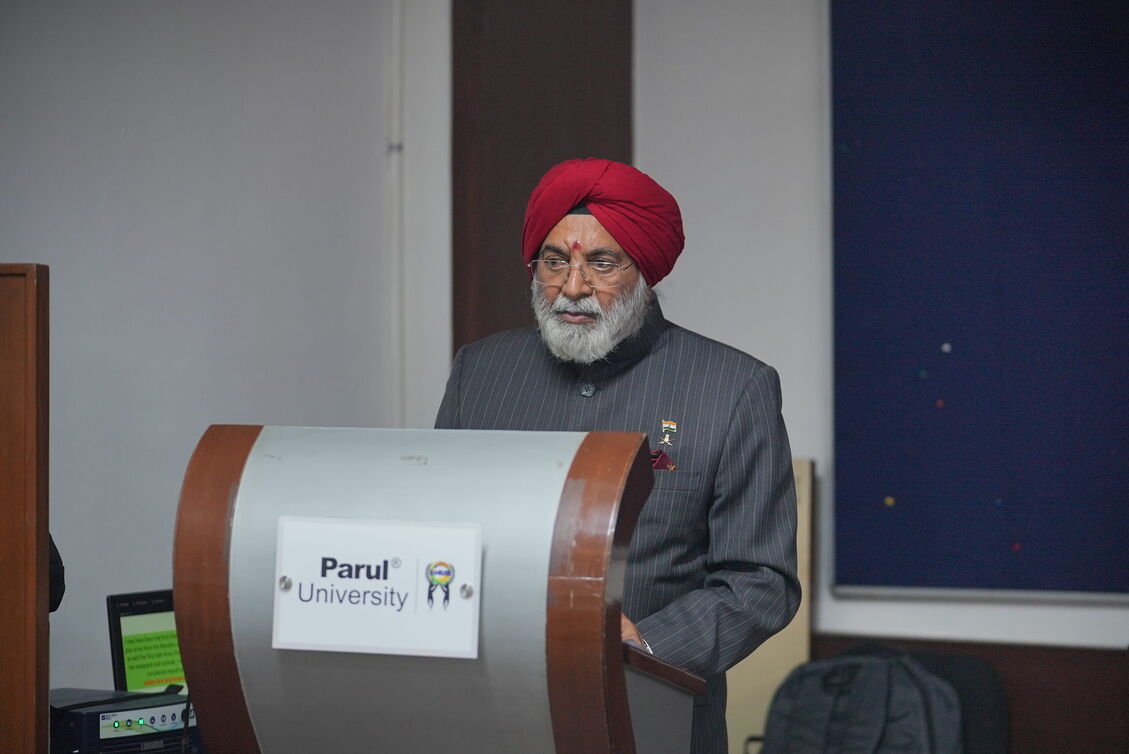
General Joginder Jaswant Singh, as world-widely famous as General JJ Singh, ranks among India’s most revered military leaders. He was born on 17 September 1945 in Bahawalpur (currently a part of Pakistan), and soldiering runs deep in his family. He is a third-generation soldier. He earned his commission into the 9th Maratha Light Infantry on 2 August 1964, having completed the 25th course at the National Defense Academy. Over the course of a 46-year military career, he has served across Jammu & Kashmir, Nagaland, Arunachal Pradesh, Sikkim, and Uttarakhand.
Core National Values: The Foundation of India’s Existence as a Nation State
General Singh opened his address by making something clear, India’s core values, rooted in social, religious, moral, and ideological principles and enshrined in the Constitution, are not abstract ideals.
India’s Geopolitical Position: An Island of Stability
He offered a telling comparison, roughly 50% of China’s land area is either frozen or desert, which gives India a significantly larger habitable area despite having less total land on paper.
He then mapped India’s neighbourhood, Afghanistan, Pakistan, Nepal, Myanmar, Sri Lanka, the Gulf states and painted a picture of a region that is deeply disturbed and chronically unstable. India, in his assessment, stands as the island of stability in the middle of all of it. At the global level, he noted that the security environment has moved away from American unipolarity towards something multi-dimensional and multi-polar, with Asia and specifically India and China, assuming dominant positions as economic power concentrated in this part of the world.
On the India–China relationship in particular, General Singh was measured in his tone. General Singh had little patience for them. He called them armchair strategists and argued that such a conflict would be far more complex than their commentary ever accounts for.
The Iron Fist in Velvet Glove: General Singh’s Counter-Insurgency Doctrine
One of the most significant parts of the entire address was General Singh’s explanation of the ‘Iron Fist in Velvet Glove’ doctrine, a counter-insurgency philosophy he described as his brainchild. The idea works on two simultaneous tracks. On one hand, you bring the iron fist down on terrorists and militants through decisive military action. On the other hand, you extend the velvet glove to the civilian population, respecting human rights, pushing development projects, and offering surrender policies.
General Singh traced the roots of insurgency back to governance failures. When people feel let down by absent or ineffective governance, that is when insurgent movements take hold. The solution, then, has to work on both fronts: security operations that neutralize militants, and parallel government action that delivers development and good governance on the ground. He held up India’s successful handling of the Punjab militancy as proof, along with the insurgencies in Assam, Nagaland, and Manipur. All of them, he said, demonstrate that this dual-track approach delivers results. He also mentioned, with some satisfaction, that the international community has studied India’s counter-insurgency model with considerable interest.
The Q&A: Seven Questions From Students, Answered by a Former Army Chief
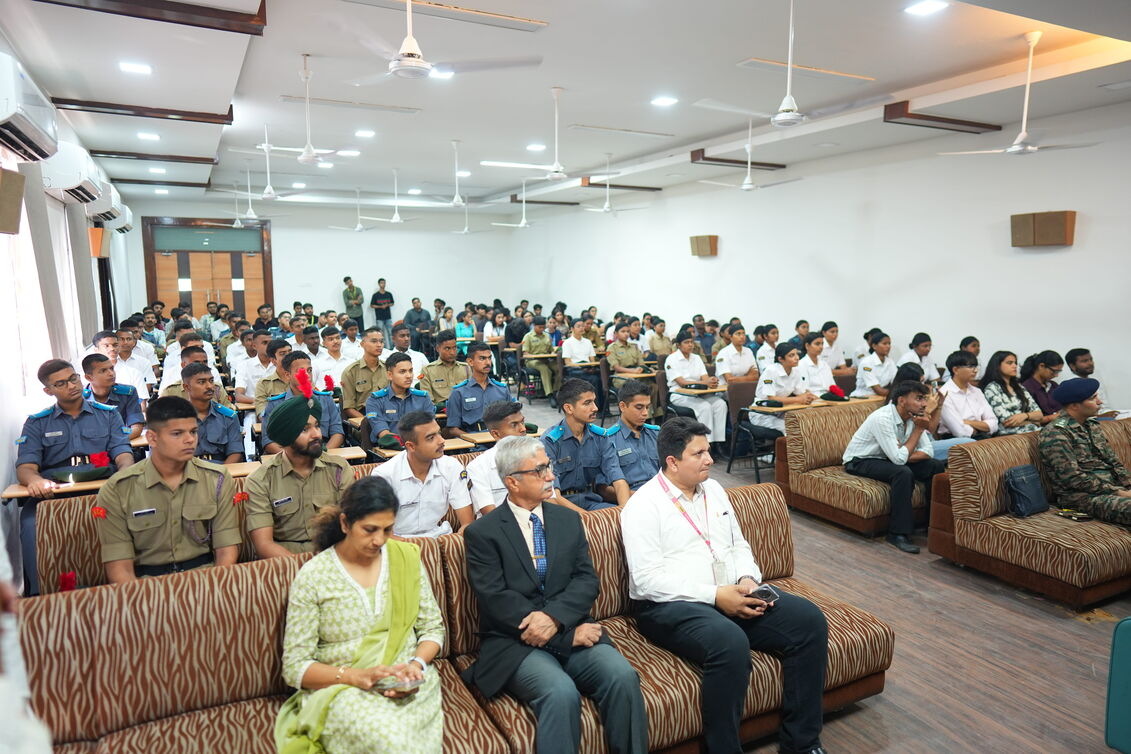
What followed the formal address was an interactive session, seven questions from students that ranged across Iran’s actions in the Strait of Hormuz, the role of youth during wartime, officer shortages in the Indian Army, the relationship between the armed forces and government, AI and technology in modern warfare, India’s restraint in offensive action, and the nature of decision-making in defence. General Singh’s answers were what you would expect from a man who spent 46 years in uniform, characteristically direct, blending strategic clarity with practical wisdom earned on the ground.
In Iran, he urged caution. The conflict, he reminded the audience, was started by America and Israel, not India. Getting drawn into an armed conflict without the conviction that you can win it would be unwise. On officer shortages, he pulled no punches either.
FAQ - Former Army Chief General JJ Singh at Parul University
Who is General Joginder Jaswant Singh?
General Joginder Jaswant Singh is a former Chief of Army Staff of the Indian Army, the first Sikh to lead the Indian Army, former Governor of Arunachal Pradesh, and the architect of the ‘Iron Fist in Velvet Glove’ counter-insurgency doctrine. A third-generation soldier, he has proudly served for 46 years.
What did General JJ Singh speak about at Parul University?
He spoke about India’s core national values, the global and regional security environment, India’s geopolitical positioning as an island of stability, the Iron Fist in Velvet Glove counter-insurgency doctrine, India–China relations, and the responsibility of India’s youth in the nation’s rise as a world power. A detailed Q&A session covered Iran, officer shortages, AI in warfare, and India’s strategic restraint.


