The conference had spent a day and a half inside the world of scientists. Researchers with PhDs. Lab data. Latin organism names. Profit charts. All important. All necessary. But the afternoon panel on Day 2 was a different animal entirely.
Four farmers walked in. Not a single doctorate among them. Not a single PowerPoint. What they carried instead was something no lab can produce: years of dirt under their fingernails, seasons of trial and error on their own land, and the kind of knowledge that comes only from having bet your family’s livelihood on a method and watched it work.
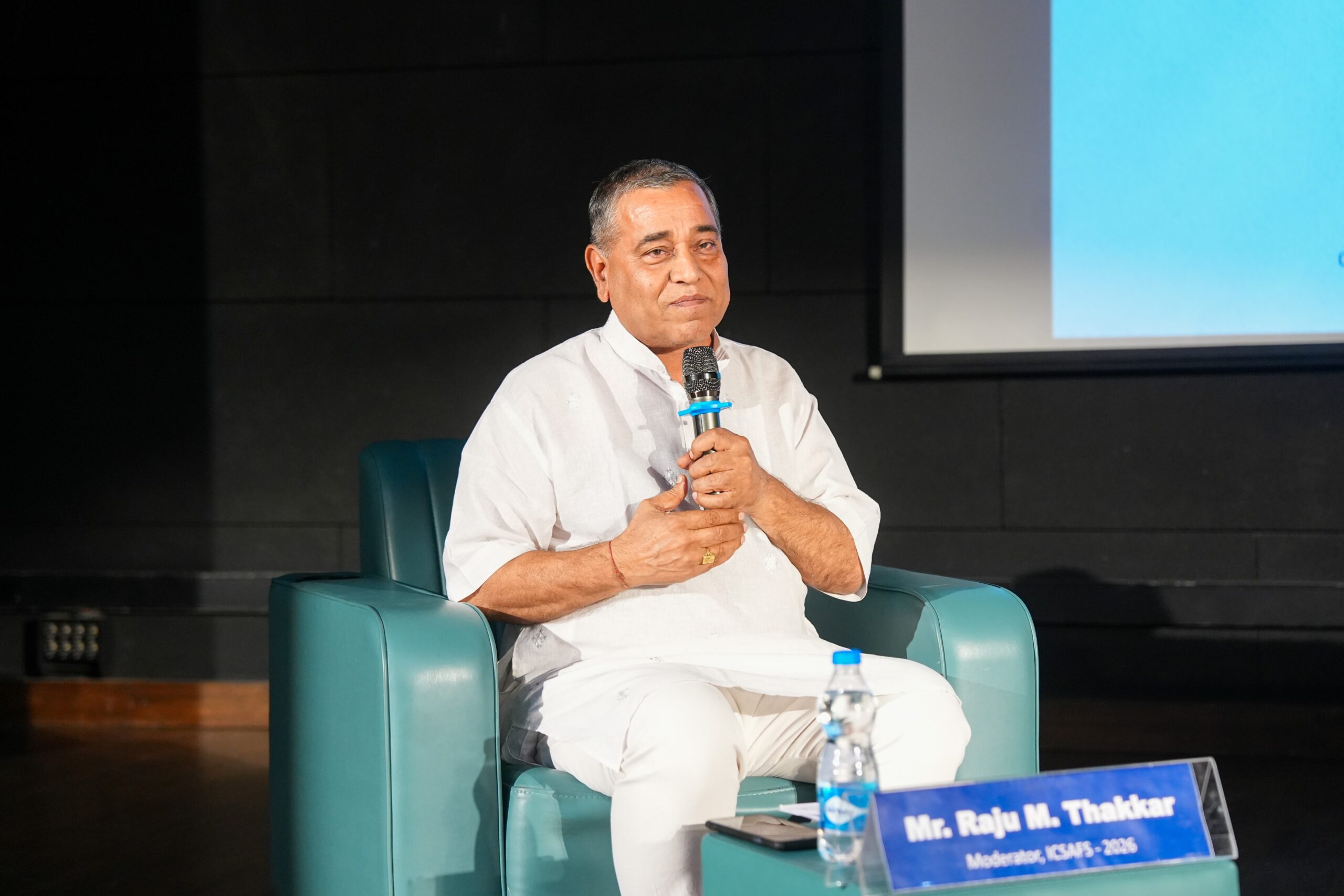
Shri Raju M. Thakkar opened the panel the way he opens most things with a story that lands before you realize it’s a lesson. He invoked Swami Vivekananda’s words about how a small group of pure and selfless people can change the world. Then he gestured toward the four people seated beside him. Those individuals, he suggested, were right there in the room. No metaphor needed.
She deliberated, I’m going to be honest of the four stories shared on that panel, this is the one we keep thinking about. Not because it had the biggest numbers. Because it had the biggest reach.
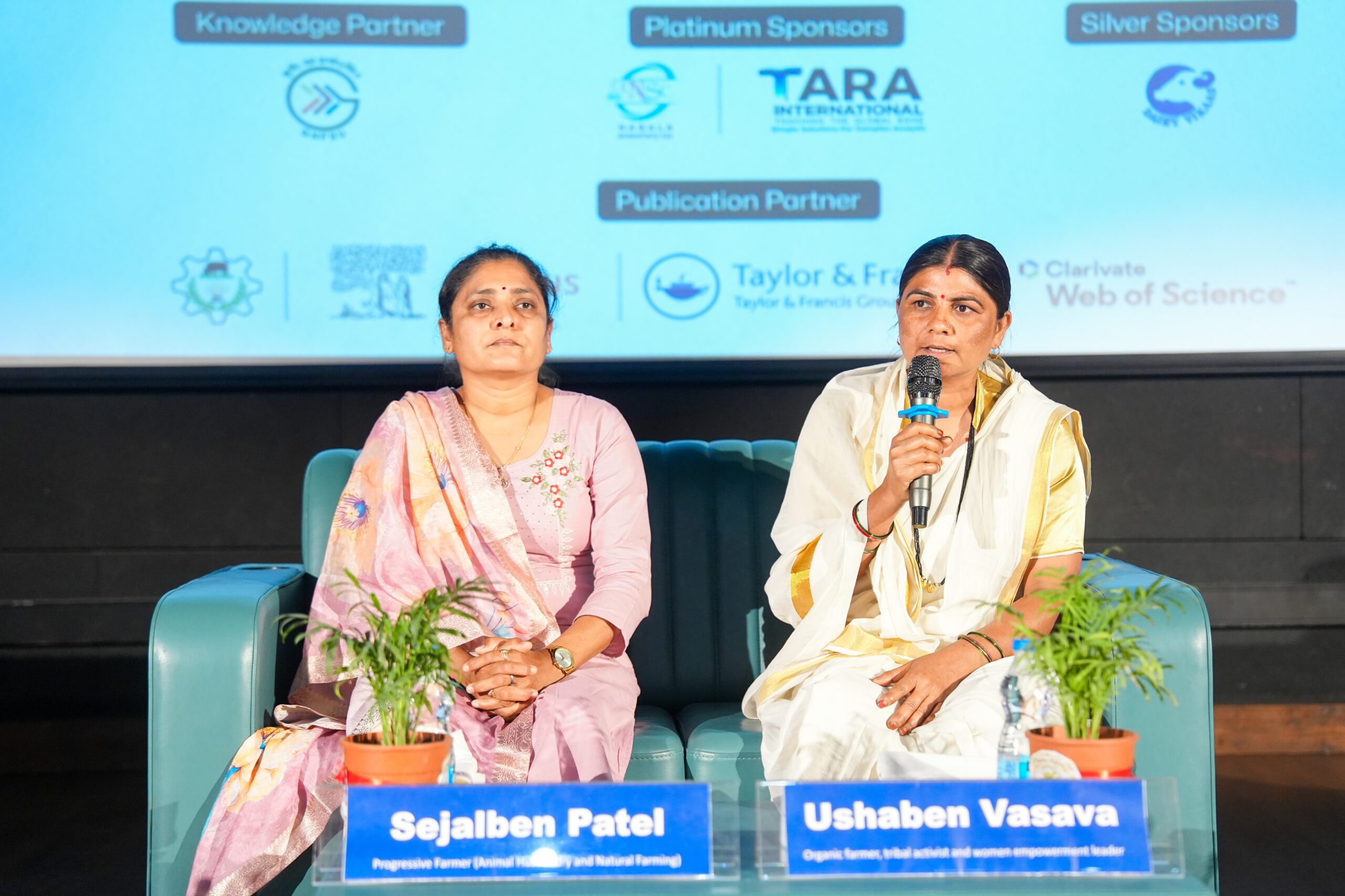
Smt. Usha Ben Dineshbhai Vasava comes from Narmada district, right near the Maharashtra border. She didn’t start with a grand plan to organise thousands of women. She started by farming vegetables and fruit on her own little patch of land. Feeding her family. Basic stuff. But somewhere along the way she began talking to women around her neighbours, relatives, women from nearby villages about how they could grow meals at home and spend less doing it. Conversations about self-reliance. About backyard harvests. About not needing to buy from the market what you can grow behind your house.
Those conversations turned into something. A small savings group concept, bachat gat took root. Women started pooling money. Started learning about state support programmes that existed for village women but that nobody had told them about. Knowledge that was technically available but practically invisible until someone like Usha Ben made it visible.
-
By 2017, she’d brought together more than 3,000 women under her Asangathan. Three thousand. And the Asangathan didn’t just stick to farming and savings. It went further.
-
Women’s rights. Property rights. There were families and anyone from a village background knows exactly the kind of families I’m talking about where daughters had zero claim to their father’s land. Households where a woman’s name didn’t appear on a single land document. Not on the ration card. Not on the property papers.
-
She pushed further still. Water-efficient farming through drip irrigation because in that region, every litre counts.
-
Biogas stoves because a rural family spending ₹800-900 on a gas cylinder refill every month is a rural family that can redirect that money into something productive if you give them an alternative fuel source.
Practical solutions. Not slogans. Not schemes on paper. Things that changed daily life for thousands of women and their families.
For all of it, she received the Nari Shakti Puraskar 2022 from the President of India, Shri Ram Nath Kovind. That’s the highest civilian recognition this country gives to women who’ve made an extraordinary difference. She got it for agriculture. For empowerment. For showing what one woman can do when she decides that the women around her deserve better and then actually does something about it instead of waiting for the government to show up.
The moderator, Thakkar ji responded to her story with a line from the scriptures: Nari hi Narayan hai. Women are divine. Looking at what Usha Ben built from a backyard vegetable patch in Narmada district, it was hard to argue with him.
Shri Dhanshukbhai Chaudhari: We Eat Chemicals, Not Food
Dhanshukbhai Chaudhari comes from Gondha village, Mandvi Taluka, Surat. Government job. Pension secured. The comfortable retirement path was right there. He could’ve spent his post-retirement years doing nothing more strenuous than reading the newspaper and drinking chai. He chose farming instead. Natural farming. And the reason he gave, stated with the bluntness of a man who doesn’t see the point in wrapping hard truths in soft language, hit the auditorium like a slap.
Today we eat chemicals, not food. That was his line. Verbatim. And then he followed it with a comparison that I haven’t been able to shake. We think twice before putting petrol in our vehicles, he said. We check the quality. We ask which brand. We worry about whether bad fuel will damage the engine. But when it comes to what we put inside our own bodies? We pay no attention at all. None. We’ll spend five minutes choosing petrol for a car but zero minutes thinking about whether the rice on our plate was grown in a chemical bath.
That comparison is the car getting more care than the body sitting heavily in the room. You could feel people squirming a little. Because he wasn’t wrong. His approach to natural farming is total. Everything comes from the farm itself. Biocompost. Manure. All of it fed directly to the plants. Nothing from outside. Nothing chemical. Nothing in a branded packet with a corporate logo. Just the land feeding itself, the way land used to be before we decided we knew better.
-
The numbers? ₹1 to ₹2 lakh annually from a 5-acre model farm.
-
He practices rainwater harvesting, water channeled into a well for irrigation so he’s not dependent on anyone else’s pipeline or anyone else’s pump schedule.
-
He handles grading, sorting, and packing of his own produce.
-
Uses a bio resource product, BRP.
-
Runs a plough nursery for vegetables and fruits.
-
Keeps his cow himself. And on that last point he paused and said something that didn’t have numbers attached to it but carried more weight than any profit chart: there is a kind of joy in gau seva in serving and caring for a cow that you cannot find in any other work.
He said it quietly. Like a man sharing something private. The room went still for a second. Then he turned to the students. And his message was the kind of thing you’d want to write on the wall of every agriculture college in the country.
He’s earning ₹1 to ₹2 lakh now from those 5 acres. But the path forward? ₹5 to ₹6 lakh. Through natural farming, through crop diversity, through selling vegetables and fruits directly to vendors instead of going through middlemen who eat your margin alive. He’s got 20 to 30 fruit plants and 3 to 4 small plots produced throughout the year, not one harvest and then nothing, but continuous income across all twelve months. That’s not subsistence farming. That’s a small business model. Running on soil and sunlight and one man’s refusal to feed chemicals to strangers.
Smt. Sejalben Patel: From Two Cows to a Gaushala and a Cancer Survivor’s Story
Sejalben Patel lives in Vachodia Taluka, Vadodara District. Which means some of the students in that auditorium probably live fifteen minutes from her farm. She started and this is important because every massive thing starts small with two cows. Just two. Kept them for her own health and her family’s well-being. Milk. Dahi. Ghee. The basics.
Two became five. Five became more. Today? Seventy cows. Her own Gaushala. Built by one woman over years of work, not by a trust with crores in donation money.
-
And from those 70 cows she doesn’t just produce milk. She makes natural astras Brahmastra, Neem Astra pest control products prepared from cow urine and other natural inputs.
-
She sells gaumutra and cow dung products in the market. What most people see as waste, she turned into a product line. A revenue stream. A business.
The Gujarat Government’s Animal Husbandry Department recognised her work with the Shreshtha Pashupalan Pramanpatra Best Animal Husbandry Certificate in 2022-23. Official recognition from the state that what this woman built from two cows in her backyard is worth studying and replicating.
But then she shared something that wasn’t about business at all. Something personal. And the room changed.
-
She had a long-standing skin disease. Tried treatments. Nothing worked the way she hoped. What did work, she said, was gaumutra. Regular use. The skin condition cleared.
-
She presented it as her life. Her father. His illness. What happened? The audience responded with loud, sustained applause not polite conference clapping but the kind of applause that comes from a place deeper than courtesy.
She finished with practical advice for the students to grow their own vegetables. Eat what you grow. Fresher meals without harmful substances. Simple words. But from a woman who’d watched her father fight cancer and come through the other side, they carried a weight that no textbook could match.
Shri Raju M. Thakkar, the moderator, responded with something from the ancient texts that felt exactly right in the moment: Aahar Shuddha, Sarva Shuddha. Purity in diet leads to clarity in everything else. Food first. Everything else follows.
Shri Valjibhai Chaudhari: Every Family Needs a Family Farmer, Not Just a Family Doctor
Last panellist. Shri Valjibhai Rayabhai Chaudhari. Baleti village, Surat District. Quiet man. But when he spoke, the words had the kind of density that comes from someone who’s spent a long time thinking before talking.
He started with what’s wrong. Chemical farming, the kind most of India practices right now follows a pattern. Soil grows weaker with each season. You pour chemicals in, you get a good yield, you pour more chemicals in because the soil can’t do it alone anymore, the yield stays flat or drops, so you pour more in.
Meanwhile the people eating this food? Their health suffers too. The initial boost from chemicals is temporary. The damage is permanent. He didn’t shout about it. He just laid it out like someone describing the weather.
Then he went broader. Today, he said, almost everything sold outside is in some way duplicate or adulterated. What is real and pure must be protected. And who protects it? Not the government they try, maybe, sometimes. The responsibility falls on students. On young people. Because they are the future of India. He said that looking directly at the audience. Not the moderator. Not at the other panellists. At the students. He called India a krishi pradhan desh, an agriculture-first country. Always has been. The identity of this nation, its spine, is its soil. And the quality of that soil, the quality of what grows in it, must be maintained for the generations that haven’t been born yet. You don’t own the land, was his implication. You’re holding it in trust. Pass it on better than you received it or answer for what you did to it.
On natural farming itself, he reached for a metaphor that resonated in a way nothing else that afternoon did. Natural farming, he said, is like bhakti. It asks for patience. It asks for faith. It asks for consistency. You don’t get results in one season and declare victory. You commit. You stay. You keep going when the neighbour using chemicals gets a flashier harvest in the short term. You trust the process because you’ve seen where the chemical path ends and you want no part of it.
-
And then his closing line. The one that got the biggest response of the entire panel. Every family should have a family farmer. Not just a family doctor.
Let that land. A family farmer, someone who grows what the family eats, who knows what went into the soil, who can guarantee that the food on the plate has no chemical history will make sure you rarely need to visit a doctor in the first place. Prevent the illness instead of treating it.
Grow the cure instead of buying it. The room loved that line. Because it took everything the entire panel had been saying about the chemicals, the health risks, the adulteration, the soil degradation and compressed it into one sentence that even a child could understand and remember.
Family farmer, not family doctor. That’s the bumper sticker version of everything natural farming stands for. And Valjibhai Chaudhari, a quiet man from a village in Surat, is the one who said it best.
FAQ - Natural Farming at ICSAFS 2026
Who were the farmers on the ICSAFS 2026 panel?
Four Gujarat farmers, each with national or state-level recognition. Smt. Usha Ben Vasava Nari Shakti Puraskar 2022, organised 3,000-plus women through her Asangathan. Smt. Sejalben Patel, owns 70 cows, runs a Gaushala, and received the Shreshtha Pashupalan Pramanpatra from Gujarat Government. Shri Dhanshukbhai Chaudhari, Best ATMA Farmer Award 2023-24, 5-acre model natural farm. Shri Valjibhai Chaudhari Best Farmer Award, ATMA-affiliated, natural farming pioneer from Surat. The panel was moderated by Shri Raju M. Thakkar, known as the Walkman of India.
Can natural farming be profitable?
Dhanshukbhai Chaudhari earns ₹1 to ₹2 lakh annually from 5 acres and he says that’s the starting point, not the ceiling. Direct selling to vendors, crop diversity, and year-round production can push that to ₹5 to ₹6 lakh. Every panellist on that stage confirmed the same core message: natural farming, done with patience and proper technique, pays. Not immediately. Not magically. But it pays. And it doesn’t destroy the soil while doing it.
Who is Shri Raju M. Thakkar?
They call him the Walkman of India. Based in Halol, Gujarat. Affiliated with Narayan Gir Gaushala. He’s been awarded the Hindustan Krushik Gaurav Award by ICAR and the Sustainable Impact Leadership Award from Amity University. He’s also spoken at Parul University’s AgriFest. As a moderator, he brings a mix of spiritual grounding, agricultural knowledge, and the ability to make four different farmers feel comfortable sharing their most personal stories on a stage. That last skill’s rarer than it sounds.


