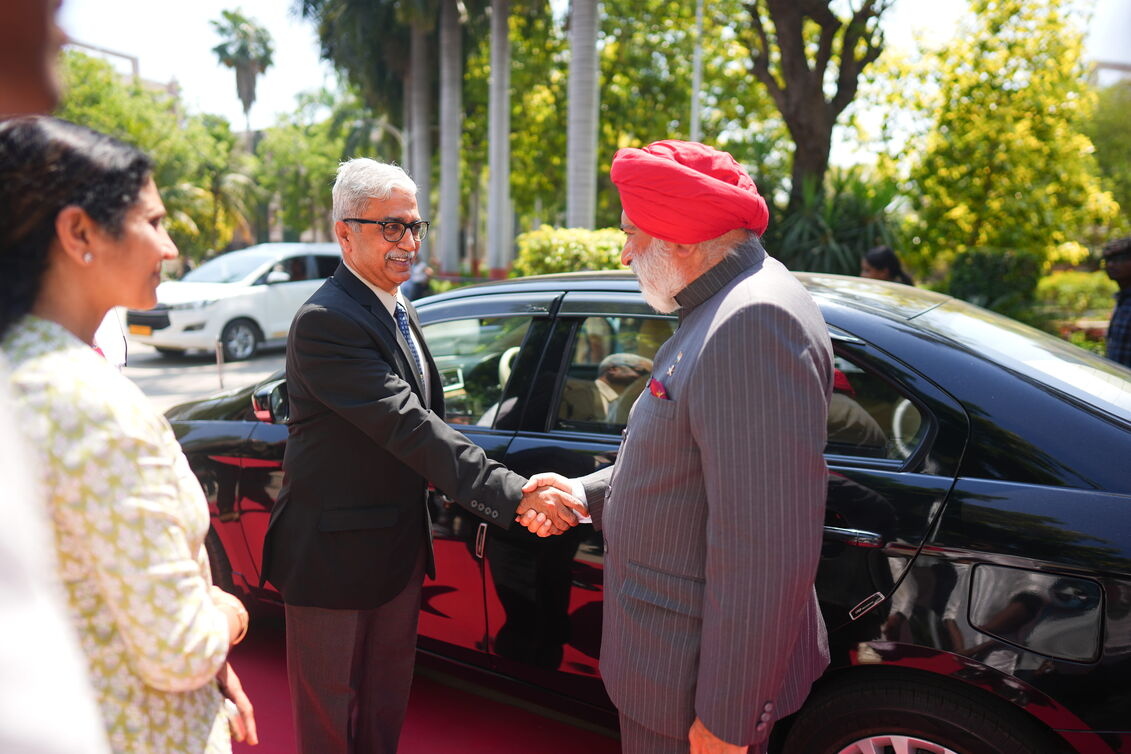
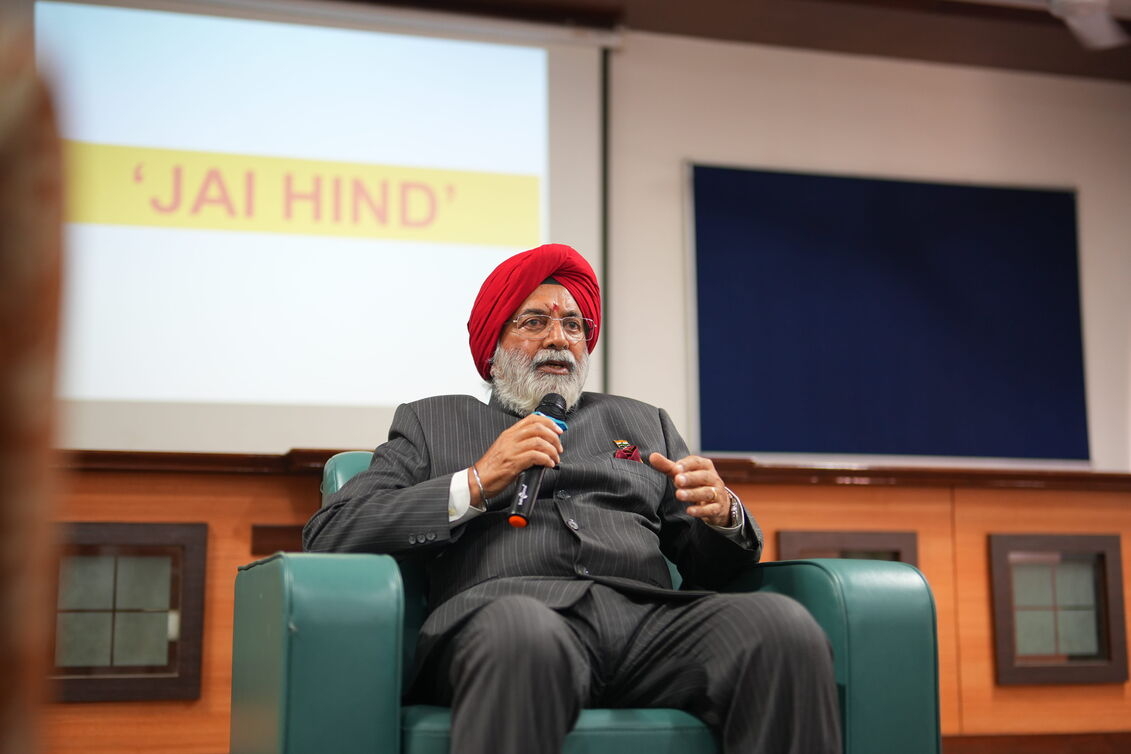
He did not start where you might expect a former Army Chief to start. There was no talk of missiles or battalions. General JJ Singh opened with values. The ideals holding Indian society together, social, religious, moral, ideological, all of them written into the Constitution. He called them the fountain of core values that must be preserved forever. And then he said something that reframed the entire conversation: these values are the foundation of India’s existence as a nation state. Not the military. Not the economy. The values come first.
That framing was no accident. In General JJ Singh’s view, national security starts with knowing what you are defending. Everything else follows from there.
Out of these values, he drew India’s national aims and objectives. Preserving sovereignty, unity, and territorial integrity. Maintaining a secular and diverse humanistic society where freedom of speech stays protected. Making sure economic growth can keep moving forward inside a secure and stable environment. And contributing to international affairs in ways that line up with India’s policies and national interests. He was particular about one thing, these are not wishful thinking. They are the mid and long-term goals that actually drive India’s entire security architecture. There is a difference between an aspiration and a plan, and General Singh made clear he was talking about the plan.
Strength Begets Respect: The Realist Framework
Then came the history lesson nobody was expecting. General Singh reached all the way back to 459 BC. The strong do what they must and the weak suffer what they must. Old words. But he brought them crashing into the present by pointing at Venezuela, a country that simply could not resist external pressure because it lacked the strength to push back. His argument was blunt. National strength provides deterrence. Without deterrence, adversaries will take unfair advantage. Every single time. That is how the world has always worked, and pretending otherwise helps nobody.
So where does modern India’s strength come from? He put it on three pillars. Strong democratic politics. A vibrant economy. And a military that is powerful, professional, secular, and apolitical. He had an interesting take on geography too. People used to think the Himalayan ranges and the deep oceans around the peninsula were India’s natural sentinels. Maybe once upon a time.
But General Singh was clear, today, the real sentinel is the combination of democratic will, economic power, and military capability. Mountains are nice to have. They are not a strategy.
India as the Centre: Geographic and Demographic Advantages
Here is where the students sat up a little straighter. Former Army Chief General Joginder Jaswant Singh at Parul University made a geographic argument that was hard to forget. India is the only country in the world with an ocean named after it. Just sit with that for a second. China has more total land area on a map, sure. But roughly 50% of that land? Frozen or desert. India has only about 10% unproductive area. Which means India ends up with a significantly larger habitable and productive land mass than the raw numbers would suggest. The map lies. The usable terrain tells the truth.
Demographics told a similar story. India and China together make up one-third of humanity. Three out of every ten human beings alive right now are either Indian or Chinese. And look at where India sits, right at the centre of a neighbourhood ringed by Afghanistan, Pakistan, the Gulf states, all of them lurching between one crisis and the next. General Singh’s phrase for India was the island of stability in the entire region. Not because instability has not tried to reach India’s doorstep. It has. But democratic institutions and the economic engine running underneath have kept the country standing while neighbours struggled. That was his point, and he made it without sentimentality.
The India–China Dynamic: Mature, Not Hostile
You could tell General Singh was choosing every word when he got to India and China. Barring the 1962 war, he said, relations between the two Asian giants have been warm and friendly. That is a fact. But the boundary dispute, in his telling, has been handled in a mature and statesmanlike manner by the leadership on both sides. He brought up Galwan in 2020 and the Doklam standoff. Both could have gone sideways. Neither did. The status quo was restored through diplomatic and military negotiations. That is not nothing, that is restraint backed by strength.
Now, the armchair strategists. General Singh had a term for the people who keep predicting an India–China war, and it was not a generous one. He called them exactly that, armchair strategists. People who, he felt, do not begin to understand the complexity of what that kind of conflict would actually look like on the ground. But he wasn’t romantic about Beijing either. China cannot be taken at face value. Understanding China, he said, takes careful, continuous assessment. Not paranoia. Not complacency. Something in between that requires actual work.
Pakistan got a different treatment altogether. He went straight to Kargil. Pakistani forces occupied heights on the north side of the border. What they did not think through and this is where his voice sharpened was what would happen once India decided to respond. That miscalculation cost them dearly. The message running underneath all three threads was consistent. Maturity when engaging China. Vigilance when assessing it. And decisive response capability when it comes to Pakistan. This was not a professor theorising. This was the man who commanded 1 Corps during Operation Parakram and who managed the India–China border as Army Chief. Experience talking, not textbooks.
The Iron Fist in Velvet Glove: A Doctrine That Changed Indian Counter-Insurgency
General Singh called the Iron Fist in Velvet Glove his brainchild. He was not being modest about it, and frankly, the record supports the claim. This counter-insurgency philosophy did not come out of a war college seminar. It came out of years spent in the thick of it, commanding a brigade in the Baramulla sector during the worst of the Jammu & Kashmir insurgency in 1991–1992, running counter-insurgency operations across the Northeast, watching what worked and what did not work when your soldiers are staring down both militants and a civilian population caught in between.
The foundational insight is deceptively simple. The principal reason any insurgent movement emerges is lack of governance, or poor governance. When people feel abandoned by the state when the roads do not get built, when the schools do not open, when nobody in Delhi seems to know or care, that is where insurgency takes root. So your response has to work on two tracks simultaneously. Track one: the iron fist. Decisive military force against terrorists and militants. No ambiguity, no half-measures. Track two: the velvet glove. Respect for human rights in how you treat the civilian population. Development projects. Surrender policies that offer militants a genuine way back to normal life. Not lip service, actual pathways.
But here is the part that makes the doctrine different from a purely military concept. The army alone cannot fix what broken governance created. The government has to run a parallel track, delivering development and good governance that go after the root causes which gave birth to the insurgency in the first place. Pull out the roots, not just the weeds.
Did it work? General Singh pointed to the evidence. India’s handling of Punjab militancy. The Assam insurgency. Nagaland and Manipur. All managed, not perfectly, nobody claimed perfection, but managed within a democratic framework without shredding civil liberties. He mentioned, and you could hear the satisfaction in how he said it, that the international community has studied India’s counter-insurgency model closely. They wanted to understand how a democracy tackled multiple insurgencies running at the same time without turning into something else in the process. That is a question worth asking. And India’s answer, General Singh argued, is the doctrine he built.
Doctrine in Practice:
The Iron Fist in Velvet Glove doctrine took shape during General Singh’s years in operational command and was refined further when he served as GOC-in-C of ARTRAC (Army Training Command), where he drafted a new doctrine for the Indian Army. It stands as a significant contribution to India’s counter-insurgency thinking and has drawn international study and attention.
FAQ - India’s National Security Challenges
What is the Iron Fist in Velvet Glove doctrine?
It is a counter-insurgency philosophy that General Joginder Jaswant Singh built over the course of his military career. On one side, decisive military action, the iron fist, against terrorists and militants. On the other, respect for human rights, development projects, and surrender policies are the velvet glove for the civilian population. The doctrine treats insurgency as a governance failure at its core, which means the fix has to come from both the security side and the development side working together.
How does India manage its border dispute with China?
General Singh explained that both nations have handled the India–China border dispute in a mature and statesmanlike manner. Flashpoints like Galwan in 2020 and the Doklam standoff were contained and resolved through diplomatic and military negotiations.
Why is India called an island of stability?
Look at the map. India’s neighbourhood includes Afghanistan, Pakistan, Nepal, Myanmar, Sri Lanka, and the Gulf states, every one of them dealing with significant instability of some kind. India, despite sitting in the middle of all that, has held together stable democratic governance, kept its economy growing, and maintained functional internal security. That track record makes it the most stable major power in the region by a considerable margin.


