
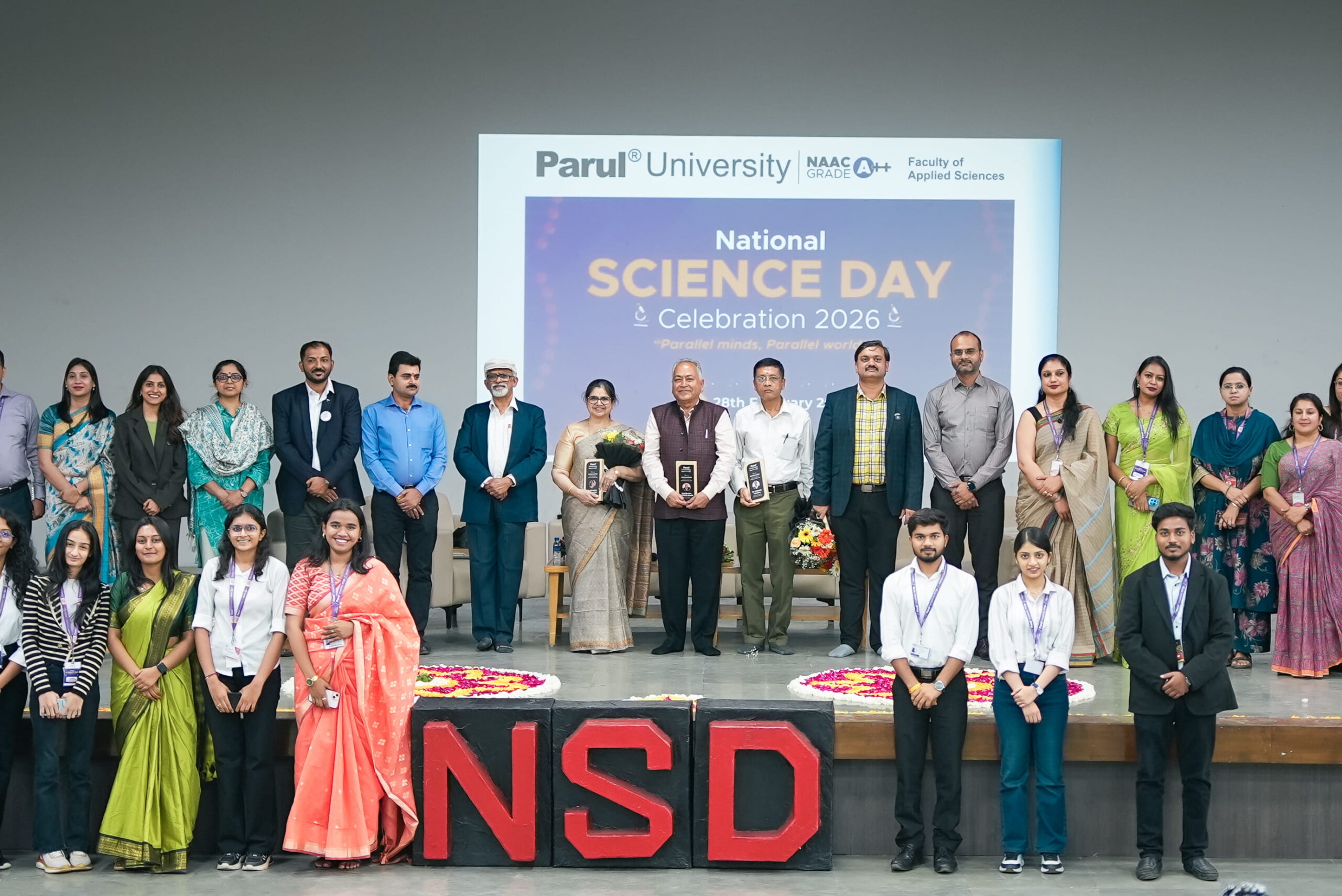
The most striking pattern across the five-speaker panel was this: none of them started with their technical expertise. Dr. Saxena started with an appeal to farmers’ moral values (Naitik Mulya). Dr. Jasuja quoted the principle of paying workers before their sweat dries. Dr. Chandorkar invoked the Sanskrit principle of moderation (Ati Sarvatra Varjayet). Dr. Sadasivuni held up a wooden memento and asked why it was not made from biodegradable material. Dr. Ishnava said directly: scientific temper needs to be combined with moral values, or innovation lacks direction.
This was not accidental. The panel’s collective argument was that sustainability is not primarily a technology problem, it is an ethics problem. Technology without integrity produces the chemical substitute for okra in jaggery making, the startup nobody needed, the innovation that solved a problem no one had. Ethics without technology produces good intentions with no scalable impact. The combination which the panel called ‘innovation without exhaustion’ is what the Sustainable Development Goals actually require. Launch a Rewarding Career in Food Safety, Quality Control, and Processing with a B.Sc. in Food Technology course
Dr. Saxena: How Moral Values Fixed a Milk Contamination Problem Technology Could Not
Dr. Alok Saxena’s most powerful example was not about technology. His dairy team in Baroda discovered that milk contamination came from farmers adulterating their supply keeping the purest milk for their own children and watering down the rest. Tetra Pak in Europe was approached for a technological fix but refused to help. Instead, the team went back to farmers with one message: this milk will be given to babies. The appeal to Naitik Mulya – moral values – transformed the quality of incoming milk. Only after that ethical shift could the supply chain support advanced refrigeration and preservation at scale.
His broader argument: India has the agricultural capacity (world’s largest milk producer, largest buffalo milk producer) but sustainability requires balancing national growth with environmental responsibility. He connected food waste conversion to bio-ethanol as a practical SDG 12 intervention, and reminded the audience that 65% of India’s population is below 35 – giving youth enormous power to drive sustainable change.
Dr. Chandorkar: We Eat Food, Not Nutrients - And That Distinction Matters for Climate
Dr. Chandorkar’s central insight was deceptively simple: we eat food, not nutrients. The gap between what people consume and what their bodies need sits at the intersection of personal health and planetary well-being. Indian pulses and legumes provide all essential amino acids, are culturally embedded, bioavailable, and cause far less environmental damage than meat production.
She addressed at the Parul University that food-climate two-way street: climate change reduces crop yields and nutritional quality, while unsustainable food production accelerates climate damage. She warned about aflatoxins fungal toxins that spoil staple crops as a major but overlooked threat connecting SDG 12 (responsible consumption) to SDG 13 (climate action). Dr. Saxena added context: the Western push for veganism often relies on an outdated image of Indian dairy, ignoring the transformation achieved by the Amul model. India’s nutrition story should be told on India’s own terms.
Dr. Jasuja: Forensic Science at the Intersection of Law, Science, and Food Security
Dr. Jasuja’s approach was philosophical before it was technical. He compared Earth to a spring with stored energy stretch it too far through environmental neglect, industrial excess, or ethical indifference, and it snaps back. He referenced the 5-magnitude earthquake felt across West Bengal as evidence that the ‘spring’ does not ask who was responsible when it releases.
On forensic food science specifically, he explained that forensic food laboratories use scientific testing to detect food adulteration whether honey has been mixed with sugar syrup, whether labels match actual contents – providing the evidence that regulatory agencies need to enforce food safety laws. Forensic science sits where law meets science, and its role in food security (SDG 2) is to ensure that the food people trust is actually what it claims to be.
Dr. Sadasivuni: From Qatar's Soil Imports to Biochar - Why Material Science Matters for Land
Dr. Sadasivuni opened with a fact that reframed how the audience thought about soil: in Qatar, people buy soil imported from India because the desert produces none. He described the 2017 blockade that cut Qatar’s land-border dairy imports, emptying supermarket shelves overnight and triggering the airlift of 4,000 Holstein cows – a dramatic illustration of what happens when resource dependencies are ignored.
On the technical side, he explained that traditional polymers clump in soil, absorbing nutrients that crops need. Biochar – produced by heating food and farm waste without oxygen – improves soil texture, retains moisture, and sequesters carbon. He warned about nano-fertilisers: while they offer efficiency gains over conventional fertilisers (which leach into groundwater), certain compounds carry potential cancer risks. His principle: safety testing must happen before deployment, not after. His broader philosophy: do not create new things when you have not maximised what already exists. He cited Khubz, the Arabic flatbread that has maintained the same price in Qatar for 20+ years – affordability designed into a staple food, not added as an afterthought.
Dr. Ishnava: Green Manufacturing and Medicinal Plant Conservation
Dr. Ishnava connected the threads. On medicinal plants, he advocated contract farming with local communities, ex-situ conservation programmes, tissue culture propagation, and certification and traceability systems – practical mechanisms to commercialise traditional knowledge without destroying the knowledge’s source. On green manufacturing, he used the example of replacing plastic phone covers with recycled aluminium or bio-based composites – a small individual change that scales when millions adopt it. He introduced green concrete (incorporating biochar) as a construction material that reduces carbon footprint in one of the most emission-heavy sectors. His conclusion: green manufacturing and circular economy thinking do not slow growth – they make growth durable.
| The Session’s Closing Words – Dr. Om Prakash Jasuja:
‘Sab ka ek hi goal hai – hum sabhi ka janam ek insaan sa hua hai, sirf insaniyat ki seva karne ke liye.’ We are all born human simply to serve humanity. The auditorium fell silent in agreement. |
FAQ - Innovation Without Exhaustion Panel
What SDGs were discussed?
SDG 2 (Zero Hunger), SDG 9 (Industry, Innovation and Infrastructure), SDG 12 (Responsible Consumption), SDG 13 (Climate Action), and SDG 15 (Life on Land).
What was the main message?
Innovation without ethics is unsustainable. India has its own path to sustainability through traditional knowledge, cultural moderation, and maximising existing resources before creating new ones.


