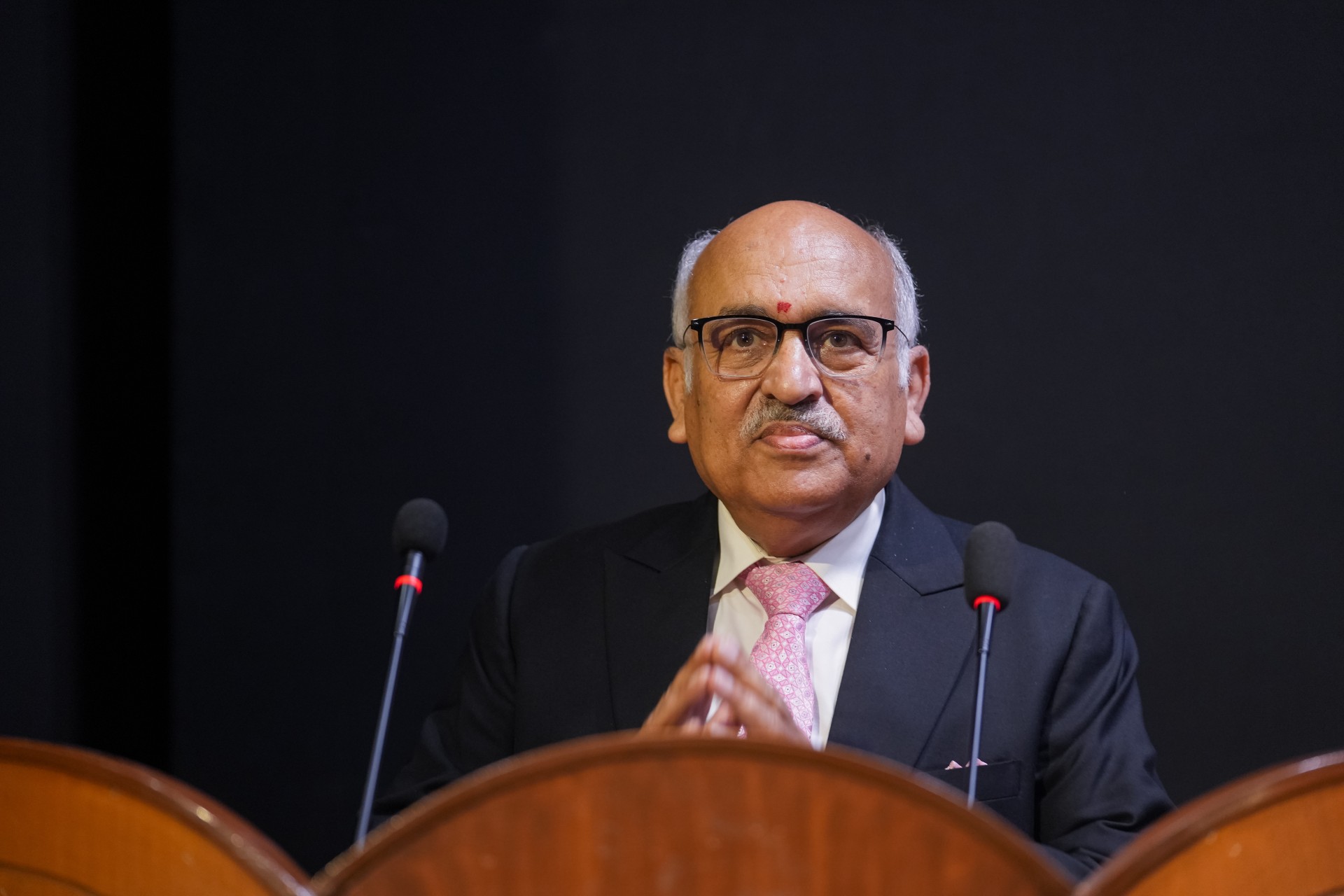
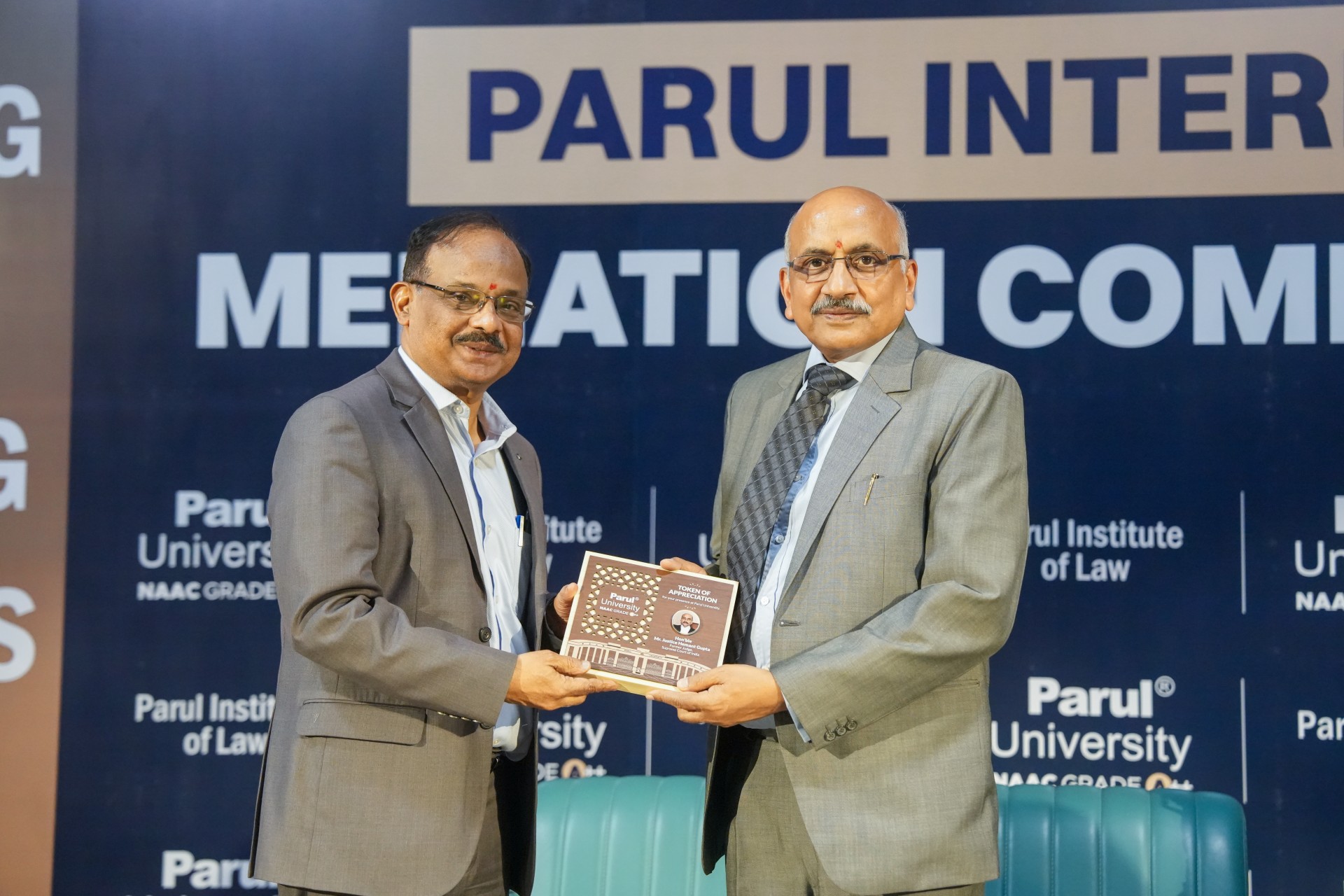
The morning of 21 March 2026 opened in the Central Auditorium of Parul University. Mohan Hindu Wahin from Manipur and Shreya Guru from Sikkim kicked things off, greeting a lively crowd of students, teachers, and legal professionals. Dr. Parul Patel, the vice president of Parul University, opened the event and honoured the three distinguished judges on stage. After that, K.N. Madhusudanan, Parul University’s Vice Chancellor, got things started with an opening speech. He quoted Oliver Wendell Holmes, reminding everyone that “the life of law has not been logic; it has been experience.” Madhusudanan talked about the partnership between Parul University and DSNLU and how they built this competition to feel real, not just another academic exercise. He told the students that real mediation isn’t about winning or defeating someone else; it’s about listening, building trust, and coming up with solutions that last.
What Each Justice Told the Room
Justice M.K. Thakkar, High Court of Gujarat Judge, began by saying that there are “too many cases, too few judges, and people waiting years for hearings.” Mediation, arbitration, and conciliation are not alternatives in the sense of being lesser, she said. They are necessary relief mechanisms. According to her, in order to become a great mediator, one should have neutrality, empathy, and the discipline to listen more than speak. She praised the PIMC event for getting the real-life cases related to dispute domains, including business contracts, maritime law, healthcare, and investment, noting that these scenarios train students for the actual complexity of legal practice. Her presence was an inspiration for all because, despite being differently abled, she built her career in civil law and government service cases.
Justice Pankaj Mithal from the Supreme Court gave a speech that cut deep, weaving philosophy and history together. He talked about mediation through scenes from Indian mythology, Angad’s peace mission to Ravan in the Ramayana, which crashed and burned after Ravan refused peace; and Lord Krishna’s offer of just five villages to the Kauravas in the Mahabharata, rejected so hard that it led to a war nobody won, not even the so-called winners. He pulled lines from Ramdhari Singh Dinkar’s poem about the Mahabharata negotiations and quoted Gandhi’s famous warning: “An eye for an eye leaves the whole world blind.”
Moving from myth to law, Justice Mithal criticized the Mediation Act 2023. He said requiring a written agreement for mediation doesn’t really work for messy real-life disputes family fights or neighborhood squabbles rarely have paperwork. He suggested family courts should make mediation compulsory before people can even file for divorce.
He revealed that the Supreme Court already informally uses this approach, resolving 6 to 7 connected cases simultaneously when transfer petitions in divorce matters come before the bench. He quoted Kabir on self-reflection and closed with a Vedic blessing, adding: “Nyay wahi jo sarv sulabh ho, aur samadhan wahi jo sthayi ho.” Justice is that which is accessible to all, and a solution is that which is permanent.
Career in law starts with B.A. LL.B. (Hons.) at Parul University.
The Competition: How PIMC Works and What the Final Round Looked Like
PIMC 2026 stuck to four core mediation principles. First, both parties had to join voluntarily; no one forced their hand. Second, everything discussed stayed confidential; nothing left the room. The mediator stayed neutral, never picking sides. And party freedom mattered, so each person who agreed had reasons; they didn’t blindly follow the crowd.
Students started with preliminary rounds and moved to the finals, where they got a chance to play the role of the mediator, counsel, or client, depending on the dispute. Here they reached the last round, which was an intense, heavy international investment fight between Auroura Renewables from the Netherlands and the Kingdom of Kalmora. Aurora had poured USD 420 million into solar infrastructure between 2015 and 2018, relying on a locked-in tariff of USD 0.11 per kilowatt-hour for 25 years. Out of nowhere in 2020, Kalmora slashed those tariffs by 35% and demanded that payments be made in their own currency.
Aurora wanted USD 385 million to cover losses on net present value, foreign exchange risk, carbon credits, and regulatory costs. There were claims about MFN violations, surprise inspections, and favouritism toward state enterprises. Teams from GGSIPU New Delhi and MNLU Mumbai ran the mediation. During joint sessions and private talks, Kalmora offered USD 260 million. Meanwhile, Aurora quietly indicated they’d settle for USD 240 million if Kalmora made some structural changes.
No final settlement was signed, but both parties moved meaningfully toward resolution. As one participant observed, a solar panel does not generate power because the sun shines only once. It generates power because the sun shines predictably, day after day, year after year.
The Valedictory Evening: Growth, Critique, and the Voice of the Voiceless
The evening session brought three speakers who collectively provided the most balanced assessment of mediation. Justice Hemant Gupta, former judge of the Supreme Court and Chairperson of the Indian International Arbitration Centre, traced mediation’s growth from its early adoption around 2002 under Order 99 CPC with 40-hour training programs to today’s ADR ecosystem. He shared a personal account: a family dispute resolved through mediation after 15 years of civil and criminal litigation. The outcome, a decree of divorce, was not happy. But it was accepted by both parties through dialogue. His message to competitors: there is no loser in this competition. There is only someone who became successful because of presence of mind at a particular time.
Justice Girish Kathpalia of the Delhi High Court, speaking from 15 years at the bar and 23 years as an adjudicator, delivered the critique the field needed to hear. Mediation has become statistics-oriented: institutions focus on numbers of settlements, not quality. Many settlements are practically non-enforceable. Serious criminal matters like dowry death (Section 304B) and negligence causing death (Section 304A) are being mediated through monetary compensation, which he called blood money. His constructive proposal: domain experts, not just lawyers and judges, should serve as mediators in specialised disputes. Technical and medical cases require subject-matter knowledge.
Prof. D. Surya Prakash Rao, Vice Chancellor of DSNLU, drew a line from India’s ancient Panchayati Sabha tradition to the modern mediation movement, noting that the Supreme Court Mediation Committee is actively institutionalising mediation training for advocates. His central message went beyond process: be the voice of the voiceless. Think of the rickshaw puller, the manual scavenger. He is the common man. You owe your voice to that man. A good lawyer is not someone who speaks eloquently. A good lawyer dedicates knowledge and hard work to justice for the underprivileged.
Come visit Faculty of Law at Parul University and learn the real-world cases.
Competition Results and Recognitions
Best Mediator
- Winner: Team Code 17 – University School of Law and Legal Studies, GGSIPU, New Delhi
- 1st Runner-up: Team Code 39 – Maharashtra National Law University, Mumbai
- 2nd Runner-up: Team Code 35 – NMIMS, Chandigarh
Best Negotiating Pair
- Winner: Team Code 38 – Jindal Global Law School, Sonipat
- 1st Runner-up: Team Code 25 – Tamil Nadu National Law University, Tiruchirappalli
- 2nd Runner-up: Team Code 07 – Dr. Ram Manohar Lohia National Law University, Lucknow
Felicitation and Special Recognitions
The judges of the final round were felicitated by the ministerial justices: Saurabh Bindal (Partner, Fox Mandal & Associates) and G.M. Kalia (Partner, GM Kalia & Co) were honoured for their contribution and guidance. Students were also recognised for outstanding performances at the 6th National Moot Court Competition: Kashika Verma, Hilary Chanu, and Anisha OS Duveen (1st Runner-up), with Mehak Thakkar and Paras Verma receiving Best Speaker awards. A significant milestone of the valedictory evening was the inauguration of the monthly newsletter of the Parul Institute of Law, a platform for student voices and the institution’s growing legal legacy, inaugurated by Shubhankar and Principal Ketan Desai.
B.B.A. LL.B. (Hons.) at Parul University and B.Com. LL.B. (Hons.) at Parul University help you study modern Indian law in depth.
PIMC 2026 Quick Facts:
Event: 2nd Edition Parul International Mediation Competition. Dates: 20-22 March 2026. Venue: Central Auditorium + Faculty of Law, Parul University Vadodara. Co-organiser: DSNLU Visakhapatnam. Teams: 44 from law universities across India. Domains: Commercial law, contracts, maritime, transport, healthcare, investments. Directed by: Dr. Parul Patel (VP PU), K.N. Madhusudanan (VC PU). Inaugural speakers: Justice Indira Banerjee (Former SC), Justice Pankaj Mithal (SC), Justice M.K. Thakker (Gujarat HC). Valedictory speakers: Justice Hemant Gupta (Former SC, Chair IIAC), Justice Girish Kathpalia (Delhi HC), Prof. D. Surya Prakash Rao (VC DSNLU). Final round judges: Justice Kathpalia, Justice Mithal, G.M. Kalia (Partner, GM Kalia & Co). Felicitated: Saurabh Bindal (Partner, Fox Mandal & Associates), G.M. Kalia. Best Mediator Winner: Team 17 GGSIPU New Delhi. Best Negotiating Pair Winner: Team 38 Jindal Global Law School Sonipat. VC Madhusudanan quoted Oliver Wendell Holmes: ‘The life of law has not been logic, it has been experience.’ Justice Krishna Iyer quoted by Justice Thakker: ‘Law is service, not business. Newsletter inaugurated by Shubhankar and Principal Ketan Desai.
FAQ: PIMC 2026
Is This Second Edition of the PIMC?
Yes, this is the 2nd edition of the PIMC. PIMC is the Parul International Mediation Competition. It is hosted by the Parul Institute of Law in association with DSNLU. This year, 44 teams competed in multi-domain disputes judged by Supreme Court and High Court justices. Unlike moot courts that simulate adversarial litigation, PIMC cultivates constructive dialogue, negotiation, and mediation skills. The 2026 final round featured a USD 420 million solar investment dispute.
Who were the judges at PIMC 2026?
Inaugural: Justice Indira Banerjee (Former SC), Justice Pankaj Mithal (SC), Justice M.K. Thakker (Gujarat HC). Valedictory: Justice Hemant Gupta (Former SC, Chair IIAC), Justice Girish Kathpalia (Delhi HC). Final round: Justice Kathpalia, Justice Mithal, G.M. Kalia. University officials: Dr. Parul Patel (VP), K.N. Madhusudanan (VC), Prof. D. Surya Prakash Rao (VC DSNLU).
Who won PIMC 2026?
Best Mediator: GGSIPU New Delhi. Best Negotiating Pair: Jindal Global Law School Sonipat. Full results include runners-up from MNLU Mumbai, NMIMS Chandigarh, TNNLU Tiruchirappalli, and RMLNLU Lucknow.


