The Penguin Who Walked Alone
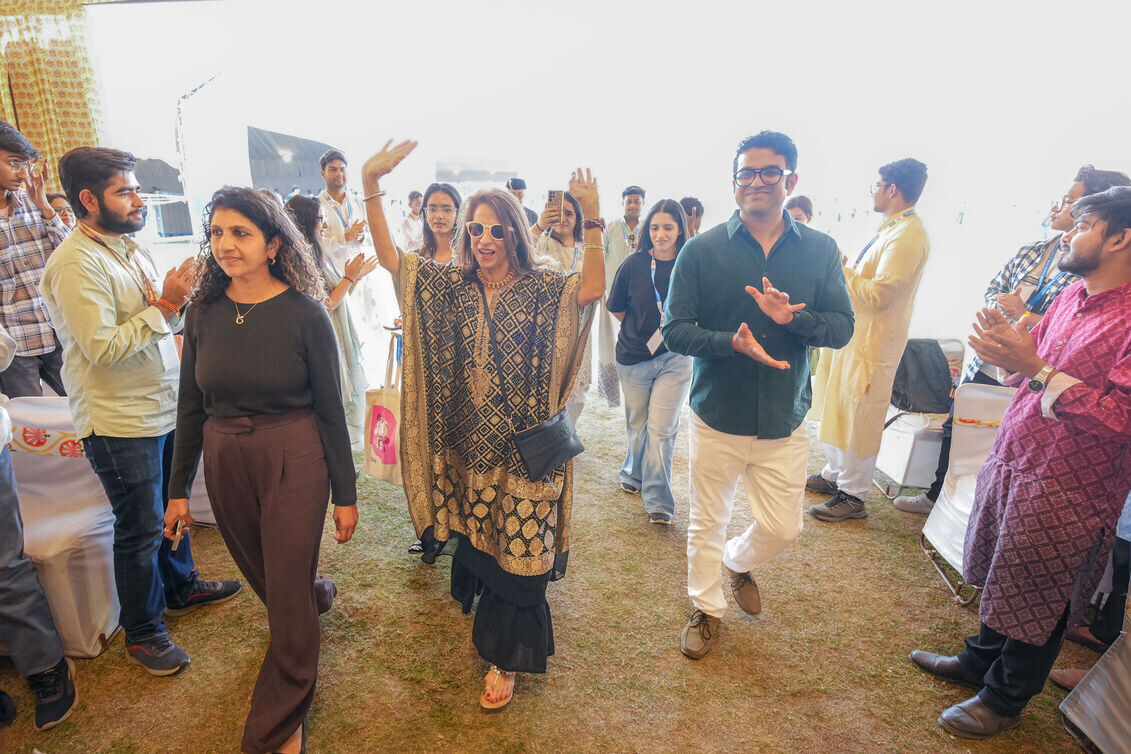
RJ Harsh opened Shobhaa De‘s standalone session at Tagore’s Shantiniketan on January 29, 2026, with a reference to a viral video – a penguin walking away from its group, choosing its own path. He described De as someone who had done the same. She accepted the analogy without modification.
- It is a reasonable description of a career that began at seventeen as a model, moved through journalism and the founding of magazines including Stardust, Society, and Celebrity, and eventually produced more than twenty books published by Penguin India.
- Be it novels, essays, social commentary – that have made her one of the most widely read and most contested figures in Indian literary culture.
- She did not plan most of it. Modelling chose her, she said, before she chose it.
- What it gave her was financial independence at a very young age – a condition she identified, looking back, as the foundation of everything else. The sequence matters: freedom came first, then the writing that made use of it.
Write the Book Within': On Voice, Identity, and the Refusal to Imitate
The session’s most direct literary instruction came when De addressed aspiring writers in the audience. Her advice was unequivocal: write the book within. Not the book you think the market wants. Not the book modelled on someone you admire. The book that only you can write – from the specific accumulation of experience, observation, and truth that constitutes your actual life.
She spoke about the double standard embedded in comparisons of her work to Western authors. For decades, certain critics described her as the ‘Jackie Collins of India’ – a comparison she did not accept and did not need. The language of comparison itself – the reflexive validation of Indian creative work through Western reference points – was something she named as a symptom of broader cultural insecurity.
“Why does Indian cinema seek validation through the Oscars instead of establishing its own benchmarks?” she asked. The question applied equally to literature, to fashion, to every domain where the reflex toward Western comparison persists. Her argument was not nationalist. It was about self-knowledge: understanding the value of what you are, and therefore not needing to be something else.”
When the moderator raised the complexity of the women in her novels, she was clear: she had never consciously set out to create complex characters. Her only intention was to do justice to them. “Characters are shaped by multiple aspects and lived realities,” she said. “I refuse to dilute my female characters. If I tone them down, there are countless others ready to diminish the lived experiences of real women.” What this means practically for student writers:
● ‘Write the book within’ – originality comes from self-knowledge, not imitation
● Read extensively: the more you read, the better you write – this is a mechanism, not just advice
● The courage to write from your own truth is the only form of courage that produces lasting work
● Comparison to Western references is a trap – Indian literature has its own benchmarks worth setting
The Cost of Freedom - and Why It's Worth Paying
Shobhaa De’s most sustained theme at VLF – Vadodara Literature Festival 4.0 was freedom – specifically, the particular kind of freedom that women in India pay for with judgment, criticism, and the persistent social machinery that seeks to return ambitious women to more manageable shapes.
- She began modelling at seventeen. She launched magazines that covered territory – female desire, glamour, ambition, sexuality – that respectable Indian publishing had largely avoided. She wrote novels with female protagonists whose inner lives were complicated, whose choices were sometimes transgressive, whose freedom was real and cost-bearing. Throughout all of it, she received criticism designed to make her smaller. She had not become smaller.
- “I would rather be criticised for being strong than pitied for being a woman,” she told the audience. And she named pity – not criticism, not hatred – as the most dangerous emotion. Pity, she explained, is self-defeating and patronising. It is the emotion through which society offers women the false comfort of diminishment: you are fragile, you need protection, your ambitions are touching but ultimately beyond you. “It is easier for society to pity a woman than to admire her.”
- This is a precise description of a mechanism by which female ambition is neutralised without appearing to oppose it. Her point was not that women should be impervious to difficulty, but that they should be clear about the nature of the obstacles – which are social, not individual – and should refuse the offered comfort of pity in favour of the harder path of continued movement.
Social Media, Trolling, and the Art of Deciding What Deserves Attention
She described social media as a ‘monster’ – not in a melodramatic sense, but in the specific sense that it has transformed success into something curated, comparison into something constant, and validation into something quantified in real time. These are not conditions that make for clear thinking, good writing, or honest self-assessment.
- She quoted about having received death threats and rape threats – more, she said, than most people she knew – and about learning to distinguish between what deserved a response and what deserved to be disregarded.
- Her advice to students was practical: step back from social media. Take breaks. Disengage entirely if necessary. This is not a retreat. It is the management of attention as a resource – the recognition that what you spend your focus on shapes what you are capable of thinking about.
- She also identified a genuine gain in the current digital moment: the democratization of publishing. Writers no longer need traditional gatekeepers to put work before readers.
Being the Shobhaa De of India, Not Anyone Else!
The photograph on her book covers – which had been subject to unnecessary commentary – she clarified was a commercial decision, not a personal statement. Male authors had their photographs on covers without comment. She had her photograph on covers, and the conversation became about whether appearance was selling the work. The double standard required no amplification: it was self-evident.
She closed the session with a statement the audience received in quiet recognition: truth is non-negotiable, and truth always comes with a price. She urged aspiring writers to write from within and to write well.
For students at VLF – Vadodara Literature Festival 4.0 – many of them women figuring out what it means to build a career while being themselves – the session was not primarily about literature. It was about the specific form of courage that a creative life requires, and the specific ways in which that courage is tested.


