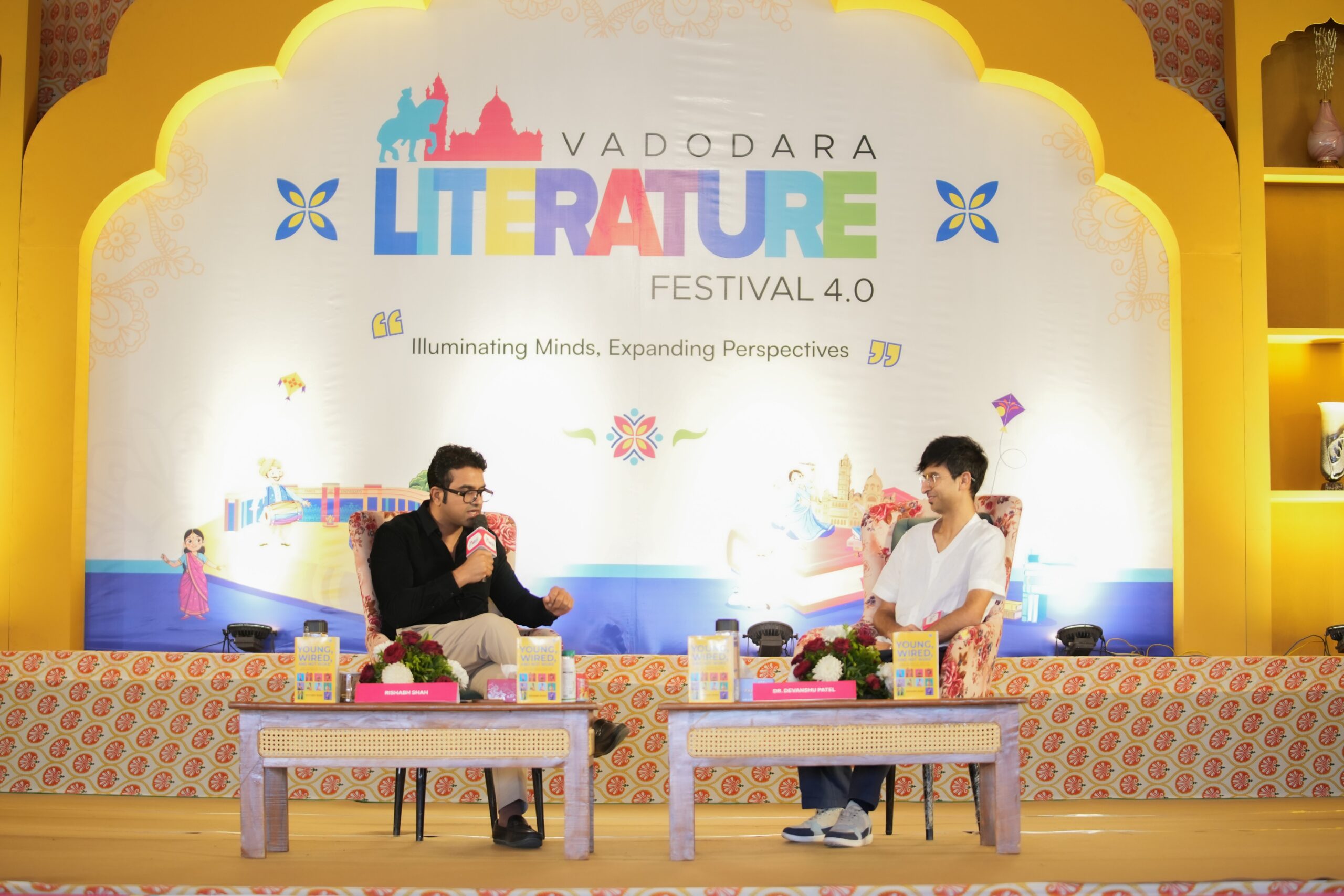
When Dr. Devanshu Patel, President of Parul University, introduced Rishab Shah at Tagore's Shantiniketan on January 28, 2026, the framing was specific: here is a man who founded India's International Movement to the United Nations at the age of nineteen, driven by the belief that young people should not have to wait for 'someday' to matter.
Fifteen years later, IIMUN has grown into an organization that operates across 75+ cities in India and 40+ countries, has hosted 34,000+ speakers, and impacts millions of students through its programs, including the literature festivals it curates - among them VLF 4.0 at Parul University. The person now sitting before an audience of students and faculty was not a youth leader anymore. He was an observer of youth - someone who had spent a decade and a half building platforms for young people to express themselves, and who had, through that sustained proximity, arrived at a set of conclusions that were more complicated than the inspirational framing of his introduction suggested.
The book he came to discuss - Young, Wired, and Not Woke - began, like IIMUN itself, as a concept in his diary. He wrote the book because fifteen years of proximity to young people had left him genuinely concerned about what he was observing.
The Problem With 'Woke': Borrowed Outrage and the Thinking It Replaces
The session's central intellectual argument was about the word in his book's title that draws the most attention: 'Not Woke.'
Rishab Shah was precise about what he meant and what he did not mean. Being 'woke' - in the sense of being aware, of caring about justice, of noticing injustice - is not the target of his critique. The target is what 'wokeness' has, in many cases, become: a performance of awareness that substitutes social media participation for actual engagement, that adopts positions borrowed from Western campus culture without interrogating whether those positions fit the Indian social context they are being applied to, and that has a 'stopping point'- a moment beyond which it curdles into ideological rigidity rather than genuine inquiry.
He was specific about the Indian dimension. India's youth, he argued, are routinely evaluated through frameworks developed in Western contexts - individualism, confidentiality, emotional autonomy - that do not accurately describe the community - based social structures that most Indian young people actually live within. Indian youth are not Western youth who happened to be born in India. They have relational competencies, collective loyalties, and social intelligences that Western psychological frameworks do not adequately capture. Judging them by Western standards is not accurate. It is a category error.
His alternative: every issue must be viewed through one's own lens, shaped by critical thinking, context, and lived experience. Not borrowed outrage. Not adopted positions. Thinking that is genuinely yours, formed through the specific accumulation of experience you have actually had.
Nine Seconds: What the Algorithm Is Doing to the Ability to Think
The session's most alarming empirical claim - and the one that produced the most visible reaction from the audience - concerned attention spans. Doomscrolling, Rishab said, has become so habitual that people often fail to watch even a full reel to completion, with genuine attention spans shrinking to around nine seconds.
He was not catastrophizing. He was describing a mechanism. The algorithm is designed to maximize time on the platform, not to maximize the quality of the experience or the development of the person using it. It achieves this by giving each piece of content exactly enough time to trigger a response before offering the next stimulus. The result, accumulated across millions of users and billions of interactions, is a systematic training of the brain toward shorter and shorter loops of attention - a training that is, at this point, almost invisible because it has been normalized into ordinary digital behavior.
His personal counter-practice: deliberately liking content from opposing political viewpoints to confuse the algorithm and force exposure to perspectives that his default preferences would filter out. He described feeling, when he first started doing this, 'very smart.' The humour was real, but so was the point: the algorithm is shaping what you think you know, and it requires active, conscious interference to prevent it from becoming the primary curator of your worldview.
On AI specifically, he made a distinction that the audience found useful: AI tools like ChatGPT can be genuinely helpful in learning - as thinking partners, as research starting points, and as tools for generating options to evaluate. What they should not be is a substitute for thinking: the practice of using AI minutes before an exam to crack format - based answers is not learning. It is a way of performing learning while avoiding the cognitive work that learning requires. The prompt you write, he suggested, is itself a form of thinking that deserves more careful attention.
'Pyaar Dosti Hai': On Relationships, Situationships, and What They Teach
The session moved into territory that few formal speakers at literature festivals typically occupy: relationships, situationships, and what young people are actually navigating in their emotional lives.
Rishab Shah's framing was, as usual, specific. His idea of love aligns, he said, with the famous dialogue from Kuch Kuch Hota Hai: 'Pyaar dosti hai.' Love is friendship. He mentioned remaining friends with his former partners - not as a performance of maturity, but as evidence of a philosophy: that the connection that existed between two people does not have to be destroyed when its form changes.
His observation about short - term relationships was genuinely unexpected: a single 'highlight' can sometimes teach lessons that a long 'post' never reaches. The relationship that ends quickly but intensely can, in certain cases, impart understanding that a comfortable long - term arrangement never forces either person to develop. This is not an argument for impermanence. It is an argument for paying attention to what each form of relationship actually teaches - and for not dismissing shorter connections as failures.
On gender identity and expression, he drew a distinction that was philosophically careful: gender expression is fluid and independent of biology; gender identity is fixed. He quoted 'Aham Brahmasmi' - the Vedic declaration of the self's identity with ultimate reality - to make the point that human identity transcends the labels of he, she, or they. He also critiqued what he called the 'theatre of over - creation' in urban spaces - the performative obligation to announce pronouns in every professional and social context - as an example of the same performative impulse that turns 'wokeness' into a social display rather than genuine engagement.
Mental Health Is Not a Western Import -It Is in the Vedic Samhitas
Rishab Shah’s most personally revealing passage came when he addressed the resistance – common across Indian generations and social classes -to mental health support and professional counselling.
His historical argument was pointed: mental health has always existed in Indian thought. The Vedic Samhitas address psychological well-being. The Bhagavad Gita is, at one level, an extended intervention in a crisis of psychological paralysis. The Yoga Sutras of Patanjali are a sophisticated manual for managing the mind. The idea that therapy or counseling is a Western concept imported by culturally confused urban youth is not only dismissive – it is historically inaccurate.
He shared a personal story that illustrated the stakes. After losing his grandfather – a man to whom he was very close – people kept visiting his grandmother and asking her to recount the loss, unknowingly forcing her to relive her grief repeatedly. He eventually put up a notice asking people not to question his grandmother and to direct any questions to him instead. The story landed because its subject – the social rituals that compound grief rather than support it – is so widely experienced and so rarely named.
His closing answer to the moderator’s final question – if you could ban one thing, what would it be? -was: theory – based exams. He advocated for practical evaluation as a more effective mechanism for enabling the genuine development of young people. It was the session’s most direct provocation. It was also, for the students in the room who had built their academic careers around exactly the thing he wanted to ban, the most honest thing he said.


