Before Anna Hazare, Ralegan Siddhi was what many rural Indian villages still are: drought-prone, impoverished, dependent on alcohol production for income, with limited education and healthcare infrastructure. When students asked how the transformation began, the answer was not a government programme or an NGO intervention. It was one man returning from the army, reading Swami Vivekananda, and deciding to change his village by changing himself first.
The students were guided by Mr Nanasaheb, who walked them through the village’s transformation over four decades. The 5.5-hour journey from Mumbai was itself a transition, from India’s financial capital to a village of 510 houses where the principles of governance predate most urban policy frameworks.
The Five Rules That Changed Everything
Since the 1980s, Ralegan Siddhi has operated under five self-imposed community rules. These are not enforced by police. There is no police station. They are enforced by collective agreement and social accountability:
- Nasbandhi (family planning): population control as a community decision, not a government mandate
- Nashabandhi (prohibition of alcohol): the village had 35 alcohol-making bhattis. All were shut down through years of patient trust-building, not overnight enforcement. Ishan Kashiv‘s LinkedIn post noted that the shutdown happened because people first saw Anna Hazare live the values before they accepted them
- Charaibandhi (ban on free grazing): livestock management to protect agricultural land and common resources
- Kulhadi Bandhi (ban on axe): preventing deforestation, protecting 250-year-old trees, maintaining joint forest committees
- Shramdan (voluntary community service): most village infrastructure was built through collective labour, not contracted construction
Rashi Verma’s experience on Mumbai Tour
Additionally, the village follows a ban on tobacco and a ban on non-vegetarian food. The entire community has adopted vegetarianism. The village celebrates its foundation day on 2nd October, Gandhiji’s birth anniversary.
Water Conservation: The Foundation of Self-Reliance
Water is the most critical resource in rural India. Ralegan Siddhi solved its water crisis through a system of check dams, wells, and a simple sedimentation-based filtration system. The numbers:
- 85 interconnected water structures storing over 1 crore litres of water
- Rs 2 crore from government support and Rs 35 lakh raised by villagers themselves, with every farmer contributing Rs 10,000 per acre annually
- Since 1985, Anna Hazare enforced the rule that no farmer could use dam water for individual benefit. Water is a collective resource
- No central sewage system. Septic tanks are renewed every 15 years and converted into compost, reinforcing the principle of self-reliance and eco-friendly living
- Black soil layered with plastic sheets to store rainwater, as Ishan observed during the visit
The water conservation system transformed agriculture. Farmers who previously struggled with drought now contribute to the collective water fund. The system is self-sustaining: community funds operate water pumps, and the annual contribution ensures maintenance without dependence on external agencies.
The Failed School: Turning Struggle Into Achievement
The village runs a unique institution called the Failed School. The name is deliberately provocative: children who struggle academically elsewhere are nurtured here into achievers. Today the school educates 750 students with 35 teachers on a 15-acre campus that was built entirely by the community starting in 1980. The science stream was recently discontinued, with the school focusing on the areas where its pedagogy has the strongest impact. The school is not a government programme. It is a community decision, funded by community resources, operating on community land.
What 3,000 People Built: The Outputs
From a village of 3,000 residents and 510 houses:
- 300+ have served in the Indian Army
- 450+ are government officers
- 50+ are teachers
- 1 hospital worth Rs 9 crore provides basic healthcare
- 7 balwadis and 3 primary schools serve the community
- No police station has ever been needed because the community governance structure resolves disputes internally
Community marriages are financially supported here. Anna Hazare puts in Rs 20,000 from his own pocket for every wedding that takes place. If the bride is from outside the village, she gets Rs 14,000, something that has slowly brought communities closer over the years.
Students who even receive top academics and people who contribute meaningfully to village life are recognised every year – it’s applicable for all the communities!
Meeting Anna Hazare: The Interaction
Anna Hazare, born in Bhingar, Ahmednagar in 1937. He joined the Indian Army at 26 and served till 1975. The 1965 war with Pakistan nearly killed him. After that, something shifted. He picked up Vivekananda’s writings and never really looked back. Ralegan Siddhi followed. Then the RTI Act and then 2011 and the Jan Lokpal movement that shook the country.
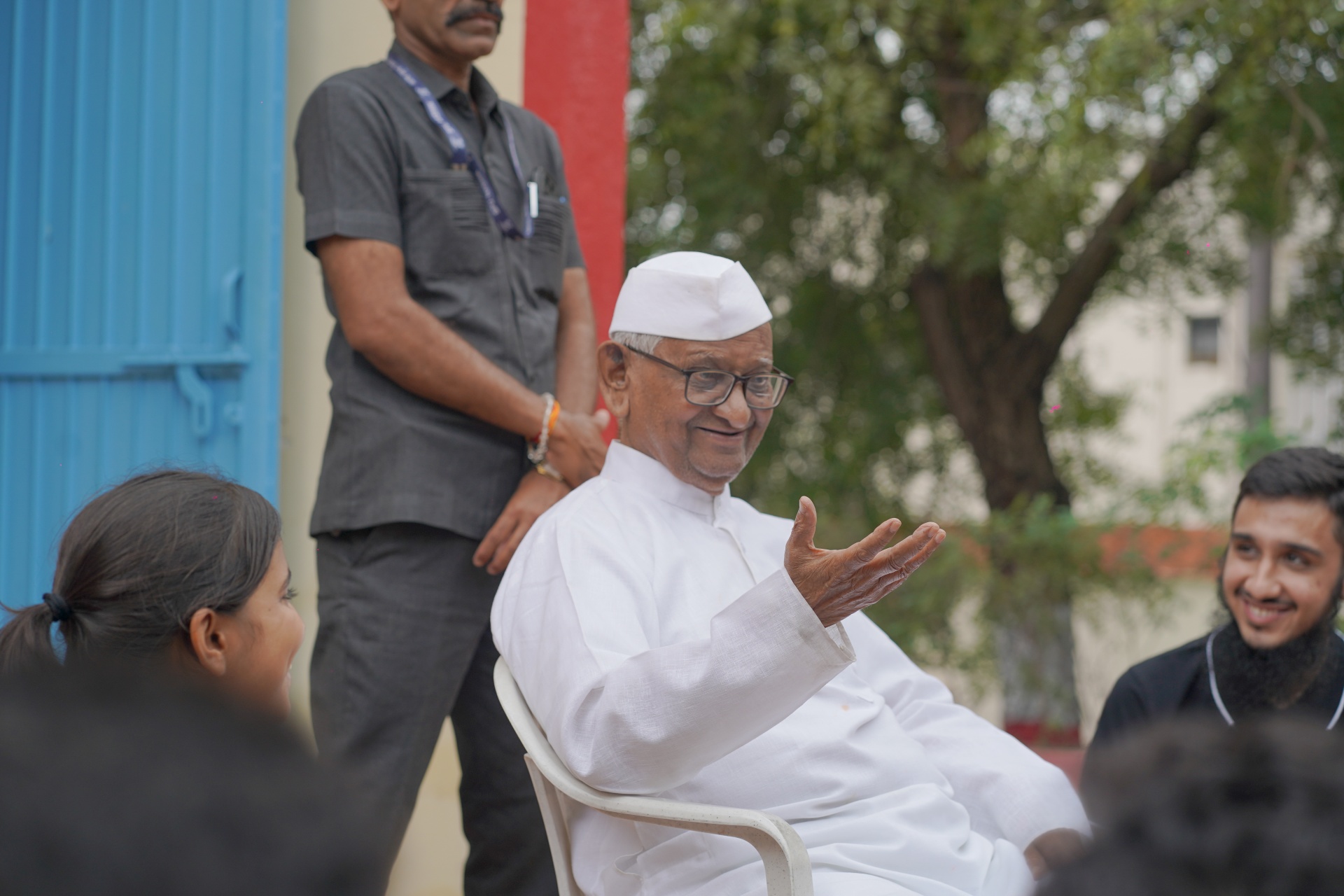
Meeting him in person is a different thing altogether. No stage, no formality. He sat with the students and just talked. Answered whatever they asked, went off on stories, laughed at points. The man is in his late eighties and still completely absorbed in the work. Students said afterwards they weren’t expecting that, the plainness of it, the lack of performance. He told them that youth with honest intentions are what the country actually runs on. If you too wish to follow his philosophy, begin your career by enrolling in Parul University’s Master of Social Work – Human Resource Management Program.
The five principles he’s carried his whole life:
- Shudh Aachaar – keep your actions clean
- Shudh Vichaar – keep your thinking clean
- Jeevan mein daag na ho – don’t let your life collect stains
- Jeevan Nishkalank – live in a way no one can question
- Apmaan Nirudh – never let go of your self-respect
“Ethics is the foundation of life, and one must hold onto it, no matter the circumstances.”
What Ralegan Siddhi Teaches Social Work Students
There’s a reason social work programmes send students here. Everything taught in classroom participatory methods, community organising, rural development, shows up here in practice, in a village that did it without waiting for permission or funding.
No external agency came and fixed Ralegan Siddhi. The people sat down, agreed on what they wouldn’t tolerate anymore, and built from there. Shramdan became routine. Water conservation became a part of culture. The school took in children others had written off. There is still no police station because, by and large, there’s no need for one. What Anna Hazare modelled was simple, he didn’t ask anything of the village he wasn’t already doing himself. That’s what got people moving. At this point of view, people are still following his ideologies and footprints!
The MSW programme at Parul University tries to carry both things together. Frameworks and fieldwork. Theory and direct exposure. The university holds NAAC A++ (CGPA 3.55), runs dedicated skill centres and Beyond Academics initiatives, that’s the foundation. Tours like this one are where students meet the human side of the work, the part that doesn’t fit in any textbook.
Read ahead the heartfelt experiences of students, as shared on LinkedIn.
Amaya Raj on how Teach For India inspired her!
Ishan Kashiv on meeting Shaheen Mistri, Mumbai Tour
Yash Ladva on her experience with Make-A-Wish-India, Mumbai Tour
FAQs
What is Ralegan Siddhi known for?
A model village in Maharashtra transformed under Anna Hazare's leadership from a drought-prone settlement to a self-sustaining community. Known for: 85 water conservation structures storing 1 crore litres, 5 self-imposed community rules (no alcohol, no free grazing, no deforestation, family planning, voluntary labour), a Failed School educating 750 students, no police station needed, 300+ Army soldiers and 450+ government officers from a population of 3,000.
What are Anna Hazare's five guiding principles?
Shudh Aachaar (pure conduct), Shudh Vichaar (pure thoughts), Jeevan mein daag na ho (life without stains, integrity), Jeevan Nishkalank (spotless blameless life), and Apmaan Nirudh (resisting humiliation, living with dignity). He shared these directly with Parul University MSW students during the Ralegan Siddhi visit.