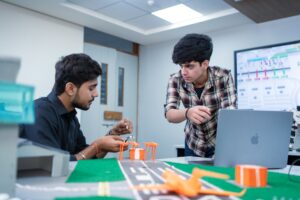
In today’s time, education is not only about reading books. Many studies show that students learn better when they do practical work and research activities. Because of this, research-oriented learning is becoming very important for science students in 2026. Courses like BSc and BSc Hons now focus more on experiments, projects, and real-world understanding.
Research helps students go beyond theory and understand how science works in real life.
What is Meant by Research Learning?
Research-oriented learning means students learn by exploring, questioning, and finding answers. Instead of only listening to lectures, students do experiments and study real problems.
What is the idea behind research learning?
- Asking questions
- Finding answers through study
- Doing experiments
- Understanding results
This method makes learning more active and interesting.
How is it different from normal learning?
- Normal learning is theory-based
- Research learning is practical-based
- Normal learning gives knowledge
- Research learning builds understanding
This kind of learning, which is based on research, is really useful for BSc and BSc Hons students.
Why is Research So Important in Science Education?
Science is a subject which needs practical understanding. Research helps students learn deeply.
What benefits does research learning give?
- It improves critical thinking
- It builds problem-solving skills
- It encourages curiosity
- It develops analytical ability
Students learn how to observe, analyse, and conclude. This is really important in the science field.
The experience of real learning:
- Students perform experiments
- They collect data
- They analyse results
- They make conclusions
This process helps students understand concepts clearly.
Developing Skill Through Research
The learning based on research makes it easy for students to develop many important skills.
What kind of skills are gained?
- Analytical thinking
- Logical reasoning
- Observation skills
- Communication skills
- Time management
These skills are useful in both academic and professional life.
What is the long-term impact?
- Better academic performance
- Strong understanding of subjects
- Confidence in solving problems
Students who do research become more independent learners.
What Role Does Research Have in BSc and BSc Hons Courses?
Research is a big part of learning in courses like BSc and BSc Hons.
In BSc:
- Exposure to basic research
- Easy experiments
- Work on a project
In BSc Hons:
- More advanced ways of doing research
- Work on the project in detail
- A study that is specialised
The difference is:
- A BSc gives you basic research skills
- BSc Hons gives you a lot of experience with research
That’s why BSc Hons is more focused and detailed.
Practical Exposure and Real-World Learning
Research helps students connect theory with real life. Science is not only about formulas, but it is also about application.
Practical exposure includes:
- Lab experiments
- Field work
- Case studies
- Research projects
What are the benefits?
- Better understanding of concepts
- Experience of real situations
- Preparation for a future career
Students become ready to work in labs, industries, and research fields.
Innovation and Creativity in Students
Research encourages students to think about new ideas. It builds creativity and innovation.
How does it help?
- Students try new methods
- They find new solutions
- They develop innovative thinking
Science students need creative thinking to solve problems. Research gives this ability.
What are the Benefits of Research Learning in a Career?
Research-based learning improves career opportunities for students.
The advantages are:
- There are better job opportunities
- It can help in higher studies options
- More paths for a research-oriented career
- There is a high demand in the industry
Students with research experience are preferred by employers.
Options for career:
- Scientist
- Research analyst
- Lab technician
- Academic professional
This is why BSc and BSc Hons courses include research learning.
Building Independent Thinking
Research helps students become independent thinkers. They do not depend only on teachers.
The process of learning:
- Students explore topics
- They find solutions
- They make decisions
This builds confidence and responsibility.
There are some institutions like Parul University that pay attention to research-based learning. That gives students practical exposure and makes it easy for them to develop strong scientific thinking.
Importance in Future Education
The education in 2026 is moving towards skill-based learning. Research is a key part of this change
The importance of research in future learning:
- It will help in advanced studies
- It will prepare for global competition
- It will build a strong academic base
Students who learn through research can adapt easily to new challenges.
Moving Towards Smarter Learning
Science education is not about merely remembering facts. It is about understanding and applying knowledge. Research-oriented learning helps students achieve this goal.
Students who actively take part in research activities gain better knowledge, skills, and confidence. They become ready to face real-world problems and contribute to innovation and development in the science field.