Design students approach internship search with more anxiety than the process actually warrants. The pathway from college to a working firm internship is structured. Students who understand the structure find internships. Students who treat it as opaque often do not. This guide documents the structure.
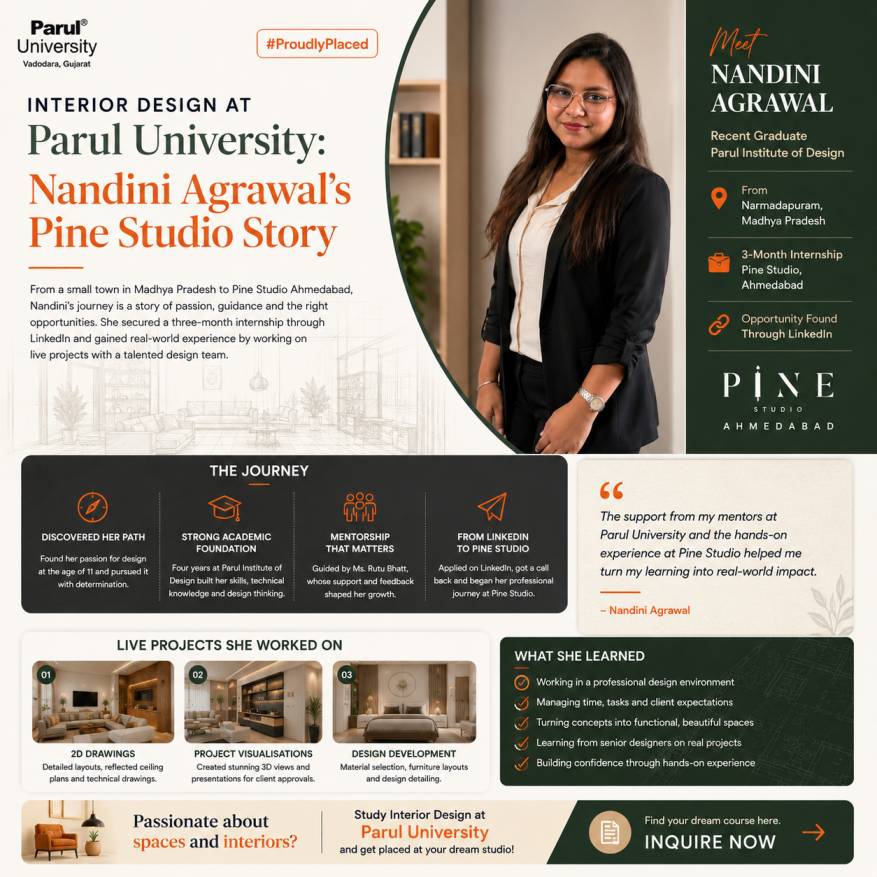
This article documents the tactical playbook for design students seeking internships at Indian firms, drawing on the documented experiences of recent Parul Institute of Design graduates including Nandini Agrawal, who secured a three-month internship at Pine Studio Ahmedabad through a LinkedIn-based search, and Jhanvi Jhagada, who secured a three-month paid internship at Studio 603 Ahmedabad through direct portfolio outreach. Together their experiences illustrate that multiple valid pathways exist; the choice of channel matters less than the consistency and preparation behind the application.
The internship as gateway in design education
Design internships sit at a specific structural position in design education. Academic programmes can develop conceptual capability, software fluency, and design thinking, but the gap between academic study and professional design practice is genuine. Internships exist to close that gap. They expose students to the operational realities that classroom instruction cannot replicate: working alongside senior designers, interacting with clients, navigating contractor coordination, understanding real material costs, and operating inside the rhythm of professional studios.
- Why internships matter more in design than in some other disciplines. Design is a discipline where output quality depends heavily on accumulated craft judgement built through repeated exposure to real projects. The gap between academic exercises and professional projects cannot be closed by reading or theoretical study alone. Only the work itself develops the judgement.
- Why internships are the moment of capability acceleration. Most design graduates report that their professional capability developed faster during internships than during any equivalent academic period. The combination of real project pressure, senior designer feedback, and exposure to firm work culture produces compressed learning that academic structure cannot match.
Build the technical foundation before applying
The most consistent pattern in successful design internship outcomes is technical preparation before application. Students who arrive at internships with software fluency and detailing capability contribute substantively from the first week. Students who arrive without these capabilities spend their early weeks catching up rather than building.
- AutoCAD as baseline. AutoCAD remains the dominant 2D drafting software in Indian interior and architectural design practice. Working capability rather than introductory familiarity is the expectation at most firms. Students should aim to build AutoCAD fluency to the point where drafting is operational rather than effortful.
- SketchUp for 3D modelling. SketchUp is the most accessible 3D modelling tool in interior design practice, widely used for design visualisation and client presentation. Students who build working SketchUp capability before internships can contribute to 3D model production from day one.
- Electrical layouts and flooring details. Beyond general drafting, specific detailing layers including electrical layouts and flooring plans are areas where junior designers are frequently entrusted with significant responsibility. Strong preparation in these areas accelerates early internship contribution.
- Adjacent tools to consider. Beyond AutoCAD and SketchUp, students should familiarise themselves with broader software ecosystems including rendering tools, presentation software, and increasingly, AI-augmented design tools that have emerged across the past two years.
Portfolio and resume preparation
The portfolio is the load-bearing artefact in design internship applications. For interior design hiring at firms, the portfolio carries more weight than the interview because it shows actual capability rather than describing it. The technical curriculum at the Parul Institute of Design emphasises portfolio development across academic years, giving graduates substantive material to assemble.
- Quality over quantity. Strong portfolios feature a smaller number of well-developed projects rather than a larger number of shallow ones. Three or four substantive projects with full development cycles communicate more capability than ten projects shown only at concept stage.
- Show working drawings, not only concept renders. Concept images alone leave hiring firms uncertain whether the student can produce the working drawings that actual construction requires. Portfolios that include 2D working drawings alongside concept visualisations demonstrate the full capability stack.
- Include thesis or capstone work. Final-year thesis or capstone projects typically represent the most integrated demonstration of accumulated learning. Including these projects in the portfolio gives firms visibility into how the student handles a substantive project end-to-end.
- Personal touch over Pinterest replication. Jhanvi Jhagada has specifically emphasised the importance of original work over Pinterest copy-paste design in junior portfolios. Firms recognise replicated reference work quickly; the personal touch is what differentiates portfolios that secure interviews from portfolios that do not.
- Resume framing. The resume should highlight specific software competencies, academic project work, any prior exposure to industry, and the standard educational and contact information. Concise resume framing alongside a strong portfolio is the typical successful structure.
Application channels: LinkedIn, direct outreach, placement cells
Design internships are accessed through multiple complementary channels. The two PID graduates documented here used different primary channels, both successfully. The choice of channel matters less than the consistency of effort behind it.
- LinkedIn as primary search channel. Nandini Agrawal used LinkedIn as her primary search channel, identifying design firms across multiple cities, understanding the work they had produced recently, and applying to a substantial number to generate multiple potential offers. LinkedIn’s advantage is breadth and informational depth about target firms.
- Direct portfolio outreach. Jhanvi Jhagada used direct portfolio outreach, identifying Studio 603 specifically, emailing her portfolio and resume directly to the firm, and receiving a callback the next day followed by a single telephonic interview that secured her selection. Direct outreach is fast when it works and requires confidence in firm selection.
- Training and Placement Cell coordination. The Training and Placement Cell at Parul University coordinates formal recruitment relationships with design firms, providing students with structured opportunities to engage with firms that have established hiring patterns. This channel is most valuable for students who want the structural backing of institutional coordination.
- Application volume strategy. Across all channels, successful design students typically apply to multiple firms simultaneously rather than betting on a single application. The breadth of applications creates room to evaluate offers on merit rather than accepting whatever offer arrives first.
Evaluating firm offers: startup vs established
When design students generate multiple offers, the evaluation question becomes operational. The most consistent pattern in PID student outcomes is preference for established firms over startups for first internship experiences, though this is not universal advice.
- The case for established firms. Established firms typically have developed internship structures, clearer mentorship pipelines, recognisable market reputation that supports downstream career signalling, and operational stability that allows interns to focus on learning rather than navigating firm dysfunction. Nandini Agrawal explicitly rejected a Vadodara startups offer in favour of Pine Studio’s established Ahmedabad presence for this reason.
- The case for startups. Startups sometimes offer broader exposure across project types, faster responsibility expansion, and direct interaction with founding-level decision-makers. For students with specific entrepreneurial direction or strong tolerance for operational unpredictability, the startup pathway can be compelling. But this is the exception rather than the default.
- Paid vs unpaid considerations. Some firms offer paid internships, others operate on stipend-only or unpaid models. For students managing financial constraints, paid internships are practically necessary. Jhanvi Jhagada’s Studio 603 internship was paid, with the firm voluntarily offering the stipend; Nandini Agrawal’s Pine Studio internship reflected the prestigious firm pattern.
- Location and logistics. Internship location affects living costs, commute time, and overall sustainability. Students should evaluate offers against their specific logistical constraints rather than treating all offers as equivalent on this dimension.
The interview pattern for design firms
Design firm internship interviews follow consistent patterns across Indian firms. Understanding the patterns reduces the anxiety that drives students to over-prepare or misjudge what the interview actually tests.
- Single round is common. Both Nandini and Jhanvi went through single-round interviews. Multi-round interviews are less common for design internships than for management or technology roles. The portfolio has already done most of the evaluation work before the interview begins.
- Telephonic format is frequent. Many design firms conduct internship interviews over phone calls rather than in-person or video meetings. Students should be prepared to present themselves effectively in audio-only formats.
- Questions focus on fundamentals. Interviews typically cover basic questions about interior design principles, the student’s existing project work, and motivation for joining the specific firm. Deep technical questioning is uncommon at the internship stage.
- Cultural and communication fit. Beyond technical content, interviews are evaluating whether the candidate will function effectively inside the firm’s working culture, communicate well with senior designers and clients, and absorb direction without friction.
Skills built through interior design internships
Beyond the specific firm work, the broader skill stack that design internships build is wider than course descriptions typically suggest. Both Nandini and Jhanvi have articulated this clearly in their reflections.
- Software fluency through daily use. Academic software training is necessarily limited. Internships are where AutoCAD and SketchUp capabilities become operationally fluent through daily use on real projects.
- Material knowledge and market awareness. Classroom learning covers material categories abstractly. Internships develop concrete knowledge of specific market materials, supplier relationships, real-world pricing, and the practical realities of material specification.
- Client communication and listening. Speaking with clients during internships develops the capability to listen carefully to client preferences, translate ambiguous requirements into design briefs, and communicate design decisions in language clients can engage with.
- Senior designer interaction. Working under senior designers develops the capability to take direction professionally, absorb feedback without defensiveness, and learn through observation as much as through instruction.
- Time management and professional discipline. Operating inside firm schedules teaches time management as immediately operational rather than as abstract discipline. Both students documented here have emphasised time management as one of the most valuable internship learnings.
- Contractor and on-site coordination. For interior design specifically, internships expose students to face-to-face interaction with construction workers and contractors, a dynamic completely absent in academic life but central to professional practice.
Also Read: Interior Design at Parul University: Nandini Agrawal’s Pine Studio Story
FAQs
How do design students at Parul University find internships?
Design students at Parul University access internships through multiple complementary channels. The Training and Placement Cell coordinates formal recruitment relationships with design firms. Students also use LinkedIn for proactive firm identification and application, as demonstrated by Nandini Agrawal who secured a Pine Studio internship through this channel. Direct portfolio outreach to specific firms is another valid pathway, as demonstrated by Jhanvi Jhagada who secured a Studio 603 internship through this approach. The choice of channel matters less than the consistency of effort and the strength of the portfolio behind applications.
What software and technical skills should design students build before applying for internships?
Design students should build operational fluency in AutoCAD for 2D drafting and SketchUp for 3D modelling before applying for internships. Both software tools remain dominant in Indian interior and architectural design practice. Beyond general drafting capability, students should develop specific competence in electrical layouts and flooring detailing, areas where junior designers are frequently entrusted with significant responsibility. Students with strong technical preparation can contribute substantively from the first week of internships rather than spending weeks catching up.
Should design students accept internships at startups or established firms?
Most PID student outcomes have favoured established firms over startups for first internships. Established firms typically offer developed internship structures, clearer mentorship pipelines, recognisable market reputation that supports downstream career signalling, and operational stability that allows interns to focus on learning. Startups sometimes offer broader project exposure and faster responsibility expansion, but this advantage is most useful for students with specific entrepreneurial direction. For most students, an established firm offers the better first internship experience, as Nandini Agrawal demonstrated by rejecting a Vadodara startup offer in favour of Pine Studio's established Ahmedabad presence.
What does the typical design internship interview look like?
Design firm internship interviews in India typically follow a consistent pattern. Single-round interviews are common rather than the multi-round structures more typical of management or technology roles. Telephonic format is frequent rather than in-person or video. Questions focus on fundamentals including basic interior design principles, the student's existing project work, and motivation for joining the specific firm. Deep technical questioning is uncommon at the internship stage because the portfolio has already done most of the evaluation work. Beyond technical content, interviews are evaluating whether the candidate will function effectively inside the firm's working culture.