Most fashion design career stories begin with childhood drawing books and teenage Pinterest boards. Paridhi Kara’s begins with a science classroom in Mandsaur and a phone call from Parul University. The four years that followed produced two industry internships, a Vadodara Fashion Week credit, and conversations with retail and design industry leaders that would have seemed implausible to the version of her who first arrived on campus.
Paridhi Kara is a recent Fashion Design and Technology graduate from the Parul Institute of Design at Parul University, Batch 2022–26. She is currently pursuing her industry exposure with two internships and has secured her first industry placement internship at DDEN as a Merchant Fashion Designer, followed by an internship at Jui Lakhani as a Fashion Design Intern.
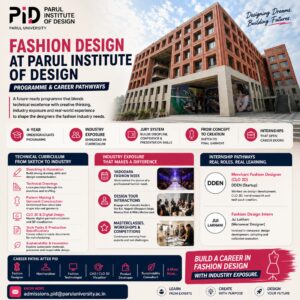
This article encapsulates her academic journey at PID, her industry experience over Vadodara Fashion Week and the Design Tour, the two industry internships which helped her level up her practical skillset, and the industry path she is carving out now. The broader Fashion Design programme at the Parul Institute of Design and the structural career pathways it supports are treated in the companion article.
Who is Paridhi Kara ?
Born and brought up in Mandsaur, Madhya Pradesh, where she completed her schooling at Saint Thomas Senior Secondary School in the science stream, Paridhi Kara is a graduate of Fashion Design from the Parul Institute of Design. The shift from science to fashion was not planned. Her understanding of fashion design came largely through films, television, and social media rather than any formal exposure to the discipline.
Her own framing of her arrival at college is honest. She looks back at the version of herself who arrived at PID as shy, introverted, most at ease in small friend circles, and not a fan of contests or onstage work. The version of herself who now sits in front of industry interviewers, works at fashion shows, and confidently presents her work is, as she says, someone she could never have predicted four years ago.
Choosing Parul University
After completing Twelfth standard, Paridhi started hunting for colleges with fashion design programmes, seeking one that would provide the right academic environment and the opportunity to move out of her hometown in pursuit of better career prospects.
A phone call from Parul University arrived during a family trip, and a friend who was independently interested in the institution suggested that they visit the campus together.
The campus visit became a turning point. The expansive infrastructure, the warmth during faculty interactions, and the overall atmosphere convinced her that this was the right place to begin her journey. She subsequently enrolled in the Fashion Design and Technology programme.
Academic foundation: the transformation
The early days at PID were challenging. Coming from a science background, Paridhi had assumed that fashion design was primarily about sketching dresses and creating attractive illustrations. The actual curriculum, however, involved technical drawings, line practice, fashion illustration, conceptual development, pattern making, and several other technical disciplines she had never encountered before. During her first semester, she experienced frequent setbacks because of her limited sketching skills, an essential component of fashion design.
Her batch consisted of around 100 students, a scale that required significant adjustment after coming from a comparatively smaller school environment.
During her first year, her attention was directed more towards making friends and exploring college life than engaging intensively with academics.
The jury system as confidence builder
Jury presentations sit at the centre of PID’s evaluation methodology. During these assessments, students explain their inspiration, research, design development, pattern making, and garment construction to faculty members and external jurors. For Paridhi, the jury process became the turning point that transformed her shyness into confidence while instilling a greater sense of discipline and structured thinking.
Her first-semester jury was the most challenging experience. The combination of natural reticence and uncertainty about her own work created an anxiety she still remembers vividly. By Semester Six, however, the experience had changed completely. Jury presentations had become her favourite part of the programme because she had developed a strong interest in menswear and the technical aspects of fashion, including jacket construction, CLO 3D, and tech pack development.
During one of her later jury evaluations, a juror remarked that she sometimes over-explained her work. Rather than taking it as criticism, Paridhi viewed it as a compliment because there had once been a time when she struggled to explain her designs at all.
Vadodara Fashion Week and the Design Tour
Two industry exposure experiences stand out across Paridhi’s four years at PID. The first was Vadodara Fashion Week, where she had the opportunity to assist the Creative Director and work directly with the professional team. The second was the institution’s Design Tour, for which she was selected after a competitive interview process and gained the opportunity to interact with leading industry professionals. Both experiences reshaped the way she understood the discipline she was studying. For more on PID’s broader industry exposure infrastructure, see the companion article on the Fashion Design programme at the Parul Institute of Design.
- Vadodara Fashion Week. Before her on-ground experience, Paridhi believed fashion shows were primarily about models walking down the runway. Working backstage alongside the Creative Director and stylist completely changed that perception. She gained first-hand exposure to aspects that audiences rarely see, including outfit selection, styling decisions, and the coordination required among multiple teams to deliver a successful fashion event. The experience taught her that fashion is as much about planning, management, and teamwork as it is about design and technical craftsmanship. It also helped her discover an unexpected strength in organising people, garments, and production workflows, a capability she had never recognised in herself before.
- The Design Tour selection. The Design Tour was not an open-access programme. Students had to apply, clear a faculty interview, and progress through a shortlisting process before being selected. When Paridhi earned her place, she felt a sense of validation that went beyond academic performance. Reflecting on the experience, she shared, “The Design Tour opened a completely new world for me, demonstrating that learning is not confined to classrooms and that one meaningful conversation with a working professional can teach more than several textbook chapters.”
Industry interactions: Nagesh, Shah, Mirchandani
Three industry interactions during the Design Tour shaped how Paridhi now thinks about her career direction.
- S. Nagesh, Chairman of Shoppers Stop: Nagesh answered every student question patiently, but what impressed Paridhi most was that he also asked the students questions. He genuinely wanted to know what Gen Z thinks about fashion and how the industry might change in the future. The reciprocal curiosity at his level of seniority taught her that even highly successful industry figures continue learning from those just entering the field.
- Monica Shah: Monica Shah is a renowned designer and Co-founder of the mindful luxury apparel brand JADE by Monica and Karishma She is an advocate of eco-friendly fashion by nurturing the lives of indigenous Indian artisans, rescuing historic textiles like Kasab zardozi and advocates sustainable livelihoods for the country’s mass of artisans. She spoke about sustainability as one of the biggest emerging areas in fashion. Paridhi has carried forward the message that sustainable design is structural rather than decorative within the industry’s near future.
- Ritika Mirchandani: The designer Ritika Mirchandani advised students not to blindly follow trends. She highlighted that trends would come and go, but a designer’s identity remains forever. This very advice encouraged Paridhi to think about creating her own design identity rather than chasing whatever was momentarily fashionable.
First internship: DDEN as Merchant Fashion Designer
Paridhi’s first industry internship was with DDEN, a startup fashion brand that was in the process of developing its website during her tenure. She joined as a Merchant Fashion Designer, where her primary responsibility was creating garment designs using CLO 3D, the digital garment simulation software that has become an integral part of contemporary fashion design practice. The designs she developed in CLO 3D were subsequently uploaded to the brand’s website.
The internship marked her first sustained exposure to the professional fashion industry and highlighted the difference between academic design projects and real-world commercial assignments. Unlike classroom exercises, industry work required her to design according to customer preferences and business requirements, testing her practical skills in a different way. Her experience at DDEN helped her develop greater flexibility, strengthen her ability to work collaboratively, and understand the importance of professionalism in a workplace environment.
Second internship: Jui Lakhani and menswear customisation
Her second internship at Jui Lakhani became one of the most valuable experiences of her academic journey. The focus on customised menswear aligned closely with the area that had emerged as her strongest interest during her Semester Six projects. At Jui Lakhani, she worked closely with customers, tailors, embroidery artisans, and master craftspeople, observing how customer requirements were transformed into finished garments through every stage of the design and production process.
- Pattern making and garment development. She gained practical exposure to pattern making and the complete garment development cycle, learning how design concepts evolve into finished garments through technical precision and skilled craftsmanship that classroom exercises can only partially replicate.
- Customer interaction. She learned that every customer approaches fashion differently. Some arrive with clear specifications, while others require guidance to define their preferences. Developing the ability to understand and communicate with clients gave her valuable insight into how successful fashion businesses operate.
- Costing, fabric, and pricing. Beyond design, she gained an understanding of production processes, fabric selection, costing structures, and pricing strategies. The experience reinforced her belief that creativity alone is not enough to build a successful fashion business; designers also need practical knowledge of operations, commercial decision-making, and customer behaviour.
- Coordination with craftspeople. Working alongside tailors, embroidery artisans, and master craftspeople helped her appreciate the collaborative nature of fashion design. She realised that translating a design from a sketch into a finished garment depends on clear communication and effective coordination with the professionals responsible for bringing the design to life.
Future direction: Paris, French, AI Digital Marketing
Paridhi is currently learning Digital Marketing with AI integration while exploring AI-powered fashion photo shoots, anticipating that artificial intelligence will become an integral part of future fashion industry workflows. Looking ahead, she has two long-term career aspirations. The first is to establish her own fashion brand specialising in menswear and resort wear. The second is to work in Paris at some stage of her career, a goal she is already preparing for by learning the French language.
Her advice to aspiring students is shaped by the lessons of her own journey. She encourages students not to rush the decision of choosing their field of study, as that choice can significantly influence their future career path. She also believes students should not rely solely on opportunities provided by their college. Instead, they should actively pursue internships and industry experiences on their own to broaden their exposure and strengthen their practical skills.
She further emphasises that long-term career growth depends on developing skills beyond one’s core discipline. According to her, communication, digital marketing, artificial intelligence, and content creation are becoming increasingly important and will play a major role in shaping future career opportunities within the fashion industry.
Also Read: How Fashion Design at Parul Institute of Design Prepares Students for Career Pathways
FAQs
Who is Paridhi Kara?
Paridhi Kara is a recent Fashion Design and Technology graduate of the Parul Institute of Design at Parul University, Batch 2022-26. She is from Mandsaur, Madhya Pradesh, and completed her schooling at Saint Thomas Senior Secondary School as a science student before Fashion Design at PID. She completed two industry internships: DDEN (Merchant Fashion Designer with CLO 3D) and Jui Lakhani (Fashion Design Intern focused on menswear customisation). Her plans include starting her own brand in menswear and resort wear and eventually working in Paris.
What internships did Paridhi Kara complete during her Fashion Design programme?
Paridhi Kara completed two industry internships during her four years at the Parul Institute of Design. The first was with DDEN, a startup brand developing its website, where she worked as a Merchant Fashion Designer creating garment designs using CLO 3D digital garment simulation software. The second was at Jui Lakhani, where she worked as a Fashion Design Intern focused on menswear customisation, working closely with customers, tailors, embroidery artisans, and master craftspeople. The Jui Lakhani internship gave her practical exposure to pattern making, garment development, costing, fabric selection, customer interaction, and coordination with craftspeople.
What was the Design Tour at Parul Institute of Design and which industry professionals did Paridhi meet?
The Design Tour at PID is a selective programme that brings shortlisted students into direct conversation with significant industry figures. Selection requires students to interview with faculty and complete a shortlisting round before being chosen for participation. During her Design Tour, Paridhi interacted with B.S. Nagesh, Chairman of Shoppers Stop, who answered student questions patiently and asked the students about their own perspectives on fashion. She also met designer Monica Shah, who spoke about sustainability as a major emerging area in fashion, and designer Ritika Mirchandani, who advised students to develop their own design identity rather than blindly following trends.
What are Paridhi Kara's future plans after graduating from Parul Institute of Design?
Paridhi Kara is currently learning Digital Marketing with AI integration and exploring AI photo shoots, anticipating that AI will become increasingly central to fashion industry workflows. She has two primary career aspirations. The first is to start her own fashion brand with a focus on menswear and resort wear, the two areas she developed the strongest interest in during her academic and internship work. The second is to work in Paris at some point in her career, and she has already begun learning French in support of that aspiration. Her broader career philosophy is that continuous learning and skill development across communication, digital marketing, AI, and content creation matter alongside core design discipline.