The assumption that a fashion designer is simply someone with an instinctive flair for sketching stylish outfits and predicting trends was once widely accepted. Today, however, the discipline has evolved far beyond that perception. Contemporary fashion design demands a deep understanding of market trends, aesthetics, technical processes, structured research, case studies, digital design software, and continuous industry exposure. The programmes at Parul Institute of Design recognise this shift and are structured to develop industry-ready professionals rather than graduates who are only academically prepared.
This article explores the Fashion Design and Technology programme at the Parul Institute of Design, covering the key structural elements of its curriculum, the industry exposure ecosystem that supports student development, the internship opportunities available throughout the programme, and the career pathways accessible to graduates.
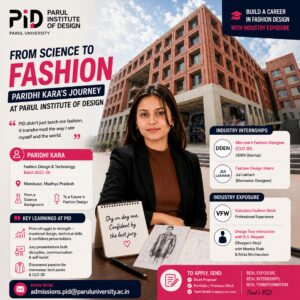
Our companion article presents the journey of Paridhi Kara, a recent graduate from PID who completed internships at DDEN and Jui Lakhani while gaining valuable industry exposure through Vadodara Fashion Week and the Design Tour.
For a broader perspective on the institutional design ecosystem at PID, you can also explore the article on interior design career pathways.
The Fashion Design programme: Positioning and Structure
The Fashion Design and Technology programme at PID is an integral part of the broader Parul Institute of Design ecosystem, alongside specializations including interior design, furniture design, and adjacent creative disciplines. The programme operates on a four-year undergraduate structure, with semesters one through six providing foundational and intermediate development, and the final two semesters dedicated to thesis work and intensive industry exposure through internships and live projects.
- Four-year structure with progressive depth: The programme is designed for progressive skill acquisition across semesters, with each year building on the technical and conceptual foundations of the previous year. Students who arrive without prior design exposure are positioned to develop capability incrementally rather than being expected to perform from the first semester at industry-ready standards.
- Technical and conceptual integration: The curriculum integrates technical disciplines including. drafting, pattern making, garment construction, software like CLO 3D, with conceptual development like design thinking, research, inspiration analysis, presentation logic. The integration is structural rather than incidental; technical and conceptual work are taught as complementary rather than separate.
- Industry exposure as an embedded element: Industry exposures are a part of the structural curriculum rather than supplementary activities. Participation in Vadodara Fashion Week, Design Tours, Masterclasses, Workshops, and Fashion Competitions are some experiential activities that are integrated in the programme, and not treated as optional.
The technical curriculum: sketching to CLO 3D
The technical skills developed across the four-year programme span the full operational range of contemporary fashion design practice. Students who arrive without prior design exposure typically develop capability across multiple technical layers by the time they graduate.
- Sketching and illustration. Foundational drawing capability is developed early. Students are not expected to arrive with strong sketching ability; the curriculum is structured to build it. Paridhi Kara has been candid that sketching was not her strength when she began; the structured development addressed this rather than treating it as a prerequisite.
- Technical drawings and line practices. Beyond illustrative sketching, the programme covers technical drawings, line practices, and the formal representational discipline that translates design ideas into specifications that production can execute.
- Pattern making and garment construction. Pattern making and the broader garment construction process are taught as integrated practical disciplines. Students develop the capability to understand how a sketched design becomes a physical garment, with the technical specifications and material decisions that the translation requires.
- CLO 3D and digital fashion design. CLO 3D, the digital garment simulation software that has become increasingly central to fashion industry practice, is integrated into the programme. Graduates leave with CLO 3D capability that is directly applicable in industry contexts, as Paridhi Kara demonstrated at DDEN.
- Tech packs and production specifications. The discipline of producing tech packs and production specifications is taught as a core capability. Tech packs translate design into manufacturable specifications, and fluency in this format is what distinguishes industry-ready graduates from purely creative ones.
- Specialisation interest development. Students typically develop specialisation interests as they progress through the programme. Paridhi developed a strong interest in menswear and technical aspects of fashion by Semester Six. The curriculum accommodates emerging specialisation focus alongside the broader foundational coverage.
The jury system as evaluation discipline
Jury presentations sit at the centre of PID’s evaluation methodology for Fashion Design. Throughout the programme, students present their work to faculty members and external jurors, explaining the inspiration, research, design development, pattern making, and garment construction behind each project. The process is intentionally rigorous, creating an evaluation environment that develops skills beyond what conventional classroom assessments can achieve.
- Early-semester jury difficulty. First-semester juries are often the most challenging. The combination of an unfamiliar presentation format, uncertainty about one’s own work, and the pressure of presenting before evaluators creates an experience that encourages students to build confidence through practice.
- Progressive capability development. As students progress through successive semesters, they develop both technical expertise and the ability to confidently explain and defend their design decisions. By the later years of the programme, jury presentations often become one of their strongest competencies rather than their greatest challenge.
- Industry-aligned skill building. The jury process closely resembles professional design reviews, where designers are expected to present and justify their work before clients, buyers, and senior professionals. This approach helps PID graduates enter internships and industry roles with strong presentation and communication skills.
- External juror exposure. Industry professionals invited as external jurors provide students with valuable feedback based on current professional practices and expectations, offering perspectives that extend beyond purely academic evaluation.
Industry exposure layers: Fashion Week, Design Tour, Masterclasses
PID’s industry exposure ecosystem operates across multiple layers, with each offering a different type of learning experience and professional development. Together, these opportunities ensure that students graduate with practical industry exposure, professional confidence, and a broader understanding of the fashion ecosystem that cannot be achieved through classroom learning alone.
- Vadodara Fashion Week. Students are given operational roles during Vadodara Fashion Week, where they assist Creative Directors, stylists, and the professional production team responsible for organising the event. This experience provides first-hand exposure to backstage operations, including styling decisions, outfit selection, model preparation, scheduling, and the coordination required across multiple teams to execute a successful fashion show.
- The Design Tour selection. The Design Tour is a selective industry exposure programme open only to shortlisted students. Selection involves faculty interviews followed by a screening process. Students who qualify gain the opportunity to interact directly with leading industry professionals, allowing them to expand their understanding of the profession while building valuable industry perspectives and networks.
- Masterclasses with industry experts. The institute regularly hosts masterclasses delivered by experienced designers, industry experts, and working professionals. These sessions extend learning beyond the classroom by covering contemporary topics such as styling, sustainability, branding, fashion business strategy, and emerging industry practices, helping students stay aligned with current professional expectations.
- Workshops with artisans and craftspeople. Students participate in specialised workshops conducted by artisans and traditional crafts practitioners, including sessions on leather craftsmanship, jewellery design, and Indian textile and craft traditions. These workshops help students appreciate the cultural heritage behind contemporary fashion while strengthening their understanding of handcrafted techniques.
- Competitions and inter-college events. The programme encourages participation in fashion competitions and inter-college design events, enabling students to benchmark their work against peers from other institutions. Such experiences promote healthy competition, expose students to diverse design approaches, and provide constructive feedback that contributes to continuous creative and professional growth.
Internship pathways into fashion firms
Fashion Design students at PID access internship opportunities through both formal placement support coordinated by the Training and Placement Cell at Parul University and through their own initiatives, including portfolio outreach, professional networking, and applications made through industry platforms.
- Multi-internship structure. Fashion Design students at PID are encouraged to complete multiple internships during their academic journey rather than relying solely on a single internship in the final semester. For example, Paridhi Kara completed two internships: one with DDEN as a Merchant Fashion Designer, where she worked extensively with CLO 3D, and another with Jui Lakhani as a Fashion Design Intern specialising in customised menswear. Completing multiple internships enables students to gain broader industry exposure and a more diverse professional skill set before graduation.
- Startup and established brand pathways. Students have opportunities to intern with both emerging startup brands and established fashion labels. Startup environments typically provide wider exposure to different aspects of business operations and require greater adaptability, while established brands offer structured learning environments focused on craftsmanship, production quality, and professional standards. Experiencing both settings helps students understand the diverse nature of the fashion industry.
- Specialisation through internship selection. Internship choices often become an important way for students to strengthen their emerging areas of interest. In Paridhi’s case, her growing passion for menswear, developed during her Semester Six projects, guided her decision to intern with Jui Lakhani, where she gained specialised experience in customised menswear. Aligning internship opportunities with individual interests allows students to build expertise while shaping their long-term career direction.
Career outcomes for Fashion Design graduates
Fashion Design graduates from PID enter a diverse industry with multiple career pathways. The wide range of opportunities reflects both the breadth of the fashion sector and the combination of creative, technical, digital, and professional skills developed throughout the four-year programme.
- Designer roles at established brands. Many graduates begin their careers with established fashion brands as Junior Designers, Assistant Designers, or Merchant Designers. These roles provide structured learning environments where responsibilities gradually expand as designers demonstrate their creativity, technical competence, and understanding of commercial requirements.
- Startup brand roles. Fashion startups and digital-first brands offer graduates opportunities that extend beyond design alone. Employees often contribute to merchandising, product development, branding, marketing, and business operations, allowing them to gain broader industry exposure while adapting to fast-paced work environments.
- Digital fashion and CLO 3D specialisation. The growing adoption of digital garment design tools such as CLO 3D has created specialised career opportunities for designers skilled in virtual garment development, digital prototyping, and product visualisation. Students who develop proficiency in these technologies graduate with skills that are directly applicable to modern fashion workflows.
- Menswear and resort wear specialisation. Niche segments such as menswear and resort wear provide focused career opportunities for graduates who develop expertise in these areas during their academic projects and internships, enabling them to build specialised professional profiles.
- Sustainability-focused practice. As sustainability becomes increasingly important across the fashion industry, graduates can pursue careers with brands that focus on ethical sourcing, sustainable materials, circular fashion, responsible manufacturing, and environmentally conscious product development.
- Independent brands and entrepreneurship. Many graduates aspire to establish their own fashion labels after gaining several years of industry experience. Professional exposure helps them build the design expertise, business understanding, industry network, and operational knowledge required to successfully launch and manage their own brands. Paridhi Kara’s ambition to build a menswear and resort wear label reflects this entrepreneurial pathway.
- International career opportunities. Some graduates pursue careers in global fashion hubs such as Paris, Milan, London, or New York. Achieving these goals typically requires a combination of strong technical skills, international exposure, cultural awareness, and language proficiency. Paridhi’s decision to learn French alongside developing her fashion expertise illustrates how students can prepare for international career aspirations.
Can students from non-design backgrounds succeed in Fashion Design at PID?
A common question among aspiring students is whether a Fashion Design programme requires a prior background in design or the arts. At PID, the answer is clear: students from non-design backgrounds are equally capable of succeeding in the programme with the right learning approach and commitment.
Paridhi Kara entered the Parul Institute of Design from a science background without any formal training in fashion or design. Her journey demonstrates how the programme’s four-year structure gradually builds industry-ready capabilities through progressive skill development, technical and conceptual learning, jury-based evaluations, and continuous industry exposure. Students from science, commerce, humanities, and other academic backgrounds can develop into confident design professionals while graduating with meaningful practical experience.
FAQs
What is the Fashion Design programme at the Parul Institute of Design?
The Fashion Design and Technology programme at the Parul Institute of Design (PID) is a four-year undergraduate programme that integrates technical curriculum (sketching, pattern making, garment construction, CLO 3D), jury-based evaluation, structured industry exposure through Vadodara Fashion Week and Design Tours, masterclasses, artisan workshops, and internship pathways into fashion firms. The programme develops industry-ready graduates rather than only academically prepared ones.
How does PID build industry exposure for Fashion Design students?
PID's industry exposure infrastructure for Fashion Design students operates across multiple layers. Vadodara Fashion Week gives students operational roles in fashion show production, assisting creative directors and stylists. The Design Tour is a selective programme bringing shortlisted students into direct conversation with industry leaders including figures like B.S. Nagesh of Shoppers Stop and designers like Monica Shah and Ritika Mirchandani. Masterclasses bring industry experts to the institute for sessions on styling, sustainability, brand strategy, and other operational dimensions. Workshops with artisans connect students to traditional crafts traditions. Fashion competitions and inter-college events test students against peers from other institutions.
Can students from non-design backgrounds succeed in Fashion Design at PID?
Yes. Students from non-design undergraduate backgrounds including science, commerce, humanities, and other disciplines enter the Fashion Design programme at PID and graduate as capable design professionals. The four-year structure is designed for progressive skill acquisition rather than assuming prior design preparation. Foundational drawing and technical skills are built across early semesters, with jury-based evaluation discipline developing presentation capability alongside technical work. Paridhi Kara's trajectory from a science background at Saint Thomas Senior Secondary School to two industry internships at DDEN and Jui Lakhani demonstrates the pathway concretely. Non-design backgrounds are not a barrier.
What career outcomes are available for Fashion Design graduates from the Parul Institute of Design?
Design graduates from PID generally find work in roles such as designer for an established fashion brand, designer and other roles for startup fashion brands, specialist designer roles concentrating on digital fashion, e.g. using CLO 3D, menswear or resort wear specialisation, sustainability conscious fashion practice for brands dedicated to ethical and circular fashion models, or independent brand and entrepreneur after years of work experience at one or more different fashion brands. You might even find international work opportunities in fashion capitals such as Paris. The range of these career trajectories is both a reflection of the range of roles the discipline fulfills, and also the diverse skills you have developed during your time as a fashion design student.