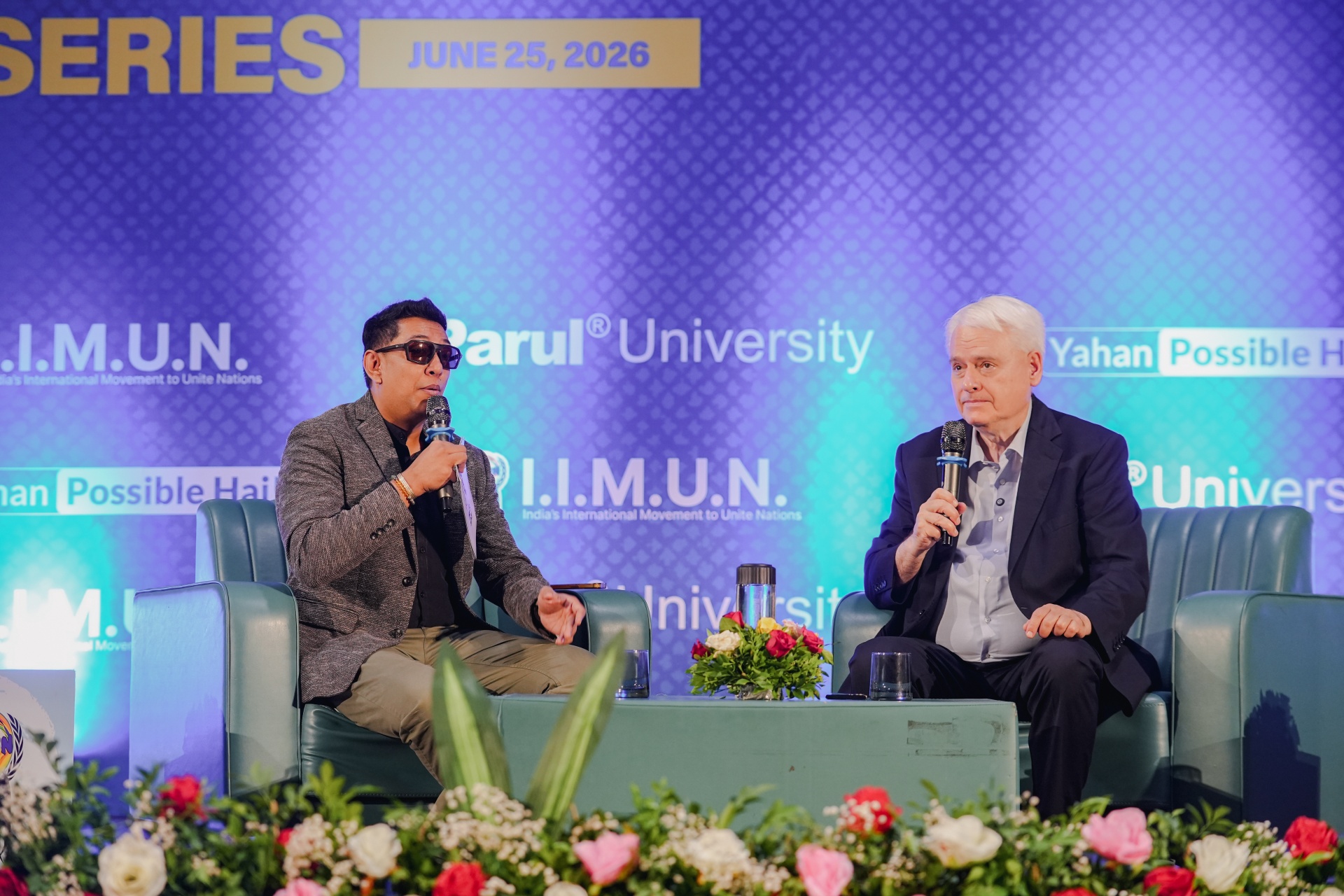
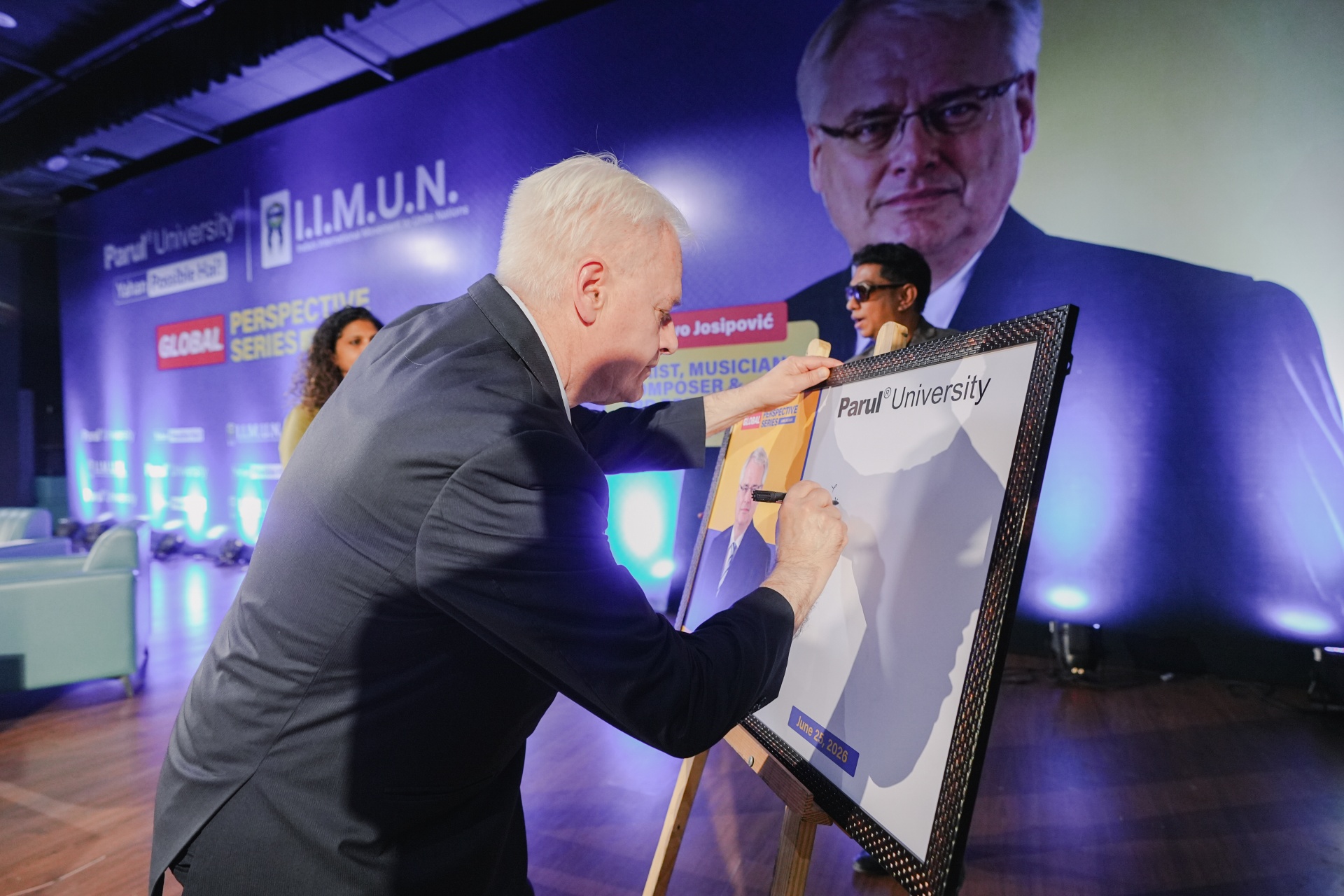
Parul University organised the Global Perspective event for students, so that they can meet the global leaders. And this time the event welcomed the former Croatian President H.E. Ivo Josipović at the Central Auditorium of Parul University, Vadodara. The event was organised in association with IIMUN. IIMUN is world’s largest youth-run nonprofit organization. The event was held on 25th June 2026He talked about his journey of becoming a president, governance, no-corruption policy, citizenship, culture and identity. The session was anchored by Vadodara’s famous RJ, RJ Kshitij, the session was not one way, it was a two way communication, something more than a lecture followed by question-and-answer. The session also observed the felicitation by VP Dr. Komal Patel.
The session sits within the international engagement infrastructure at Parul University, which spans 120+ foreign university partnerships, 6,000+ international students, and the global excellence ecosystem. The event was organised with India’s International Movement to Unite Nations (IIMUN). Josipovic’s substantive remarks on leadership, diversity, cultural diplomacy, and multilateralism are covered in the companion article on his leadership philosophy and the Celebrating Inclusion and Diversity theme . The institutional accreditation framework is at the accreditation record, with the broader institutional record at the master hub.
The Global Perspective Series
The Global Perspective Series is among Parul University’s flagship intellectual initiatives, designed to bring foremost thinkers, leaders, practitioners, and innovators to the campus for direct interaction with the student community. The series operates on the conviction that the ideas students encounter and the conversations they participate in are foundational to shaping tomorrow’s leaders, rather than incidental to their education. The Josipovic session was delivered in collaboration with India’s International Movement to Unite Nations (IIMUN), the youth-led organisation that runs Model United Nations conferences and global citizenship programmes across India and internationally.
As the series regularly invites global leaders and speakers, this collaboration connected the university’s international engagement ecosystem with IIMUN’s mission of promoting global citizenship. The university has over 120 foreign university partnerships and a community of more than 6,000 international students from over 75 countries. Through semester exchange programmes and visiting faculty exchange initiatives, international teachers and professors regularly engage with students at Parul University, strengthening campus life and cross-cultural exposure.
The session was designed to give students the opportunity to interact directly with the guest speaker, ask questions, exchange perspectives, and draw inspiration from global leadership experiences.
Profile: a jurist and composer who became a head of state
The former president is one of the leaders in the public eye who carries the intellect of a great leader. He has worked in different careers, from becoming a legal scholar to a classical composer. He pursued what he liked, the fields that were considered hobbies and not a career that one could take up. Eventually becoming a legal academic and a trained composer. His love for law and music led him to join the Faculty of Law in Zagerb as a professor of criminal procedures and international criminal law. Love for music led him to teach harmony at the Music Academy, and then he became an emeritus professor, along with supervision of doctoral candidates.
- The composer. Josipovic has worked primarily in modern classical music, writing for chamber orchestra and completing an opera inspired by the life and legacy of John Lennon that has been performed in multiple countries. He directed a significant contemporary music festival in Croatia, during which he brought the Indian sitar maestro Pandit Ravi Shankar to the country, an encounter that deepened his appreciation of Indian classical music and non-Western musical traditions.
- The parliamentarian. He served as a member of the Croatian Parliament and worked on legislative drafting from an opposition perspective, an experience he described as requiring intellectual perseverance given the structural disadvantages that opposition members face.
- The President. He was elected President of Croatia in 2010 and completed one full term until 2015, guiding major diplomatic and institutional transitions in the period following Croatian independence. His signing of the EU Accession Agreement was among the milestone events of his presidency.
- The India connection. Josipovic has previously visited India, making his visit to Parul University a continuation of an existing relationship with the country. The Parul University session marked his first visit to Gujarat.
Programme and ceremonial welcome
The day’s proceedings moved from institutional interaction to intellectual exchange to cultural hospitality. Josipovic was received by the university leadership and welcomed with a traditional ceremonial honour. A courtesy meeting in the Central Administration Board Room introduced the guest to the university’s academic programs, international collaborations, and student demographics, setting the tone for the auditorium session. The formal program in the Central Auditorium opened with the introduction of the chief guest, followed by the moderated Guest-Moderator session centred on social initiatives, public policy, and international relations, then the student Q&A and felicitation.
RJ Kshitij moderated the session. The afternoon programme included a guided campus tour and a visit to the Lakshya 2047 Centre for Future Skills, the university’s dedicated skills-development and future-readiness infrastructure. The formal session concluded with a felicitation ceremony in which Vice President Dr Komal Patel honoured Josipovic on behalf of the institution, recognising his distinguished service to public life and his intellectual contributions to law and the arts.
Croatia's journey: from Yugoslavia to independence to the European Union
Josipovic traced Croatia’s history from its founding as a constituent republic of socialist Yugoslavia, through its independence as a sovereign state, to its current membership in the European Union. He situated Croatian independence within the broader collapse of the Socialist Federal Republic of Yugoslavia, a process marked by armed conflict that destroyed infrastructure and strained the social fabric but ultimately produced national resolve to rebuild. He recounted Croatia’s recognition as a sovereign state, its admission to the United Nations and NATO, and, at greatest length, its path to the European Union.
Of the six successor states of former Yugoslavia, only Slovenia and Croatia have been admitted to the EU. Croatia’s admission in 2013 required sustained national effort across successive governments and political parties. Josipovic framed EU qualification not as a bureaucratic process but as a civilisational one that required Croatian legislation to align with European standards across wide policy ranges, changing Croatian institutions and, through them, the standards and values of Croatian citizens.
He offered a direct account of the diplomatic challenges of accession, including concerns raised by European partners, notably Germany, about corruption levels in Croatia. He engaged the concern directly and pointed to an irony: German law at the time permitted companies to treat the cost of paying bribes abroad as a legitimate business expense. The provision was subsequently repealed, but its existence illustrated for him the complexity embedded in international governance. In his own words: “during this procedure that lasted years and years, we became not only a better state, but a better society.”
Reconciliation and regional peacebuilding: the three presidential goals
The session became more interesting when the former president discussed the three presidential goals. He said that many efforts went into advancing reconciliation between Croatia and its neighbours, mainly Serbia, Bosnia and Herzegovina, post-war, which left scars on all and traumatized all. He added that when he became the president the position of relations with the neighbours was poor. This led to working on goals: making Croatia part of EU, geniune reconciliation with Serbia, Bosnia and Herzegovina and last but not the least, working on confronting corruption in practice rather than symbolically. He said that the these three goals are interlinked, as EU would not accept Croatia with corruption, and to become part of the EU Croatia need to abide by the standards of the EU. The peaceful collaboration efforts with neighbors was not easy, as it was not happily welcomed by people of Croatia, where one portion viewed at as goodwill toward Serbia as capitulation. He mentioned about the pro-European Serbian President at the time, Boris Tadic as a real partner in the process of reconciliation and acknowledged Tadic’s courage in reaching out to the Serbian people through impactful speech and campaigns in politically hostile space. His lesson for students: leaders with both courage and commitment can take measured steps toward peace in the most difficult conflicts.
Corruption as a challenge to the integrity of public life
Josipovic addressed corruption as a visceral challenge to the integrity of public life rather than an abstract policy issue. He was frank about corruption’s pervasiveness in post-war Croatia and the seriousness with which his administration attempted to address it. His metaphor was direct: “Corruption is a cancer. When you compare it in medicine, it is like an illness that is eating inside.”
He framed corruption as an existential issue beyond a purely legal one: it corrodes the integrity of government institutions, erodes public confidence, and undermines the capacity of governments to serve their citizens. He argued that fighting corruption requires not only legal frameworks but cultural change, with societies becoming genuinely sensitive to corruption as a moral failing rather than merely a risk to be managed. Croatia, he suggested, has made progress, though the work remains incomplete. His detailed reflections on leadership, values, diversity, and multilateralism are covered in the companion article.
Why the session matters for Parul University students
The Global Prespective series hold importance as it allows students to interact with the guests directly and get inspired from them to pursue what they like. The former Croatian President who is a jurist, classical music composer, professor and a former president, discussed with students that you must pursue what you like the most. The session covered the topics such as leadership, governance, and international relations that univrsity does carry too in their programs. Programs such as law,and management have these areas covered.
Parul University in The Times Higher Education Sustainability Impact Ratings 2026 ranks in the top 20 list in India for SDG 17 partnership for the golas. Parul University also holds 7th in India and joint 46th worldwide for SDG 4 (Quality Education) with Quality Education score 81.1.
FAQs
Who is the former Croatian president who visited Parul University?
The 3rd President of Croatia H.E. Josipović, visited Parul University for the Global Perspective Series. The event was organized in association with IIMUN. He served the country from 2010 to 2015. He is a jurist and a recognised classical composer, through which he also served as a criminal procedure professor at the Faculty of Law in Zagreb. He worked as a teacher of harmony at the Music Academy. He was invited as a guest speaker on 25 June 2026. He addressed students and talked about leadership, cultural exchange, governance, and policy-making. The event was followed by Q&A with students and felicitation by Vice President Dr. Komal Patel.
What is the Global Perspective Series at Parul University?
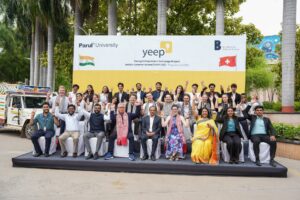
Parul University believes in true leadership learning. With this principle, the university organised a flagship intellectual initiative for students where thinkers, global leaders, practitioners, and innovators are invited to an event named Global Perspective Series. It is a series in association with IIMUN where students can directly interact with the guests. Leaders like H.E. Ivo Josipović are invited to the event; he visited the university on 25 June 2026, where he talked about leadership, hobbies, governance, and much more. The series highlights the university's international infrastructure, which includes 120+ foreign university partnerships, 6000+ international students coming to the university from 75+ countries, and global programs that includes the semester exchange, visiting professor programs, and YEEP (Young Entrepreneur Exchange Project) with the partner university Bern University of Applied Sciences, Switzerland. Apart from this the university also hold the 17th rank in SDG (Sustainable Development Goal) in the Times Higher Education Sustainability Impact Ratings 2026.
What did the Croatian president discuss about the path to the EU?
EU accession is a civilisational process, the former Croatian President said. He feels that it doesn't seem to be a bureaucratic initiative. He added that out of the six states of Yugoslavia, Slovenia and Croatia are part of the EU with Croatia becoming part of it in 2013, as it required sustained national works through the ruling government and political parties. He mentioned that to become a part of the European Union, Croatian legislation is required to follow European standards and policies. He offered a candid account of the diplomatic challenges, including concerns raised by Germany about corruption levels, and noted the irony that German law at the time permitted companies to treat foreign bribery payments as a legitimate business expense before the provision was repealed. His signing of the EU Accession Agreement was among the milestone events of his 2010 to 2015 presidency. He summarised the process by saying that across the years-long procedure, Croatia became not only a better state but a better society.
What happened during Josipovic's visit to Parul University campus?
The programme moved from institutional interaction to intellectual exchange to cultural hospitality. Josipovic was received by the university leadership with a traditional ceremonial honour, followed by a courtesy meeting in the Central Administration Board Room where he was briefed on the university's academic programmes, international collaborations, and student demographics. The formal session in the Central Auditorium, moderated by RJ Kshitij, opened with the introduction of the chief guest, followed by the moderated Guest-Moderator dialogue on social initiatives, public policy, and international relations, then a student Q&A. The session concluded with a felicitation ceremony in which Vice President Dr Komal Patel honoured Josipovic on behalf of the institution. The afternoon programme included a guided campus tour and a visit to the Lakshya 2047 Centre for Future Skills, the university's dedicated skills-development and future-readiness infrastructure.