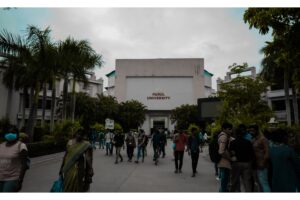
The on-campus accommodation facilities of Parul University host over 27,000 students in its 250-acre campus spread over Vadodara. The women’s hostels have wardens, mess facilities, and security measures in place to provide a safe and well-ordered residential environment. Parul University’s efforts to create an inclusive campus identity are recognized in the 2026 Times Higher Education Sustainability Impact Ratings, where the institution was ranked 7th in India and joint 60th worldwide in SDG 5 Gender Equality. The university’s score is based on methodology-weighted indicators that track the impact of its teaching, research, and outreach activities on gender equality.
Residential and campus infrastructure is documented on the Living at PU page. The Women Startup Programme operates through PIERC (Parul Innovation and Entrepreneurship Research Centre). The institutional accreditation framework supporting the gender-equality position is covered in the accreditation record, while scholarship pathways, including the ACPC route and central government schemes for female students, are documented in the scholarship pathways.
Hostel residences and the female warden system
Female hostels at Parul University operate as separate residential buildings with their own infrastructure. A female warden lives within the building to provide both the formal supervisory presence and an instant resource that female students can approach for issues ranging from medical concerns to social difficulties. The female warden is the immediate point of contact for after-hours questions, emergencies, and pastoral care concerns that do not require escalation to medical or counselling services.
- Capacity and structure: The female hostels are part of Parul University’s on-campus accommodation for over 27,000 students, with separate residential buildings for male and female students. At the hostels, rooms are available in twin-sharing and triple-sharing. Rooms are allocated based on the student’s programme, year of study, and preferences, subject to availability.
- Hostel mess and dining: Female hostels have separate mess facilities, with a menu that includes both Gujarati and PAN-Indian food. The campus provides vegetarian-only mess facilities within the hostels. For students with different dietary preferences, additional food courts and canteens are available at various locations across the campus.
- Visitor and entry-exit protocols: Gate-pass entry and exit recording operates across hostel buildings, with timing protocols documented for student movement. Parent visits operate through documented visitor protocols, with female-only visitor blocks for student interactions during designated visiting hours.
- Internet and connectivity: 40 GBPS WiFi coverage extends through the hostel buildings, supporting both academic work and the off-campus video communication that students depend on for regular contact with their families.
Security infrastructure: CCTV, gate-pass, and Internal Complaints Committee
The 250-acre campus is continuously under CCTV surveillance for 24 hours, 7 days a week. The CCTV infrastructure is established separately with camera networks for hostel buildings, academic blocks, common areas, and entry-exit points. CCTV systems are centrally monitored, and recorded footage is retained according to established data retention policies. This helps the university respond to incidents in real time as they happen and also review footage later for investigation when needed. Gate-pass systems record all entry and exit movements at campus boundaries, with student movements logged through identification card systems.
At Parul University, we follow the UGC Regulations on Curbing the Menace of Ragging in Higher Educational Institutions and provide students with clearly defined procedures for reporting and addressing ragging-related concerns. These practices also support our commitment towards institutional values and best practices, as reflected under NAAC A++ Criterion 7.
At the university campus, we also have an Internal Complaints Committee (ICC), which is constituted under the Sexual Harassment of Women at Workplace (Prevention, Prohibition and Redressal) Act, 2013. The ICC serves as the formal body for handling complaints related to harassment issues through established investigation procedures and defined timelines.
- Emergency response infrastructure: For any medical emergency or healthcare need, students can access 24×7 care at the on-campus Parul Sevashram Hospital. Located within the university’s 250-acre campus, it is a NABH-accredited super-speciality hospital. With more than 750 beds and over 1,100 outpatient visits every day, it provides comprehensive healthcare services beyond routine campus medical support. The on-campus location of Parul Sevashram Hospital ensures that students can receive emergency medical care within minutes, without needing to travel to an off-campus hospital.
- Anti-ragging committee structure: Anti-ragging committees operate at both institutional and departmental levels with documented reporting mechanisms. Student-facing materials, including grievance redressal procedures, are circulated during orientation and maintained on institutional notice boards.
- Internal Complaints Committee composition: ICC composition follows the SHWWA Act 2013 with a senior woman employee as Presiding Officer, members from among employees, and external members from organisations committed to women’s rights or familiar with workplace harassment law.
Counselling support for psychological wellbeing
At Parul University, we have on-campus Student Counselling Services to support psychological wellbeing, including academic stress, social adjustment challenges, and other mental health concerns. The counselling is highly confidential, and students’ details are maintained with the utmost secrecy.
The counselling process is separate from disciplinary procedures. It enables students to seek help in a supportive environment without worrying about academic or disciplinary consequences. Students can communicate with trained counselling professionals in confidence because all sessions are conducted under strict confidentiality protocols. Moreover, a safe and trusted space is provided for discussing personal concerns.
The counselling pathway operates alongside the broader Parul Sevashram Hospital infrastructure, where clinical mental health consultations are available when required. Female students can access counselling resources through the female wardens in their hostel residences or by directly taking an appointment with the counselling team. The counselling pathway is available for support related to routine counselling, academic pressure, homesickness, social adjustment, and the broader transition to university life that many first-year students experience.
Women Startup Programme through PIERC
The Women Startup Programme operates through PIERC (Parul Innovation and Entrepreneurship Research Centre) as a dedicated entrepreneurship pathway for female students. India is the world’s third-largest startup ecosystem. Of 2.12 lakh DPIIT-recognised startups, 1.02 lakh (48 percent) have at least one woman director or partner. The Startup India Seed Fund has allocated approximately Rs 294 crore to women-led ventures, with Gujarat among the most active states in this expansion.
Through PIERC, at Parul University we run the Women Startup Meet as a recurring engagement that has reached its sixth edition. The programme connects female students to incubation infrastructure, government funding pathways through the Student Startup and Innovation Policy (SSIP), DPIIT recognition, the Startup India Seed Fund, and the broader iHub network. We are proud to state that more than 37 women-founded ventures have been supported through PIERC.
- Three-day bootcamp at Founders Studio: Women Startup Meet 6.0 included a three-day startup bootcamp organised exclusively for female students at the Founders Studio in the BBA Building. The bootcamp covered ideation methodology, customer validation, pitch construction, and the government grant application pathways that female founders specifically need to navigate.
- Idea pitching engagement: More than 60 female students participated in the idea pitching engagement, with shortlisted teams progressing to mentorship rounds with PIERC’s incubation managers, including Hutesh Baviskar (Incubation Manager) and Sonal Sudani (Incubation Manager, Grants).
- Government grant pathways: Female founders are supported through application pathways for SSIP grants from the Government of Gujarat, DPIIT recognition for startup status, the Startup India Seed Fund, and the iHub Gujarat network. The Pragati Scholarship Scheme for Girl Students administered through AICTE is accessible alongside Parul University’s institutional scholarships.
- Case studies anchoring the curriculum: The curriculum of the Women Startup Programme documents case study references of brands founded by women, including Ghazal Alagh’s Mamaearth and the journey of Honasa Consumer to IPO, as well as Falguni Nayar’s Nykaa and her transition from investment banking to consumer technology. The Vikshit Bharat 2047 vision frames the broader policy context with which the programme aligns.
Female faculty currently serving
Two of the seven Stanford-Elsevier Top 2 Percent Scientists at Parul University are female faculty members. One of them, Dr. Deep Pooja, is an Associate Professor in the Faculty of Pharmacy with an h-index of 37 and an i10-index of 73. Her research focuses on pharmacology, pharmacy, polymers, and drug delivery systems. Based on the Stanford-Elsevier global scientist rankings, which measure research impact using citation data from the Scopus database, Dr. Deep Pooja is recognised among the world’s top 2% scientists.
Dr. Juhi Saxena serves as an Assistant Professor in the Department of Biotechnology, Faculty of Engineering and Technology, with an h-index of 18 and an i10-index of 29. Her research spans General Clinical Medicine and Biotechnology. Beyond the Stanford-Elsevier-ranked faculty, female professors and assistant professors contribute across the Faculty of Pharmacy, Faculty of Engineering and Technology, Faculty of Management Studies, Faculty of Architecture, Faculty of Performing Arts, Faculty of Applied Sciences, Faculty of Medicine, Faculty of Homoeopathy, Faculty of Ayurved, and other faculties.
Named placement and academic outcomes for female students
The 2026 placement season included named female student outcomes across MBA, B.Tech, and other programmes. Each placement is publicly verifiable through the student’s LinkedIn profile and the company hiring records.
- Varnita Agarwal: A student of the MBA Marketing programme, she ranked 7th among 2,000 MBA students in her first semester. She was selected as one of 31 Mavericks after a rigorous 30-day evaluation process. She declined an offer from Berger Paints to secure a placement at KPMG with a package of ₹4.50 LPA. Her two-year journey towards securing a role at a Big Four firm is documented in her LinkedIn profile.
- Kairavi Jhaveri: She secured a placement package of ₹27.86 LPA during the 2026 placement season. Her placement marks one of the highest packages received by a female student in the graduating cohort. Her achievement is documented through the university’s placement records and her LinkedIn profile.
- Susmitha Tavva: During the 2026 placement season, she received four job offers. She was one of the 459 students to secure multiple placement offers, with the Placement Cell providing structured guidance to help her make an informed career decision.
Female speakers and visiting figures who have engaged the campus
Parul University has welcomed several accomplished women from diverse fields through PU Talks, educational tours, and convocations. These include former Indian cricketer Mithali Raj; Olympic badminton medallist Saina Nehwal; Paralympic medallist Deepa Malik; YouTuber and actress Prajakta Koli; spiritual leader and author Sadhvi Bhagawati Saraswati; former Indian Air Force Wing Commander Sonika Tanwar; Smt. Babitha Rayudu, Executive Director at SEBI; Padma Bhushan and Padma Vibhushan awardee, classical dancer and guru Sonal Mansingh; spiritual leader and mentor BK Shivani Ji; former President of Mauritius H.E. Ameenah Gurib-Fakim; and Shirin Ebadi, Nobel Peace Prize laureate.
The engagement of public figures across professional and creative domains supports the overall institutional position on gender representation in leadership roles, with the speakers reaching the student body directly through campus engagements rather than through video relay.
THE Sustainability Impact Ratings 2026 Top 30 India for SDG 5 (Gender Equality)
Times Higher Education Sustainability Impact Ratings 2026 places Parul University 7th in India and joint 60th worldwide for SDG 5 (Gender Equality). The ranking methodology weights institutional contribution to gender equality through research output, stewardship of gender-equal practices, outreach to communities and stakeholders, and teaching content covering gender equality.
The full methodology and Parul University’s specific position are accessible at The Sustainability Impact Ratings Portal. The ranking is calculated by Times Higher Education rather than self-reported by the institution, with submitted data audited through THE’s verification process.
FAQs
Is Parul University safe for female students?
Parul University operates female hostels as separate residential infrastructure with a female warden in residence, providing both the formal supervisory presence and the practical resource female students can approach for issues from medical concerns to social difficulties. Parul University has a comprehensive safety and support infrastructure across its 250-acre campus. The campus is monitored through 24×7 CCTV surveillance, including hostel buildings, while a gate-pass system records all entry and exit movements. The university also follows UGC anti-ragging regulations, with documented mechanisms for reporting and addressing ragging-related concerns. In addition, the Internal Complaints Committee (ICC) operates under the Sexual Harassment of Women at Workplace (Prevention, Prohibition and Redressal) Act, 2013, providing a formal framework for handling harassment-related complaints. For medical emergencies, students have access to the 24×7 NABH-accredited Parul Sevashram Hospital, located within the campus. With more than 750 beds, the hospital enables emergency medical care to be reached within minutes from anywhere on the 250-acre campus. The university's commitment to creating an inclusive and equitable environment is also reflected in the Times Higher Education Sustainability Impact Ratings 2026, which ranked Parul University 7th in India and joint 60th globally for SDG 5 (Gender Equality). The ranking is based on methodology-weighted indicators that assess the university's contributions to gender equality through research, outreach, and teaching.
Does Parul University have a female warden in the hostel?
Female hostels at Parul University have a female warden who resides within the hostel building. The warden is the first point of contact for after-hours queries, medical referrals, and pastoral concerns that do not require escalation through formal disciplinary or medical channels. The female warden also oversees the day-to-day functioning of the hostel, including mess coordination, room allocation queries, visitor protocols during designated hours, and other routine support students may need during their residential stay. However, counselling support for psychological wellbeing is managed separately from the warden's role and can be accessed through direct appointments with the university's counselling team.
Is there a separate mess for female students at Parul University?
Female hostels at Parul University operate with separate mess facilities. The hostel mess is vegetarian-only with menu planning covering both Gujarati and pan-Indian options. Beyond the hostel mess, the broader campus operates multiple food courts and canteens that female students access across daily life, with the on-campus food infrastructure supporting students with dietary preferences outside the hostel mess. The separate mess arrangement operates as part of the broader infrastructure that supports female students' residential experience including the female warden, CCTV-monitored security, and gate-pass entry-exit protocols.
What support is available for female students with mental health or psychological concerns at Parul University?
Parul University operates a confidential counselling support pathway for psychological wellbeing concerns. The counselling resource is separated from disciplinary processes, which means engagement with counselling does not carry academic or disciplinary consequences. Trained counselling professionals are accessible through direct appointment with the counselling team, with the female warden in hostel residences serving as the immediate point of contact for students who want to access counselling. The Parul Sevashram Hospital on campus provides clinical mental health consultations when required. The counselling pathway supports routine concerns including academic pressure, homesickness, social adjustment to university life, and the broader transition concerns that affect first-year students.
How does the Women Startup Programme at Parul University work?
The Women Startup Programme operates through PIERC (Parul Innovation and Entrepreneurship Research Centre) as a dedicated entrepreneurship pathway for female students. The programme has reached its sixth edition with the Women Startup Meet 6.0, including a three-day startup bootcamp organised exclusively for female students at the Founders Studio in the BBA Building. 60+ female students participated in idea pitching, with shortlisted teams progressing to mentorship rounds with PIERC's incubation managers. 37 women-founded ventures have been supported through PIERC. Female founders access application pathways for SSIP grants from the Government of Gujarat, DPIIT recognition for startup status, the Startup India Seed Fund, and the iHub Gujarat network. The Pragati Scholarship Scheme for Girl Students administered through AICTE operates alongside Parul University's institutional scholarships. Programme case studies reference Mamaearth (Honasa Consumer) and Nykaa, framed within the Vikshit Bharat 2047 vision.