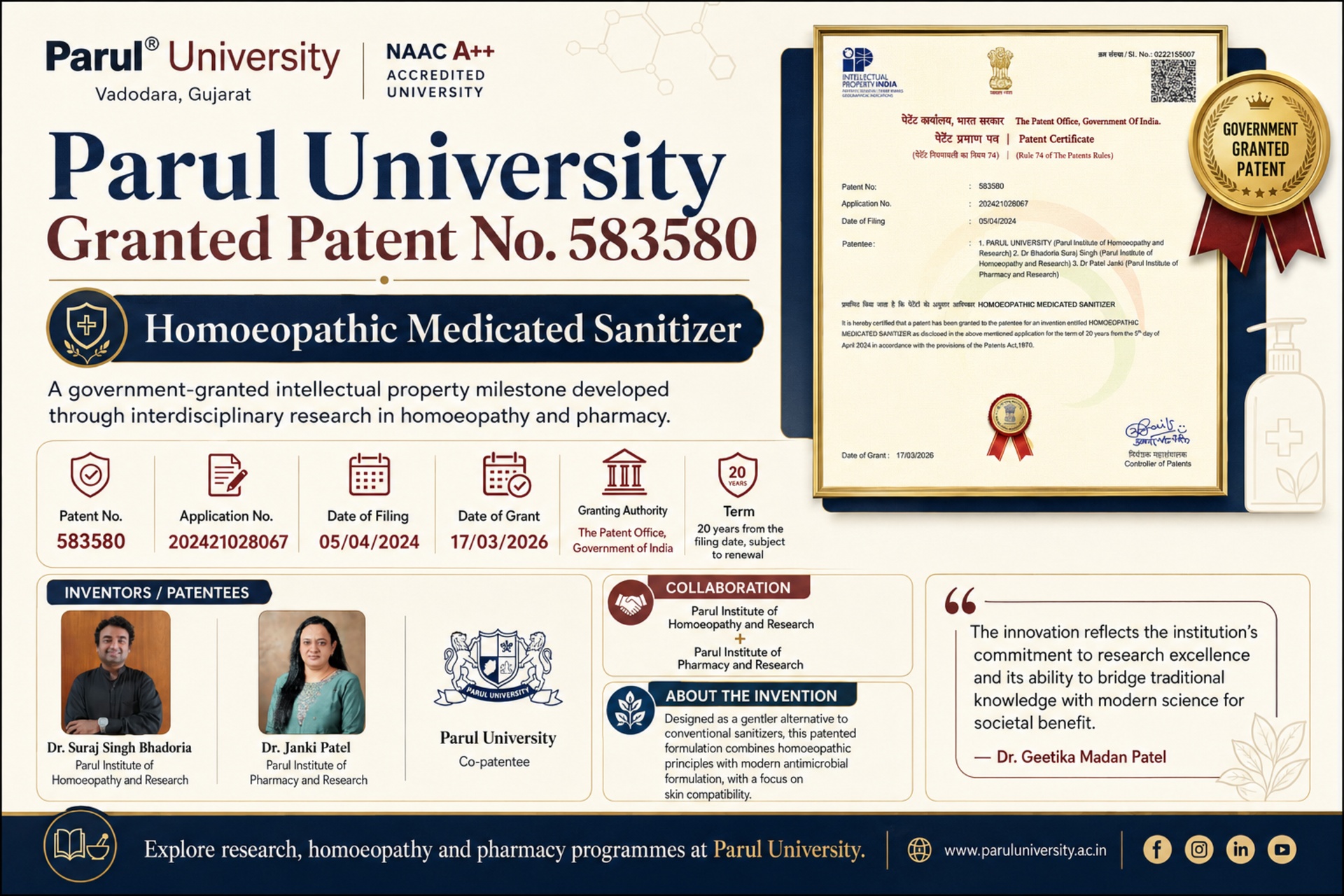
Parul University has successfully secured a patent for the Homoeopathic Medicated Sanitiser, developed by two faculty researchers. It was developed by Dr. Suraj Singh Bhadoria & Dr. Janki Patel. The patent number 583580 was filed on 5th April 2024 and granted on 17th March 2026. It is co-owned by Parul University and these two faculty members.
This progressive innovation is a testament to research-driven development, intended as an alternative to alcohol-based and chemical sanitisers, which may cause skin dryness or irritation with repeated use. The newly developed formulation combines homoeopathic principles with next-generation antimicrobial technology and was developed across the research institutes of Parul University.
The Patent at a Glance
The following details are drawn directly from the patent certificate and the Patent Office record.
- Invention: Homoeopathic Medicated Sanitiser.
- Patent number:
- Application number:
- Date of filing: 5 April 2024.
- Date of grant: 17 March 2026, recorded in the Register of Patents on the same date.
- Term: twenty years from 5 April 2024, subject to renewal under the Patents Act, 1970.
- Patentees: Parul University (Parul Institute of Homoeopathy and Research), Dr. Suraj Singh Bhadoria (Parul Institute of Homoeopathy and Research), and Dr. Janki Patel (Parul Institute of Pharmacy and Research).
- Granting authority: the Patent Office, Government of India, with the patent granted by the Controller of Patents.
“Patent No. 583580, granted 17 March 2026: a verifiable record, not a claim.”
What the Homoeopathic Medicated Sanitiser Is Designed to Do
The invention responds to a well-recognised problem. As sanitiser use rose sharply during recent public health crises, so did the side effects of frequent use: dryness, irritation, allergies, and weakening of the skin’s natural protective barrier. Conventional alcohol-based and chemical sanitisers are effective against microbes, but can be harsh on skin when used many times a day.
The aim of the invention, as described by the research team, is to maintain antibacterial effectiveness while being gentle on the skin. The formulation uses specially prepared homoeopathic ingredients selected for antimicrobial action, in a composition intended to remain compatible with skin during repeated daily use at home, in schools, hospitals, workplaces and public spaces.
According to the research team, laboratory studies conducted during development indicated antibacterial activity alongside biocompatibility. These are the institutes’ own reported findings from their development work rather than an independent clinical determination, and they describe the basis on which the invention was taken forward.
The Research Behind the Invention
The invention is the outcome of interdisciplinary work across two of Parul University’s research institutes, Dr. Suraj Singh Bhadoria of the Parul Institute of Homoeopathy and Research and Dr. Janki Patel of the Parul Institute of Pharmacy and Research, each profiled below. The collaboration is the substance of the achievement.
Working together, the researchers identified suitable homoeopathic ingredients and, by their account, validated them through laboratory testing for antimicrobial properties, skin suitability and safety. The pairing of a homoeopathy institute with a pharmacy institute is the point of interest: it is what allowed a traditional-medicine approach to be developed and tested within a modern pharmaceutical-science framework.
The inventors describe an approach in which homoeopathic ingredients are prepared through ultra-high dilution, a technique they associate with effects at very small scales. This is presented here as the inventors’ stated method rather than as an established mechanism, since the science of ultra-high dilution remains debated in the wider research community. What the patent records is that the resulting composition was found, on examination, to be novel, inventive and industrially applicable.
The grant itself followed the standard examination process rather than a formality. The application was filed in April 2024, examined under the Patents Act, subjected to a hearing in February 2026, and granted the following month, with a single claim on record. That procedural trail is part of what makes the achievement verifiable: it is documented at each step in the Patent Office record, not asserted by the University alone.
The Inventors: Dr. Suraj Singh Bhadoria and Dr. Janki Patel
Patent No. 583580 is co-owned by Parul University with the two faculty members who invented the formulation, one from each of the collaborating institutes. Both are named as co-inventors and co-owners on the grant.
Dr. Suraj Singh Bhadoria, Parul Institute of Homoeopathy and Research
Dr. Suraj Singh Bhadoria is a researcher at the Parul Institute of Homoeopathy and Research, the institute within Parul University devoted to homoeopathic medicine and its scientific study. On this invention, he brought the homoeopathic formulation expertise: the selection and preparation of the homoeopathic ingredients around which the sanitiser is built. He is named as a co-inventor and co-owner on Patent No. 583580.
Dr. Janki Patel, Parul Institute of Pharmacy and Research
Meet Dr. Janki Patel, a proud researcher at the Parul Institute of Pharmacy & Research. Through this achievement, she contributed to the pharmaceutical and formulation science that transformed the homoeopathic ingredients into a sanitiser composition, followed by laboratory testing. She is a co-inventor and co-owner of Patent No. 583580.
The collaboration between a homoeopathy expert and a pharmacy specialist reflects the substance of the invention: a combination of traditional medicine concepts with a modern pharmaceutical approach. This synergy led to the patent being jointly held by two research institutes of Parul University.
What a Granted Patent Does, and Does Not, Mean
Because health products attract strong claims, it is worth being precise about what this grant establishes. A patent is an intellectual-property right, not a health approval, and the distinction matters.
A patent granted under the Patents Act, 1970, by the Patent Office, Government of India, certifies three things about an invention: that it is novel, that it involves an inventive step, and that it is capable of industrial application. The application here was examined under sections 12 and 13 of the Act, a hearing was held in February 2026, and the patent was then granted and entered in the Register of Patents.
A patent does not, however, certify that a product is clinically effective, that it is safe for medical use, or that it may be sold. Those are separate determinations under separate regulatory regimes. As the patent documentation itself notes, large-scale manufacture and commercialisation of the invention would require conformance with all applicable regulations. The right conferred is protection of the invention for twenty years from the filing date, subject to timely renewal, and nothing more than that.
Stated plainly: Parul University now holds a verifiable, government-granted right over a novel invention. Whether and how that invention reaches the market is a later question, governed by other rules.
A patent certifies novelty, inventive step and industrial applicability. It is not a licence to sell, nor a proof of cure.
Why This Parul University Patent Matters
This exclusive grant is a meaningful marker of research capability. It shows that Parul University can carry an idea through the full arc of translational research, from a laboratory concept to a formally examined and granted piece of intellectual property, across disciplinary boundaries.
It also fits a broader pattern. The University reports a substantial research programme spanning many funded projects and dedicated research centres, described in its guide to research at Parul University, and a Faculty of Pharmacy with several highly cited researchers, examined in the guide to pharmacy at Parul University. A granted patent co-owned with faculty from two institutes is a concrete instance of that research capacity producing protected intellectual property.
There is a national dimension too. The invention sits within the AYUSH sector, India’s framework for traditional systems of medicine including homoeopathy, and aligns with policy encouragement for indigenous, locally developed healthcare technologies. The research team frames the work as contributing to that wider effort.
Speaking on the achievement, Vice President Dr. Geetika Madan Patel placed it in that frame.
“The innovation reflects the institution’s commitment to research excellence and its ability to bridge traditional knowledge with modern science for societal benefit.” – Dr. Geetika Madan Patel, Vice President, Parul University
Where the Invention Could Be Used, and What Comes Next
The research team describes the formulation as suited to settings where sanitiser is used repeatedly throughout the day, and where skin tolerance therefore matters. Those settings are ordinary and numerous.
- Everyday settings: Homes, schools, hospitals, workplaces and public spaces, where frequent hand hygiene is now routine.
- Frequent users: Healthcare and sanitation staff, and others who sanitise many times a day and are most exposed to the drying effects of conventional products.
As for what follows a patent, the research team frames several possible directions, each of which sits ahead rather than behind the current grant. Future work, by their account, could extend the antimicrobial range of the formulation, test it in larger studies, and develop related hygiene products on the same principles. The patent also creates a basis on which industry partnerships and commercialisation could be explored.
It is worth restating the honest position on all of this. These are stated aims and possibilities, not accomplished results. What has been achieved and verified is the patent itself, a government-granted right over a novel invention. The steps from a granted patent to a tested, approved, marketed product are real and separate, and they lie in the future.
FAQs
What patent has Parul University been granted?
Parul University has been granted Indian Patent No. 583580 for an invention titled Homoeopathic Medicated Sanitiser. The application, number 202421028067, was filed on 5 April 2024, and the patent was granted by the Patent Office, Government of India, on 17 March 2026, for a term of twenty years from the filing date.
Who invented the Homoeopathic Medicated Sanitiser?
The invention was developed by Dr. Suraj Singh Bhadoria of the Parul Institute of Homoeopathy and Research and Dr. Janki Patel of the Parul Institute of Pharmacy and Research. The patent is co-owned by Parul University together with the two inventors, reflecting interdisciplinary work across the University's homoeopathy and pharmacy institutes.
What is a Homoeopathic Medicated Sanitiser?
It is a sanitiser formulation, developed at Parul University, that uses specially prepared homoeopathic ingredients and is designed to be antibacterial while remaining gentle on the skin. Its stated aim is to reduce the dryness and irritation associated with frequent use of conventional alcohol-based and chemical sanitisers, according to the research team's development studies.
Does a patent mean the sanitiser is proven safe and available to buy?
No. A granted patent certifies that an invention is novel, involves an inventive step, and is capable of industrial application. It does not certify clinical efficacy or safety, and it is not a marketing approval. As the patent documentation notes, large-scale manufacture and commercialisation would require conformance with all applicable regulations, which are separate from the patent grant.
When was the patent granted and how long does it last?
The patent was granted and recorded in the Register of Patents on 17 March 2026. It runs for twenty years from the filing date of 5 April 2024, subject to payment of renewal fees under the Patents Act, 1970.
What does this patent say about research at Parul University?
It demonstrates that Parul University can take an idea through translational research to a formally examined, government-granted patent, across two research institutes. It is one instance within a wider research programme of funded projects, dedicated research centres, and a Faculty of Pharmacy with several highly cited researchers.


