India’s pharmaceutical retail market recorded volume growth of more than 3% in June 2026, marking the first time in two years it has exceeded this level. (TOI) This demand is one reason why pharmaceutical laboratories need trained people who can support research, quality testing and product improvement.
For an M.Pharma student, entering a research laboratory can feel very different from attending a normal classroom. There are instruments, chemicals, samples, safety rules and detailed records everywhere. Every activity has a fixed method, and even a small mistake can affect the result.
What Does a Normal Day in a Research Laboratory Look Like?
A laboratory day often begins before the actual experiment. Students may review the method, check the required materials and prepare the work area. They also confirm whether instruments are available and properly calibrated.
The first task can be as simple as weighing a drug or preparing a solution. However, accuracy matters. A small change in concentration, temperature or mixing time can change the final result.
Students may spend one part of the day preparing samples and another part waiting for an experiment to finish. During this time, they may read research papers, enter observations or plan the next trial.
How Do Students Prepare an Experiment?
An experiment should begin with a question, not only with a procedure. Students must know what they are trying to measure and why that information matters.
Before beginning, they may need to:
- Read earlier studies related to the topic
- Decide the materials, quantities and test conditions
- Prepare a step-by-step experimental method
- Check safety instructions for chemicals and equipment
- Arrange labels, notebooks and sample containers
- Discuss the method with a research guide
Students must also prepare controls or comparison samples where needed. Without a proper comparison, it may be difficult to know whether the new formulation or process created any real improvement.
Get Compelete Details From Expert
Request a CallWhich Instruments May M.Pharma Students Encounter?
The instruments used depend on the research area. Students working on formulations may study drug release, particle size, stability or ingredient interactions. Those involved in pharmaceutical analysis may focus more on identity, purity and concentration.
A laboratory may include equipment for weighing, mixing, heating, drying and measuring pH. More advanced facilities may provide tools for spectroscopy, chromatography, dissolution studies and material characterisation.
Students may encounter:
- Analytical balances for accurate weighing
- UV-visible spectrophotometers for measuring light absorption
- Dissolution equipment for studying drug release
- Chromatography systems for separating and analysing compounds
- Stability chambers for testing products under controlled conditions
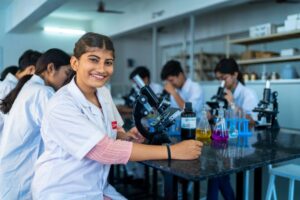
- Microscopes and material-analysis instruments for examining samples
Why Is Sample Preparation So Important?
An advanced instrument cannot correct a badly prepared sample. If a tablet is not powdered properly or a solution has an incorrect concentration, the final data may be misleading.
Sample preparation may include drying, filtering, grinding, dilution or coating. The exact process depends on the type of material and the test being performed.
Students must prevent contamination. They use clean containers, proper labels and suitable storage conditions. Samples should have clear names, dates and batch numbers so that they can be traced later.
If two samples are accidentally exchanged, the complete experiment may become useless. This is why laboratory organisation is not a minor skill. It is part of research quality.
What Happens When an Experiment Fails?
Failed experiments are common in research. A formulation may separate, a tablet may dissolve too quickly, or an instrument may produce an unclear graph.
Students first check whether the failure came from the idea, the method or the equipment. They may examine calculations, sample conditions and instrument settings. They should not repeat an experiment without trying to understand the problem.
Sometimes, a negative result is scientifically useful. It may show that a material is unsuitable or that one process condition must be avoided. Such information should be recorded honestly.
Changing or removing unwanted data is not acceptable. Research becomes trustworthy when students report what actually happened, including errors and limits.
Why Does Laboratory Documentation Matter So Much?
A research result must be supported by a clear record. Another trained person should be able to understand what was done and, wherever possible, repeat it.
Students maintain laboratory notebooks containing dates, quantities, methods, observations and calculations. Instrument files and graphs must also be stored with correct sample details.
Documentation is important because:
- It helps identify where an error occurred
- It allows different trials to be compared
- It supports reports, theses and research papers
- It maintains traceability of samples and results
- It prevents important details from being forgotten
How Do Students Turn Raw Data into a Research Finding?
An instrument usually provides numbers, peaks, curves or images. These outputs do not explain themselves. Students must connect the data with the research question.
They may compare different batches, calculate averages or use statistical methods. One unusual value should not be treated as proof without checking whether it is an error.
Students also compare their findings with published research. If their result is different, they need to study possible reasons. Differences in raw material, method or storage conditions may explain the change.
How Does Parul University Support M.Pharma Laboratory Learning?
Parul University offers M.Pharma programmes under the Master’s Programs of its Faculty of Pharmacy. These programmes are intended for students interested in advanced pharmaceutical research, new experiments and specialised technology-based roles.
The Faculty of Pharmacy reports an ecosystem with more than 500 Scopus-indexed publications and 30 patent applications. Its mentors also include researchers listed among globally recognised scientists.
FAQs
Do M.Pharma students need strong mathematics skills?
Basic mathematics and statistics are important for calculations, data comparison and research interpretation.
Can students select their own M.Pharma research topic?
Topic selection usually happens with faculty guidance based on interest, facilities and research feasibility.
Are laboratory coats and gloves always compulsory?
Protective equipment requirements depend on the activity, but students must follow the laboratory’s safety rules at all times.