A granted patent for a faster tuberculosis culture medium is the visible result. The person behind it is a Parul University tuberculosis researcher whose career quietly built towards it for over twenty years.
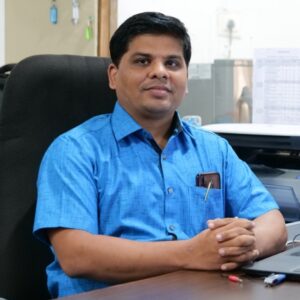
Dr. Vijay Jagdish Upadhye is Deputy Director of the Research and Development Cell and Associate Professor at the Parul Institute of Applied Sciences in Vadodara, with research interests in immunodiagnostics for tuberculosis and infectious diseases.
He holds a PhD with postdoctoral training at Imperial College, London, and is registered under Vidwan-ID 50619 in India’s national database of experts.
A Career Built on One Thread
His official biography lists more than 13 years of research experience across immunodiagnostics for tuberculosis, hepatitis, and infectious diseases, alongside biomarker research, macrophage and cell-culture studies, and enzyme kinetics. This breadth matters because the TB culture medium did not emerge from a narrow specialisation, but from a career focused on understanding pathogen behaviour and improving diagnostics without compromising accuracy.
His Google Scholar profile lists more than 2,000 citations, with a significant share of this impact concentrated in the last five years, the same period during which the patent progressed through India’s examination process.
The recognitions form a parallel timeline to the patent journey. He received recognition in the field of IPR and patents at Patent Fest 2023 in Nagpur, was named Best Researcher for 2021-2022 by the International Journal of Microbial Science, and received the Senior Scientist and Best Teacher recognition from the Microbiologists Society, India.
In 2019, he received the Prof. R. H. Pandya Academic Performance Excellence Award from Parul University. The earliest recognitions, clustered around 2005 to 2007, coincide with the period he identifies as when the idea for a faster culture medium first began taking shape.
The Problem That Would Not Leave His Mind!
Though my PhD work was on diagnostics, it was in my mind that we should really work sometime in the coming years on reducing this time period.
– Dr. Vijay Jagdish Upadhye
The story began in 2004, when he started doctoral research in tuberculosis and repeatedly encountered the same challenge: Mycobacterium tuberculosis is a slow-growing organism, taking roughly four weeks on solid media and more than two weeks on liquid media, with contamination remaining a constant risk throughout the extended waiting period.
His doctoral and postdoctoral work focused formally on immunodiagnostics, but the question of reducing culture time remained with him. Even as molecular tools advanced, the culture method, which continues to be the clinical gold standard, remained largely unchanged. That gap became the research question that would shape the next two decades of his work.
Standing on a Mentor’s Shoulders
Without a student, a guide is also incomplete. Without a guide, the student is incomplete too.
– Dr. Vijay Jagdish Upadhye
When asked whom he wished to acknowledge, he did not hesitate to name his doctoral guide, the late Dr. B. C. Harinath, under whom he trained at the Mahatma Gandhi Institute of Medical Sciences in Sevagram.
He recalls, with evident fondness, developing a diagnostic dipstick kit for roughly ninety rupees using X-ray sheet strips, cellulose acetate membranes, and ordinary washing powder, decades before today’s sophisticated tools. The work remains a striking example of frugal and resourceful scientific innovation.
The same value system is reflected in how he credits his own doctoral students, Mithul Bhuptani and Rahul Shribhate, by name for their separate work on rapid diagnostic kits for filariasis, without being prompted.
The Collaboration and the Institution
We cannot change it. We can trigger it. We can boost it. Just as we can boost it for a child.
– Dr. Vijay Jagdish Upadhye
A culture medium is essentially food for bacteria, and organisms, like people, grow better when their nutrition is enriched. Rather than trying to alter the bacterium itself through genetic modification, an approach that could risk changing the very drug-resistance profile the test exists to measure, the team enriched the environment in which the bacteria grow.
Dr. Vijay Upadhye compared it to adding a nutrient supplement to milk, and to the difference between how a child and an older adult absorb food: the organism’s slow pace remains unchanged, but its growth can be accelerated. His analogy was a two-hour journey that cannot be reduced to ten minutes but can potentially be shortened to one hour.
The distinction matters because it accelerates a biological process without overriding it, helping preserve diagnostic accuracy.
The Philosophy: One Problem, Fully
A single laser beam focusing on one problem, and one good effort and one solution, is enough, rather than tackling so many things at a time.
– Dr. Vijay Jagdish Upadhye
His advice to young researchers is a reflection of his own approach: choose quality over quantity and address a single problem with complete commitment rather than pursuing many challenges at once.
He is equally clear that credentials are tools, not the final goal, arguing that a breakthrough remains incomplete until it reaches the people who need it. Research confined to a laboratory, he says, is like treasure buried in the Himalayas: valuable, but ineffective until it reaches the community.
Coming from someone who pursued one question for twenty-two years before seeing it recognised, the message is not merely a statement but a summary of a lifelong research philosophy.
FAQs
Who is Dr. Vijay Upadhye?
Dr. Vijay Upadhye is a tuberculosis researcher at Parul University, Vadodara. He is also serving as Deputy Director of the Centre for Research for Development & an associate professor in the Department of Microbiology at the Faculty of Applied Sciences. His core research truly focuses on immunodiagnostics for tuberculosis and other infectious diseases. Besides this, he is a co-inventor of the approved and granted patent for faster TB culture medium!
What are his peak inventions?
He is mainly recognised for a granted Indian Patent; explaining an enriched culture medium that reduces the growth time of tuberculosis from 8 weeks to 10 to 14 days. This isn’t an overnight achievement; it’s the outcome of more than 2 decades and constant research in TB. His research portfolio covers immunodiagnostics, biomarker identification, and diagnostics of infectious diseases. To read more about him, you can refer to his Google Scholar Profile, which has more than 2,000 citations!
Where did Dr. Vijay Upadhye train?
He completed his doctoral research in tuberculosis at the Mahatma Gandhi Institute of Medical Sciences in Sevagram, under the late Dr. B. C. Harinath, and undertook postdoctoral training at Imperial College, London. He is registered in India’s national Vidwan database of experts and scientists.