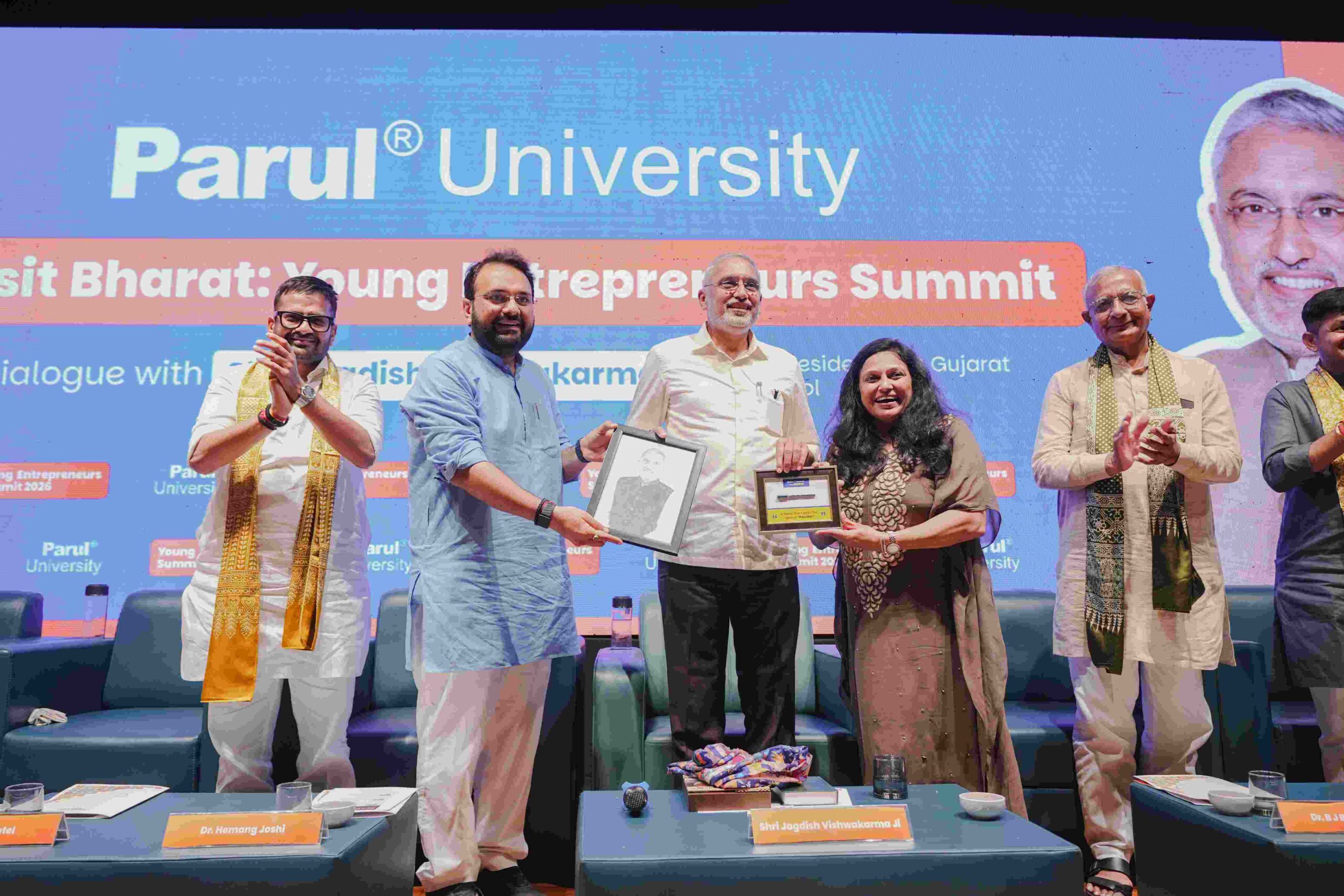
Just one single incubator ensured idea generation, validation, value creation, techno-creative support, funding help, networking management and what not? At Parul University’s Viksit Bharat Young Entrepreneurs Summit 2026, 8 PIERC incubated ventures showcased their working products to investors & stalwarts. They spanned from hydrogen eclectic aviation to a pocket-sized heart monitor to children’s clothing, each one had moved the idea stage and have reached at a level where they’re all set to monetize.
The summit itself, and the PIERC incubation ecosystem that produced these companies, are covered in the companion article on how PIERC turns ideas into funded companies. The broader PIERC portfolio of 303 incubated startups is documented at the PIERC ecosystem record, and the wider career context at the Parul University placement record.
The deep-tech bets: aerospace and thermal engineering
Two of the companies were building genuinely hard engineering, the kind that needs laboratories, patents, and years of development rather than a fast go-to-market. These are the ventures that justify a university incubator having serious research infrastructure behind it.
- Cligent Aerospace (Cligent Technologies Private Limited) – As founded by Harsh Joshi & Vivek Dhut, they both are proud alumnus of Parul University. Cligent Aerospace has championed massive heights as they’re developing an indigenous electric Short Take-off and Landing aircraft, designed to make regional air mobility short, possible and works on low-infra based runways. The flagship CL-1000 is a full-fledged 9 seater, exclusively designed to take off and land seamlessly within 50 to 100 metres roughly, covering the length of a cricket pitch, allowing it to operate from grass fields, coastal regions and island territories that traditional aircrafts cannot reach.
- When the founders were questioned on the engineering, they held their ground: a DC electric motor for propulsion, a 150 kW power rating, a motor weighing around 60 kg, cruising speed near 250 km/h, and a candid answer on landing loads, where an aircraft of roughly 5.7 tonnes can put nearly 12 tonnes through its landing gear on touchdown. They also confirmed a strong domestic-manufacturing position, with almost all parts made in India and only a few aircraft-specific components still imported, alongside a patent portfolio and early letters of intent from logistics players.
- KuhlTherm Private Limited. As co-founded by Kishan Baravaliya, he is a proud alumnus of Parul University. KuhlTherm is an advanced liquid-cooling technology for an infrastructure that gets hot very easily such as – data centers, computing labs, EV charging stations. This company has exclusively gained 9.5 Crore from venture investors and championed a place among Inc42’s Top 30 Startups to watch. They even hold a patent filing on this exclusive technology. Both companies point at the same underlying capability: a student can build hardware-intensive, IP-heavy technology at Parul University because the laboratory infrastructure, including the Micro Nano Research and Development Center approved by the Industries Commissionerate of Gujarat, the DSIR-approved R&D Centre, and the 250+ technology laboratories, actually exists on campus. Deep-tech ventures cannot be prototyped on a laptop, and the presence of these two on the stage was the clearest signal that the infrastructure is being used.
Health Based Tech Ventures - Ensuring medical care affordable and portable
2 peak companies were exclusively working on the health sector and each one of them have targeted the broader problem – how to make quality health care more accessible, affordable with a hospital machine, ensuring a massive relief in chronic pain surgery-less, or by reaching to patients via centers.
- Kavitul Technologies Private Limited. Founded by Ajinkya Puranik, Kavitul builds portable cardiac diagnostics, most notably an advanced ECG device that brings accurate heart monitoring and early detection of cardiac abnormalities to clinics, diagnostic centres, and remote settings where a full hospital unit is impractical. The obvious challenge with shrinking medical hardware is whether accuracy survives the shrink, and that is exactly what the founder was asked. His answer was technical and specific: the portable device uses the same sampling rate and a validated, standard algorithm as full-sized machines, so signal quality and frequency response stay comparable to a traditional ECG. The company has generated Rs 2.5 crore in revenue over three financial years and is used by more than 1,500 doctors, and its work has drawn recognition across the healthcare and innovation ecosystem.
- Flexiora Solutions Private Limited. As founded by Jalendu Pathak and his team of healthcare professionals, Flexion has exclusively developed Arthagone – a device used for joint & knee pain, juxtaposition heat retention, gentle compression and fluid-absorption technology to increase the holistic circulation of mobility. It is a regulated medical product, carrying ISO 13485:2016 and CE certification and a valid medical-device manufacturing licence. Questioned on whether the relief was real, the founder pointed to more than 250 human trials and 126 clinical trials with positive results for back-pain patients, and was direct in correcting a common assumption: there are no magnets in the product, and the effect comes from a proprietary mineral-based formulation integrated into medicated fabrics manufactured in Vadodara. Knee and back products are live, with elbow, shoulder, posture, and ankle solutions developed and awaiting rollout.
The health cluster is instructive because it shows the incubator supporting companies through the specific hard part of medical entrepreneurship: regulatory compliance. Certifications, manufacturing licences, and clinical trials are where most student health ventures stall, and companies clearing those hurdles is a more meaningful signal than revenue alone.
The consumer builders: turning everyday products into businesses
Not every strong company is deep-tech. Three of the ventures were consumer businesses, and each began from a founder noticing a gap in an ordinary market and deciding to fill it properly. These are the companies that prove entrepreneurship at a university is not only for engineers.
- Story Tailor Kids Private Limited. Founded by Krishna Siddhpura, Story Tailor grew from a simple observation that the market offered few Indian, culturally rooted clothing options for children. The brand makes skin-safe cotton nightwear and apparel inspired by Indian heritage, mythology, and folktales, weaving storytelling into everyday clothing so that a child’s wardrobe carries a little cultural and moral education with it. Asked about the operational basics, the founder was straightforward: fabric sourced from Ahmedabad and Jaipur, printing done in Ahmedabad. The company has generated Rs 70 lakh in revenue, drawn a Rs 10 lakh grant from the Government of Gujarat, secured a Rs 75 lakh investment on the IDEABAAZ platform, and won the TiE Women Chapter 2025 for the Vadodara region.
- JP Perfumery Works Private Limited. Founded by Hardik Buddhdev, JP Perfumery carries a 90-year-plus heritage in fragrance into a modern business making incense sticks, dhoop, and aromatic blends for homes, temples, and wellness spaces. When the questions turned to the chemistry, the founders were fluent: pure essential oils drawn from tulsi, rose, jasmine, marigold, and other botanicals, extracted through distillation that yields roughly 5 to 10 grams of oil per kilogram of raw material, with even the spent flowers recycled into other products. The company has generated Rs 3.3 crore in revenue over two financial years and built a B2B network of more than 100 distributors, retailers, and institutional buyers.
- Learnkin Private Limited. Founded by Foram Roy, Learnkin sits at the intersection of consumer and mission, building activity-based early-learning kits for children aged 1.5 to 6, aligned to the National Education Policy and the Adhaarshila framework. Its content is deliberately inclusive and gender-neutral, and it has developed what it describes as India’s first transdisciplinary music curriculum for early years. The company has generated Rs 1.16 crore in revenue, been recognised as Best Learning Kit in India by the Times Group, and received a National Education Excellence Award.
The fintech play: making investing legible to ordinary people
One company was building in financial technology, addressing a problem most young Indians recognise: that investing is intimidating, fragmented, and hard to learn.
- Pocketwise Technologies Private Limited. Founded by Ajit Patel, Pocketwise is building Aarthik AI, a financial-intelligence platform that pulls education, stock screening, and advisory into one place. Its three products, Alpha Learn for financial education, Beta Scan for AI-powered stock screening and market intelligence, and Capital for advisory and portfolio management, are designed to take a user from confused beginner to confident investor within a single ecosystem. The company has received Rs 20 lakh under the Startup India Seed Fund Scheme routed through PIERC, secured a strategic investment through PIERC’s Startup Nivesh initiative, been selected for the NVIDIA Inception Program, and raised further funding at a pitch event at UPES Dehradun. It reports more than 3,000 early-access users and Rs 35.6 lakh in annual recurring revenue. Notably, when Pocketwise presented, the guest asked no questions and the founder’s presentation drew applause on its own, a small sign that a pitch can be complete enough to leave little to interrogate.
What the eight have in common
An incubator that produces a hydrogen-capable aircraft, a portable heart monitor, a data-center cooling system, a children’s clothing brand, an early-learning company, a heritage fragrance business, a regulated pain-relief device, and an AI finance platform is not running a narrow programme for a particular kind of student. It is supporting founders across engineering, healthcare, consumer goods, education, and finance with the same underlying model.
Every one of these founders came through PIERC, and most are Parul University students or alumni who built their companies while connected to the incubation ecosystem. The grants many of them accessed, the Startup India Seed Fund Scheme in particular, were routed through PIERC, which handles the navigation that individual founders rarely manage alone. For a prospective student weighing where to study, the useful takeaway is not any single company. It is that the path from student to founder is well-worn enough at Parul University that eight companies at very different stages and in very different sectors could stand on one stage and each hold up to scrutiny.
FAQs
Which startups pitched at Parul University's Young Entrepreneurs Summit?
8 PIERC-backed incubated companies showcased their work at the Viksit Bharat Young Entrepreneurs Summit. The startups are - Cligent Aerospace (founded by Harsh Joshi & Vivek Dhut), Kavitul Technologies (founded by Ajinkya Puranik), KuhlTherm (co-founded by Kishan Baravaliya), Story Tailor Kids (founded by Krishna Siddhpura), Learnkin (founded by Foram Roy), JP Perfumery Works (founded by Hardik Buddhdev), Flexion Solutions (founded by Jalendu Pathak), Pocketwise Technologies (founded by Ajit Patel).
What is the Cligent Aerospace building?
Cligent Aerospace, founded by Parul alumni Harsh Joshi and Vivek Dhut and incubated at PIERC, is developing an indigenous electric Short Take-Off and Landing (STOL) aircraft aimed at making regional air mobility accessible from short, low-infrastructure runways. Its flagship aircraft, the CL-1000, is a nine-seater designed to take off and land within roughly 50 to 100 metres, about the length of a cricket pitch, enabling operations from grass fields, coastal regions, island territories, and other environments where conventional airports do not exist. The aircraft uses a DC electric motor rated at 150 kW, with the motor weighing around 60 kg, a cruising speed near 250 km/h, and a maximum speed near 320 km/h. Almost all components are manufactured in India, with only a few aircraft-specific parts still imported, and the company holds a patent portfolio with early letters of intent from logistics companies.
What healthcare startups came out of PIERC at Parul University?
Two health-technology companies presented at the Young Entrepreneurs Summit. Kavitul Technologies, founded by Ajinkya Puranik, builds a portable ECG device that delivers accurate cardiac monitoring and early detection of heart abnormalities for clinics, diagnostic centres, and remote settings, using the same sampling rate and validated algorithms as full-sized hospital machines. It has generated Rs 2.5 crore in revenue over three financial years and is used by more than 1,500 doctors. Flexiora Solutions, founded by Jalendu Pathak, has developed Arthagone, a non-invasive device for joint and knee pain that combines heat retention, gentle compression, and fluid-absorption technology, backed by more than 250 human trials and 126 clinical trials, and carrying ISO 13485:2016 and CE certification along with a medical-device manufacturing licence. Both companies illustrate how PIERC supports health ventures through the regulatory compliance, certification, and clinical validation that most student health startups struggle to clear.
Are these startups founded by Parul University students?
Yes. The companies that presented at the Young Entrepreneurs Summit were founded by Parul University students and alumni who built their ventures while connected to the PIERC incubation ecosystem. Cligent Aerospace was founded by Parul alumni Harsh Joshi and Vivek Dhut, and KuhlTherm was co-founded by Parul alumnus Kishan Baravaliya. The other founders, including Ajinkya Puranik of Kavitul, Krishna Siddhpura of Story Tailor Kids, Foram Roy of Learnkin, Hardik Buddhdev of JP Perfumery Works, Jalendu Pathak of Flexiora, and Ajit Patel of Pocketwise, developed their companies with PIERC support. Many of the government grants these companies accessed, particularly the Startup India Seed Fund Scheme, were routed through PIERC, which handles the grant navigation that individual founders rarely manage on their own. This reflects Parul University's broader model of treating entrepreneurship as a supported career path alongside conventional placement.
What does the range of these startups say about PIERC?
The breadth is the most important signal. PIERC has produced companies across an unusually wide range: a hydrogen-capable electric aircraft, a portable heart monitor, a data-center cooling system, a children's clothing brand, an early-childhood education company, a heritage fragrance business, a regulated pain-relief device, and an AI-powered finance platform. This range demonstrates that the incubator is not running a narrow programme for one type of student, but supporting founders across engineering, healthcare, consumer goods, education, and finance with the same underlying model of idea validation, prototyping, business formalisation, grant navigation, and investor access. For deep-technology companies like Cligent and KuhlTherm, the on-campus laboratory infrastructure, including the Micro Nano Research and Development Center and the DSIR-approved R&D Centre, is essential, while consumer and fintech companies benefit more from the mentorship, grant relationships, and investor connections. Across the PIERC portfolio, 254 startups have been incubated and supported, collectively generating over Rs 40+ crore in revenue.