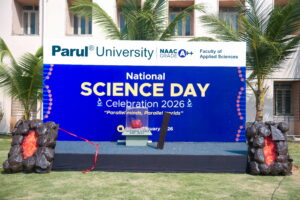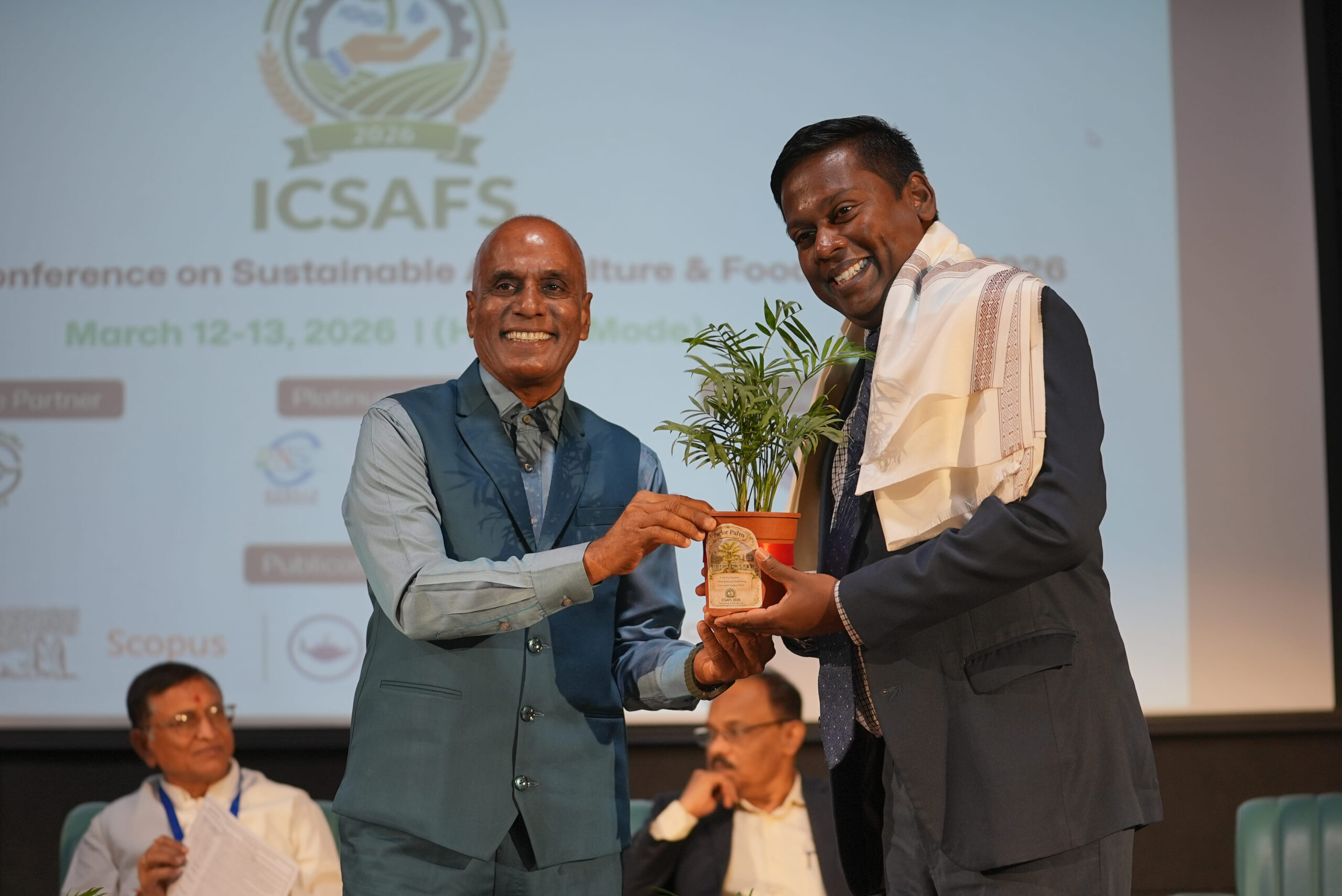
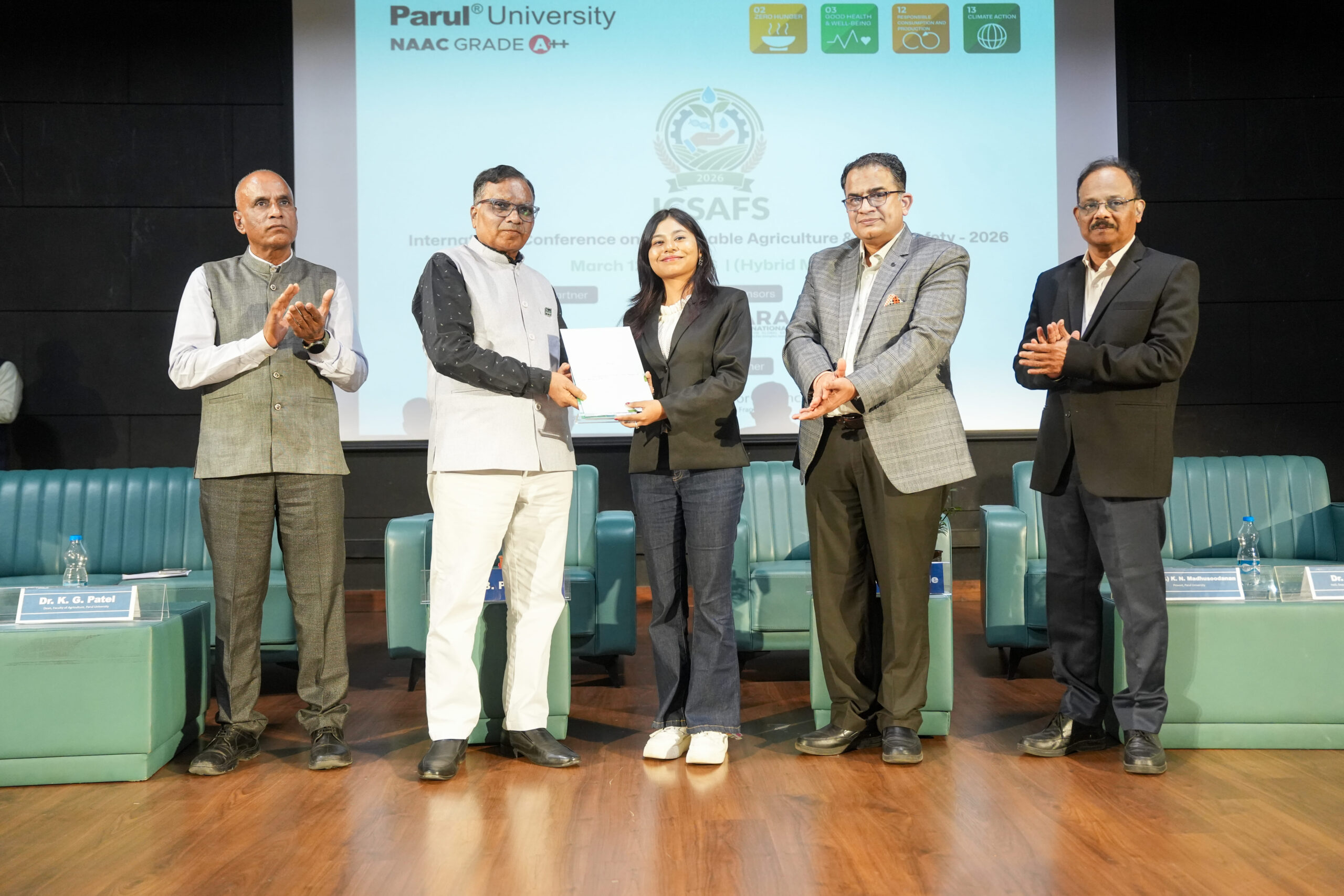
Session one. Biologicals and biopesticides. Dr. Mukesh Patel, 36 years in the field, Vadodara-based, 55-plus biological products under his company Agriland Biotech stood up and showed the room that this market is growing at 16% annually worldwide.
Sitting at 1 to 2% of global production. We keep repeating this number across articles because we still can’t believe it. The USA’s at 40%. We’re at 1 to 2%. Surface Technology, microencapsulation, precision agriculture all of it commercial-ready. All of it waiting for someone to scale it in India. Not someday. Now. Today. Whoever’s reading this and thinking about career options after 12th, this is one of them. A real one.
Session two covered insights on Medicinal and aromatic plants. Dr. Jnanesha AC, CSIR-CIMAP scientist, came in virtually from Hyderabad and dropped numbers that should be on every agriculture student’s wall. ₹8,000 crore global market. India’s export share, ₹1,000 crore. Supply shortfall – 30 to 40% for crops like Ashwagandha and Kalmegh. And the profits? Rose Geranium at ₹3.5 lakh-plus. Sarpagandha roots contain reserpine worth ₹30 lakh per kilogram. Per kilo. From a root. That grows in dirt. I’ll never get over that number. It changes what you think is possible in agriculture.
Session three highlighted the importance of Microwave-assisted food processing. Professor Pradyuman Kumar, SLIET Punjab. Quieter session. Fewer dramatic numbers. But don’t make the mistake of skipping past it. Microwave extraction doubles bioactive compound yield compared to conventional methods. Microwave pasteurisation attacks dairy fouling and fouling eats up nearly 80% of dairy production costs, so cutting that down isn’t a nice-to-have, it’s a survival move for dairy companies. Creates resistant starch for diabetic foods. Improves protein digestibility. This is where the next generation of food patents will come from.
Session four described Natural farming. Four Gujarat farmers. Award-winners. Real people, real land, real income. ₹1 to ₹6 lakh annually from natural methods. Cow-based inputs. Rainwater harvesting. Direct-to-consumer sales that skip the mandi middleman entirely. One of them, Dhanshukbhai Chaudhari, dropped a line I’ve quoted in two articles now because it deserves repeating: in a job, your income has a ceiling. In agriculture, it does not. He’s a retired government servant who chose to farm. Not because he had to. Because he understood something most people don’t.
Agriculture and Food Science Programmes at Parul University
So the opportunity’s staring at you. What now? Which programme? Where? What do you actually study for three or four years to prepare yourself for the kind of careers we’ve been talking about? Let us get specific because vague advice is useless advice.
B.Sc. (Hons.) Agriculture (4 years)
What happens inside the programme? Agronomy, how to grow things. Soil science, what they grow in. Horticulture. Plant biotechnology – the molecular stuff, the genetics, the biotech angle that companies like Agriland Biotech are building products around. Agricultural economics, because a brilliant farmer who can’t read a market is a broke farmer. Pest management and if you’ve been reading this series, you know how much the pest management industry is about to change with biologicals. Environmental conservation because you can’t keep taking from the soil without putting it back. If you’re equally passionate about building a career in this domain, enrol into Parul University’s Master of Science in Agriculture – Plant Pathology!
And here’s the bit that separates this from a programme that lives only in a classroom. Instructional farms. Actual farms. On campus. Where students grow real crops in real soil with real problems. Greenhouses. R&D labs that don’t exist just for photos in the brochure. Industrial visits, you go to factories, processing units, farms that are running at commercial scale, and see what the textbook looks like when money’s on the line.
Now connect the dots. Dr. Mukesh Patel talking about Trichoderma and Beauveria bassiana and microencapsulation? That’s pest management and plant biotechnology. Dr. Jnanesha’s medicinal crop profit data? That’s agronomy and agricultural economics. The farmer panel’s natural farming methods? That’s soil science and environmental conservation. Everything from ICSAFS 2026 maps directly onto this degree. And the conference didn’t happen at some hotel in Ahmedabad. It happened at this university. In the same auditorium where these students attend lectures. You can’t buy that kind of proximity between what you’re learning and what the industry’s actually doing. You can only be in a place that bothers to create it.
1. Different path. Different question. If B.Sc. Agriculture asks “how do we grow better food?” then Food Technology asks “what happens to that food after it leaves the farm?” Because between a field in Gujarat and a dinner plate in Gurugram, there’s a whole world of processing, preservation, quality testing, packaging, and regulation. Someone has to understand all of it. That someone is a food technologist.
2. The programme covers food chemistry and what food actually is at a molecular level. Microbiology: what’s living in your food that shouldn’t be, and what’s living in it that should. Processing technology how you turn raw agricultural output into a product that sits on a shelf for six months without killing anyone. Quality control. Food laws FSSAI, import-export regulations, labelling rules. Nutrition because all of this is pointless if the end product doesn’t actually nourish the person eating it.
3. There are food processing labs. Quality assurance facilities. Industry-led projects where actual companies, not hypothetical case studies, actual businesses, give students real problems to solve before they’ve graduated. NEP 2020 aligned, so the structure’s modern, not inherited from someone’s 1990s syllabus.
4. Remember Professor Pradyuman Kumar at ICSAFS? The microwave extraction data? Anthocyanin yields doubling? Dairy fouling costs? That’s food technology. That’s this field. And the students in this programme don’t just read about microwave processing in a chapter. They’re on the same campus where a professor presented cutting-edge research on it. The distance between the textbook and the frontier is about a two-minute walk across campus.
B.Tech Food Technology (4 years)
B.Tech gives you the science plus the engineering. Industrial food processing. Preservation systems that work at factory scale, not kitchen scale. Quality control systems that handle ten thousand units a day, not ten. Product development, taking an idea from a lab bench to a supermarket shelf with everything in between figured out.
Specifically and this connects straight to ICSAFS 2026, the programme covers non-thermal processing techniques. Microwave technology. The exact stuff Professor Pradyuman Kumar presented. The techniques that double extraction yields. The techniques that cut dairy costs. The methods that create foods designed for diabetic consumers who represent one of the fastest-growing food markets on the planet. B.Tech Food Technology doesn’t just teach you about these innovations. It trains you to build the machines, design the processes, and run the factories that make them commercially real.
Food science if your instinct is to understand what happens after the harvest. Food engineering if your instinct is to build systems that process food at scale. You know which one pulls you. Trust that pull. It’s smarter than your neighbour uncle’s opinion about what you should study.
Career Paths After Graduation
Agri-entrepreneurship. Your own venture. A biological product company, Dr. Patel showed you the playbook and the 1-2% market gap that’s begging to be filled. A medicinal plant cultivation business, Dr. Jnanesha gave you the crop-by-crop profit data, the CIMAP varieties, and the water advantage.
A natural farming consultancy, because thousands of farmers want to switch but don’t know how, and Dhanshukbhai Chaudhari just showed you what’s possible on 5 acres. Every speaker at ICSAFS 2026 pointed at market gaps. Massive ones. Unmissable ones. The startup ideas aren’t hidden. They were presented on slides in front of an auditorium full of people.
Food technology and processing. R&D roles. Microwave extraction research. Non-thermal preservation development. Bioactive compound innovation. These positions are multiplying because the food industry is being pulled in two directions at once consumers want healthier food and regulators want safer food. The science that delivers both is where the jobs are growing fastest.
Every food product that enters any market domestic, export, e-commerce, retail needs someone guaranteeing it meets FSSAI standards, Codex Alimentarius requirements, and whatever the importing country demands. And the cost of getting it wrong, one contamination scare, one recall, one export ban terrifies companies enough that they’ll pay very well for people who get it right. Consistently. Quietly. Without drama. That’s a career with security. Real security. The kind that doesn’t depend on a startup succeeding or a market trending upward.
Medicinal plant cultivation and export. ₹8,000 crore global market. Thirty to forty percent supply shortfall. The buyers exist. The demand exists. The supply doesn’t. Not yet. Honestly, why not someone who studied agriculture at Parul University and watched Dr. Jnanesha present these numbers in person and is going to build a vertically integrated business. Grow the plants. Grade them. Process them. Export them. Own the chain from seed to shipping container. That business doesn’t exist at scale in India yet. It will. The person who builds it will do very, very well.
Soil science and sustainable farming advisory. India’s soil is tired. Decades of chemical farming have stripped it. Farmers feel it, yields dropping, input costs rising, the land giving less and demanding more. What they need isn’t a pamphlet from the district agriculture office. They need someone who can test their soil, read the results, and tell them specifically, in language they understand, in their language, what to do differently.
That’s a soil scientist. That’s a sustainable farming advisor. And there are nowhere near enough of them. Nowhere near. Especially not ones who’ve actually seen biological alternatives and medicinal crop data and can offer a farmer a real path forward instead of just saying “use less chemicals” and walking away.
Government roles. ICAR. State agricultural departments. ATMA, remember, that’s the agency that recognised Dhanshukbhai Chaudhari with the Best Farmer Award. NABARD. FCI. These institutions run Indian agriculture at the policy and implementation level. They’re vast. They’re always hiring. And they desperately need people who understand modern agricultural science, biologicals, medicinal crops, water-efficient farming, microwave processing, not just the conventional textbook curriculum from fifteen years ago. If you enter government service with ICSAFS-level knowledge, you walk in better prepared than 90% of your peers. That’s not an exaggeration. It’s arithmetic.
Defence and pharmaceutical R&D – Sounds like a stretch until you remember that Sarpagandha’s reserpine sells for ₹30 lakh a kilo. That’s pharmaceutical territory. Extracting bioactive compounds from plants for drug development. For nutraceuticals, the space between food and medicine that’s exploding worldwide. Pharma companies want people who understand plant biology and extraction chemistry and commercial scalability. That Venn diagram has very few people sitting in it right now. Which means the ones who do sit in it get to write their own salary.
Why Parul University
1. NAAC A++ accreditation. That’s the top grade India’s national accrediting body awards. Not A. Not A+. A++. NIRF Top 50 Innovation. QS Diamond Rating. These aren’t self-declared marketing badges. They’re external assessments by organisations whose entire job is evaluating universities.
2. The Faculty of Agriculture, Gujarat’s first private agricultural college, Centre of Excellence, we’ve been over this but it bears repeating because that designation isn’t decorative. PIERC – Parul Innovation & Entrepreneurship Research Centre, sits on campus and incubates agri-startups. So if you walk out of ICSAFS 2026 with a business idea buzzing in your head, there’s an actual incubation facility on the same campus willing to help you turn that buzz into a business plan and that plan into a company. How many universities offer that pipeline? Conference to classroom to incubator? Count them on one hand.
3. Annual events – AgriFest, where students present their own innovations and interact with working farmers. ICSAFS, the international research conference we’ve been dissecting across five articles. MoU with the National Defence Academy. Defence Scholarships. And 3,500-plus international students from 56-plus countries.
FAQ - Career in Agriculture and Food Technology
Can I study agriculture after 12th?
Parul University’s B.Sc. (Hons.) Agriculture, 4-year programme, open to 12th Science with PCB. Gujarat’s first private agricultural college. Centre of Excellence from the state government. And here’s the thing nobody tells 12th-pass students, you’re not picking a fallback option. You’re entering a field where the global biopesticide market’s growing at 16% a year and medicinal crops pull in three to ten times what rice does. On the same land. With less water. That’s not a consolation prize. That’s a head start while everyone else fights over engineering seats.
What is the difference between B.Sc. Food Technology and B.Tech Food Technology?
Easiest way to think about it. B.Sc. Food Technology- 3 years, or 4 if you do Honours - makes you a food scientist. You understand what food is, how it behaves, what makes it safe, what makes it spoil. Chemistry, microbiology, quality control, processing. B.Tech Food TechnologyM 4 years, needs JEE Main and 12th PCM, makes you a food engineer.