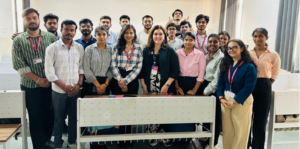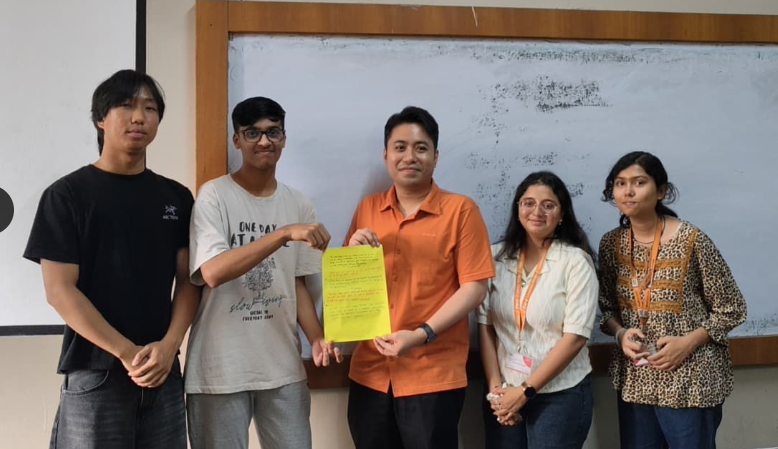
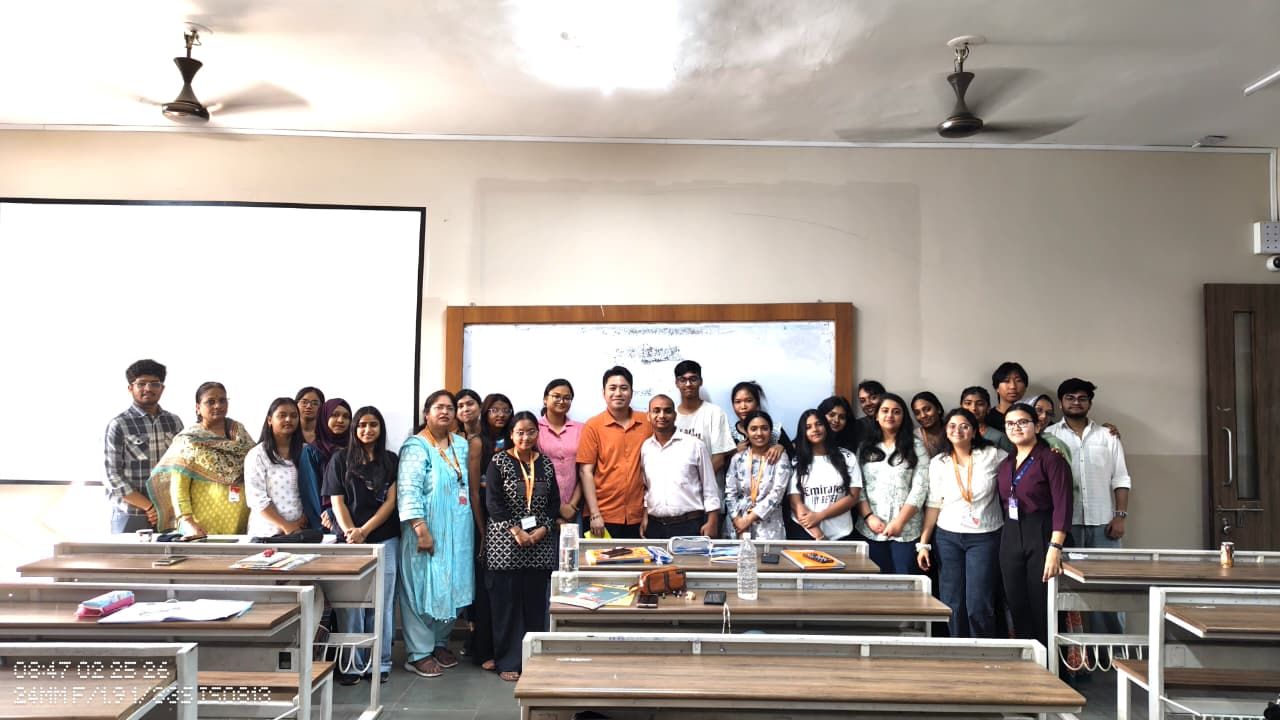
Dr. Al Ryanne G. Gatcho from Hunan Institute of Science and Technology (China) opened his first session at the Faculty of Liberal Arts with a question: how can you write a short story without understanding its format? He compared the absence of structure to a fish out of water. Then he used a mountain to map story architecture:
- Base (exposition): stable and calm. Characters, setting, and background introduced. Like the surface of an ocean with no conflict present.
- Inciting incident: the moment stability shifts to tension. Captures the reader and sets the tone.
- Rising action: a series of events building tension and complexity. Distinct from the climax.
- Climax: the summit. Not just the most dramatic moment but the most meaningful one, where the direction of the narrative is decided.
- Resolution: does not need to be happy or neatly concluded. Predictable endings reduce impact. Open-ended conclusions keep readers engaged.
Students identified the exposition in The Necklace (the invitation letter) and analysed Alice Munro‘s The Office in a 15-minute in-class exercise. He emphasised that experimentation does not mean abandoning structure. A story can begin with a flashback or conflict instead of a conventional introduction. He referenced I Want to Die but I Want to Eat Tteokbokki as an example of non-traditional narrative that maintains coherence. He distinguished flat characters (single trait, consistent) from round characters (evolving, complex) and noted that the protagonist can be the source of conflict, not just an antagonist.
Session 2: Finding the Right Platform to Publish
He presented two micro-fictions he had written. First Ride described a rickshaw journey with detailed observations but no clear direction. A Cup of Masala Tea presented a meaningful conversation reflecting intercultural communication, literature, and social responsibility. Students identified the second as publication-ready because it had a strong narrative, well-developed characters, and a clear message. The first felt like random observations without motive.
His publishing framework:
- Choose the right platform first: wrong platform forces you to change your writing. The right platform preserves your voice.
- Consider: type of writing, intended audience, style and theme, publication requirements
- Literary journals: he shared rejections from Molotov Cocktail (flash fiction) before finally getting published. Persistence matters.
- Writing competitions: Keekli Charitable Trust (India) conducts short story competitions
- Student publications: school and college journals where beginners can start. Many established writers began here.
- Online platforms: Wattpad for free sharing. He published early work there, though he now considers those pieces weaker.
- Anthologies: he contributed poems to When Words Become Verse, including Cravings and Dance with the Letters (inspired by his dyslexic nephew)
Session 3: Five Student Stories Reviewed Live
The final session focused on reviewing student drafts. The professor followed an interactive method: the author sat in the centre while the class gave feedback. Before starting, he taught students to critique the work, not the person, and to avoid vague statements.
Rudransh (1st year English Lit): A Search For What Doesn’t Exist. Fantasy genre. Appreciated: philosophical tone, the line ‘this child has no fate yet’ as conceptual anchor. Issues: too much explanation, emotional build-up too late, naming overload, weak character development, inconsistent dialogue tone.
Anamika: Story about Riya finding her voice despite a controlling father. Appreciated: strong climax, emotional debate competition scene, ‘the voice shook but did not break’, ‘love remained intact with a voice’. Showed adjustment rather than rebellion, which is rare. Issues: names in all caps, over-explanation, needed more sensory detail.
Yashna: The Last Adventure. Strong imagination, philosophical centre, well-handled ambiguity in ending. The letter as symbol added depth. Issues: protagonist Walker not fully realistic, tension dropped at points, time machine element needed better foreshadowing.
Jayesh More, who assisted Dr. Gatcho from 2 March to 25 March 2026, described him as genuinely willing to engage in meaningful dialogue beyond classroom hours. At the farewell, Dr. Gatcho referenced the Japanese concept of Ichigo Ichie, the idea of cherishing fleeting moments, to describe his experience at Parul. His encouragement to students abroad to visit Parul University demonstrated the impact of the exchange.
What Students and Faculty Said in IVPP 2026: LinkedIn Testimonials
The student and faculty responses after the programme were not institutional press releases. They were personal reflections posted publicly on LinkedIn. Key voices:
- Khushi Gajjar (MBA): Communication is not just about language but about empathy, context, cultural awareness, and mutual understanding
- Firdaus Alam (MBA): This was more than a seminar. It was a journey of perspectives. He did not just teach us. He connected with us, and we all learned from each other
- Harsh Gupta (MBA): Described Day 7 of Indonesian sessions, listing every framework from Kim’s micro-level synchrony to Jackson’s Development Model, ending with: we ended our day with a big smile and eagerness for the next session
- Yuvraj Singh (MBA): His group from Punjab, Delhi, and Gujarat found that Hindi acted as a unifying link across cultures, reinforcing unity in diversity as lived experience
- Jayasri Acharya: Described a 3-week session concluding with research papers, project reports, and presentations on Harmony in Diversity, analysing HCL Technologies, Glenmark Pharmaceuticals, and Waste Management Inc.
- Tanush Jajoo (MBA): Learning how simulation supports decision-making, risk analysis, and business planning added great value to my understanding of modern management
- Jayesh More (Liberal Arts): Dr. Gatcho’s teaching style allowed ideas to breathe freely. His farewell referenced the Japanese concept of Ichigo Ichie, cherishing fleeting moments
However, in response to the same, Dr. Bonifacius Hendar Putranto thanked Parul University and students for hosting international and intercultural collaboration in the future. If you’re equally passionate about building your own startup, you can enroll into MBA at Parul University.
FAQ
Does Parul University offer creative writing workshops with international faculty?
Yes. Dr. Al Ryanne Gatcho from Hunan IST (China) conducted a 3-session creative writing workshop for English Literature students at the Faculty of Liberal Arts in Feb-March 2026. Sessions covered short story structure, publishing platforms, and live student story reviews.