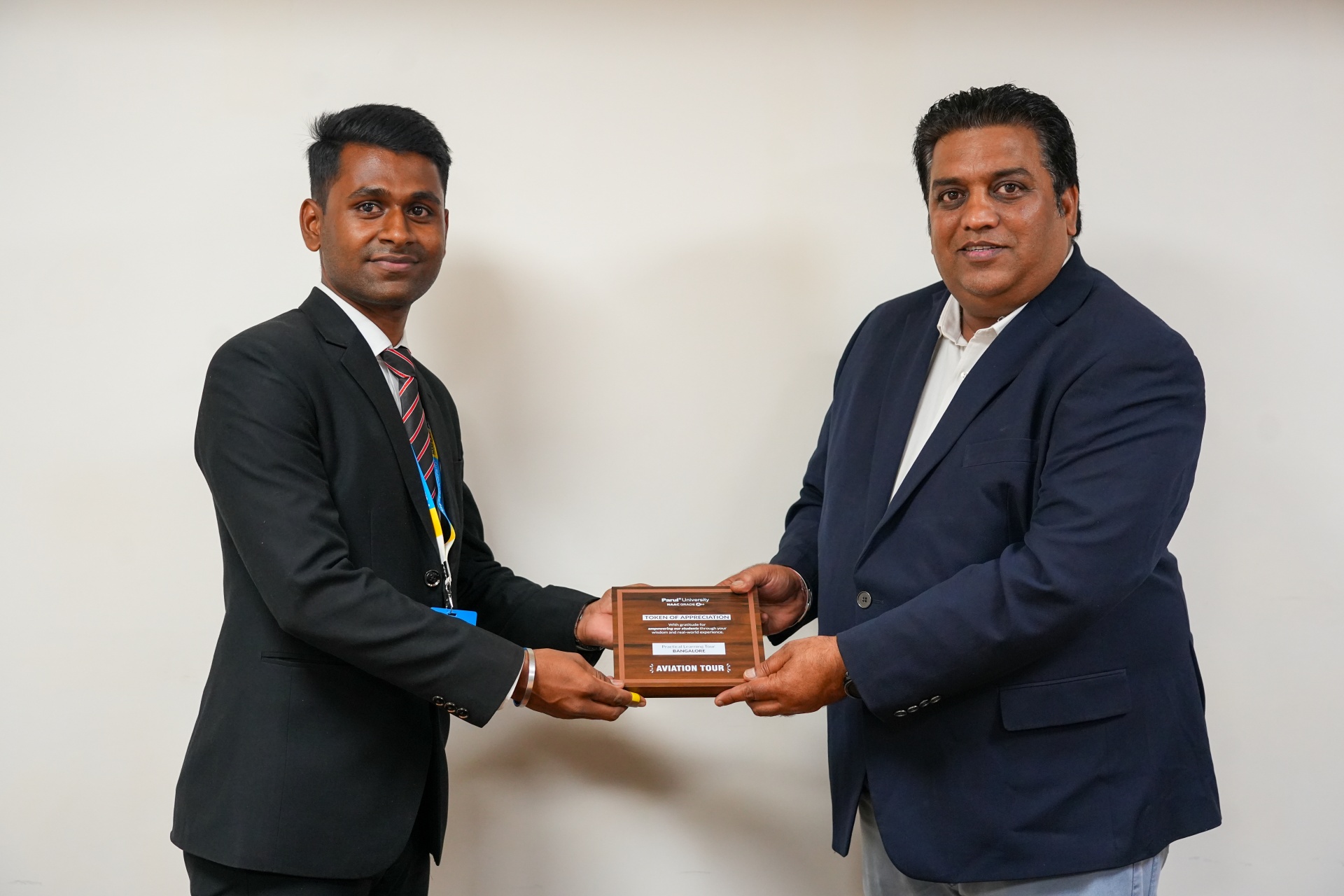
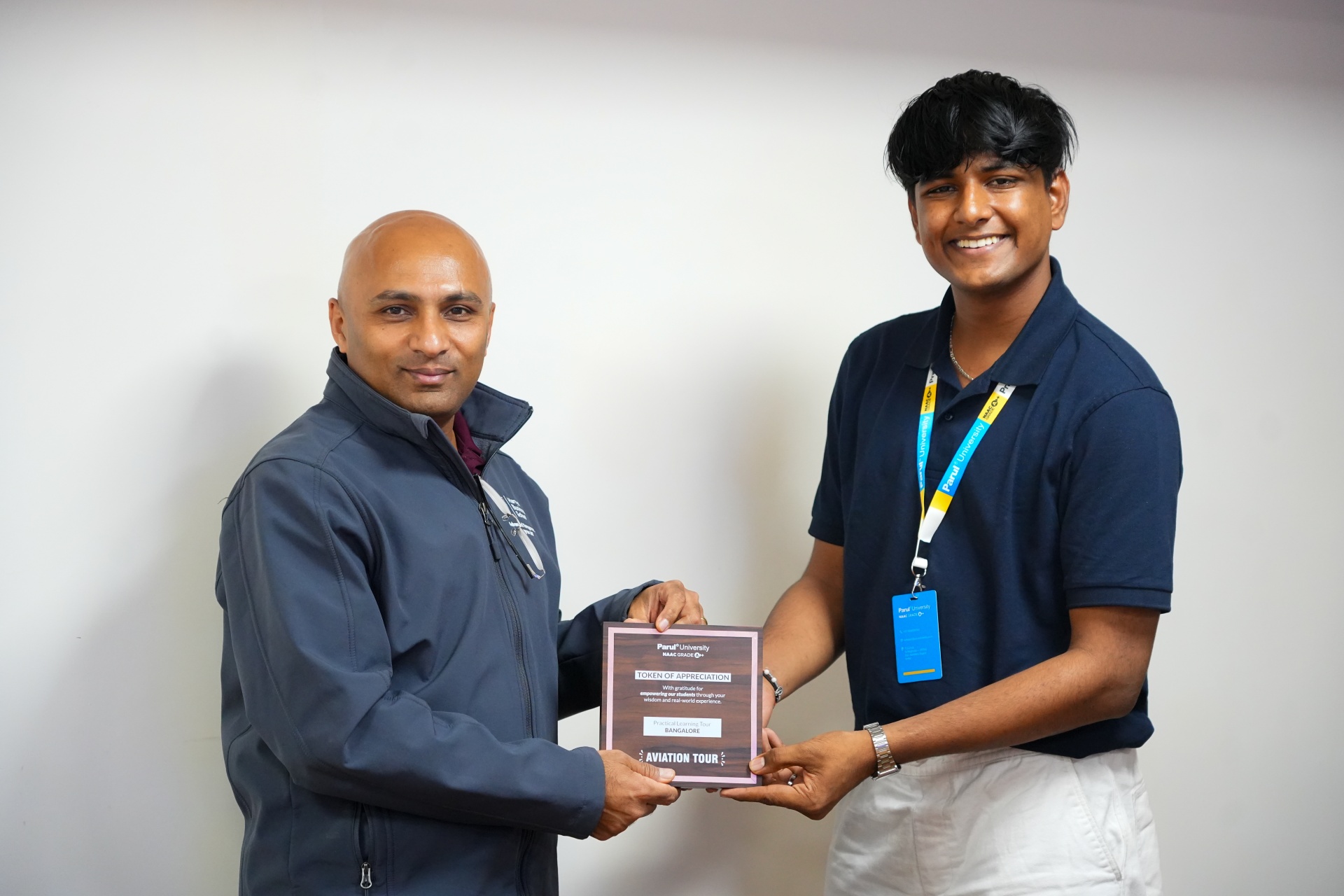
Bangalore is India’s aviation and aerospace capital. Collins Aerospace manufactures aircraft components here. DGCA regulates from here. CAE trains pilots here. BIAL (Kempegowda International Airport) manages one of India’s busiest airports. AEQUS manufactures for Airbus and Boeing. Blue Dart operates India’s largest domestic air cargo network from here.
For Parul University’s aviation students, visiting all 12 institutions across this corridor meant seeing the complete aviation value chain: from the component that goes into an aircraft to the regulation that certifies it, from the pilot who trains on a simulator to the sales executive who sells the ticket, from the cargo handler who loads freight to the COO who manages the entire airport.
The tour operates within Parul University’s Practical Learning Tour programme (146 tours, 19 cities, 280 companies). Parul University’s Aviation and Hospitality domain offers industry-aligned programmes with a mock aircraft for aviation training, expert sessions from industry professionals, and world-class practical training spaces. NAAC A++ (CGPA 3.55). 2,200+ recruiters. Delay not and explore Aviation and Hospitality Courses at Parul University!
Aerospace Manufacturing and Engineering
Collins Aerospace (Narasimha Shenoy, Sr Principal Engineer)
Aircraft evacuation systems: safety slides and rafts designed to protect passengers in emergencies. Engineering ethics, compliance, corporate social responsibility, and the roles of different departments.
AEQUS Aerospace (Kapil Mahajan, CHRO and Sobia Sahar, Marketing Head)
Emerging technologies: VTOL (vertical take-off and landing) and UAVs (unmanned aerial vehicles). The value of intellectual infrastructure and product design. Sobia Sahar’s personal career journey into aerospace marketing. Head here to read how you can build your career in Aviation after 12th at Parul University.
Regulations and Safety
DGCA (Kavita Sharma and Abhishek Nigam, Deputy Directors)
They spoke highly of India’s aviation regulatory framework, licensing procedures, safety standards and compliance. Beyond this, if you’re passionate about designing skies with passion and pursue, level up your career as an engineer with a M.Tech in Aerospace Engineering of Parul University.
Airlines and Airport Operations
Star Air (Vijay Chakravarthy, Former Emirates Leader and Bopanna, Head Airports)
Airline operations and airport coordination. Professional qualities: confidence, honesty, patience, courage to learn from challenges. Real-life example of managing a large team during a flight delay through calm decision-making and proactive problem-solving.
Air India Express (Praveen Kumar, Regional Head)
How sales connects engineering, operations, and management to business outcomes. The complexity behind selling even a single ticket.
BIAL (Satyaki Raghunath, COO)
Daily airport operations management. Coordination between airlines, ground handling, and airport authorities. Inclusion of passenger flow management and real-life challenges at Kempegowda International Airport.
Cargo and Logistics
Worldwide Flight Services (Rakesh Rajan, HR Head)
Cargo handling operations at airports. Safety checks, documentation, handling procedures. Teamwork and time management in ground handling.
Blue Dart Aviation (Esha Reddy, Chief Airport Operation and Chetan V, Sr Station Head)
Domestic cargo and import-export operations. Delivery methods, safety precautions, unit load devices (ULDs). Blue Dart’s fleet, network reach, and round-the-clock logistics model.
Training and Education
CAE (HR, Engineers, Type Rating Expert)
Advanced flight simulator systems. How real-world scenarios and past incidents are recreated for pilot training. Career opportunities in simulation engineering, avionics, and technical roles. Internships, licensing exams, and CAE‘s global training operations. Type-rating sessions demonstrating discipline, preparation, and mindset required in aviation. They quoted –
“Make the world a safer place.”
IIM Bangalore (Dr Venkatesh Chari, Retired IAF and Biju Nanukuttan, Flight Data Systems)
Aviation management and leadership covers career opportunities beyond flying positions. AI in aviation as a powerful enabler, not a replacement. IATA and ICAO regulatory frameworks. They quoted – “Let our learning be radiant.”
The interdependent ecosystem: flight operations, maintenance, ATC, airports, and aircraft design. By pursuing B.Tech in Aerospace Engineering, you can pursue all your flying passions, right at the campus of Parul University.
Christ University (Dr J. Mathew, Dean and Head of Management)
Higher education opportunities. AI importance in future careers. Skill development and academic excellence. Industry readiness and continuous learning.
NMIT (Dr H.C. Nagaraj, Principal)
Aeronautical engineering education. Laboratories covering propulsion, structures, avionics. He shared there are many opportunities in this ever-evolving field.
PU Programme - Aviation and Hospitality, B.Tech & M.Tech Aeronautical
This tour serves students across three Parul University programmes. BBA Aviation Management (airport operations, airline management, cargo logistics, safety standards, aviation law), B.Tech Aeronautical Engineering (aerospace manufacturing, aircraft systems, propulsion, structures, avionics), and Diploma in Aviation Management (ground operations, cargo coordination, customer handling). Besides this, head here to learn what are the ideal career choices in Aviation Domain
Head here to check-out student reviews from the Aviation Tour – LinkedIn Experiences by Students.
Prince Italiya on Aviation Tour
Yuvika Baldaniya on her visit to Collin Aerospace
Zuverya Shaikh on 2nd day experience of Aviation Tour
FAQ
What institutions did Parul University aviation students visit in Bangalore?
The visit spanned twelve institutions across the city, each chosen for a different reason and each delivering something the classroom genuinely couldn't. Collins Aerospace gave students a firsthand look at aircraft evacuation systems, the kind of exposure that tends to stay with people longer than a lecture on the same subject. DGCA opened up the regulatory side of civil aviation in India, and what surprised most students wasn't the framework itself but the ecosystem sitting inside it, over 25 active startups operating within that space, alongside a broader discussion of how FAA and ICAO standards shape the industry internationally.


