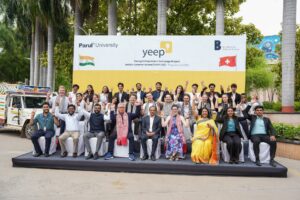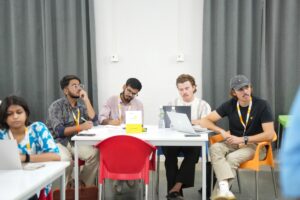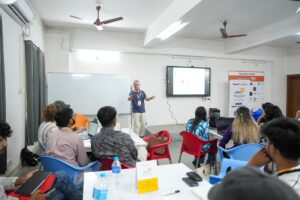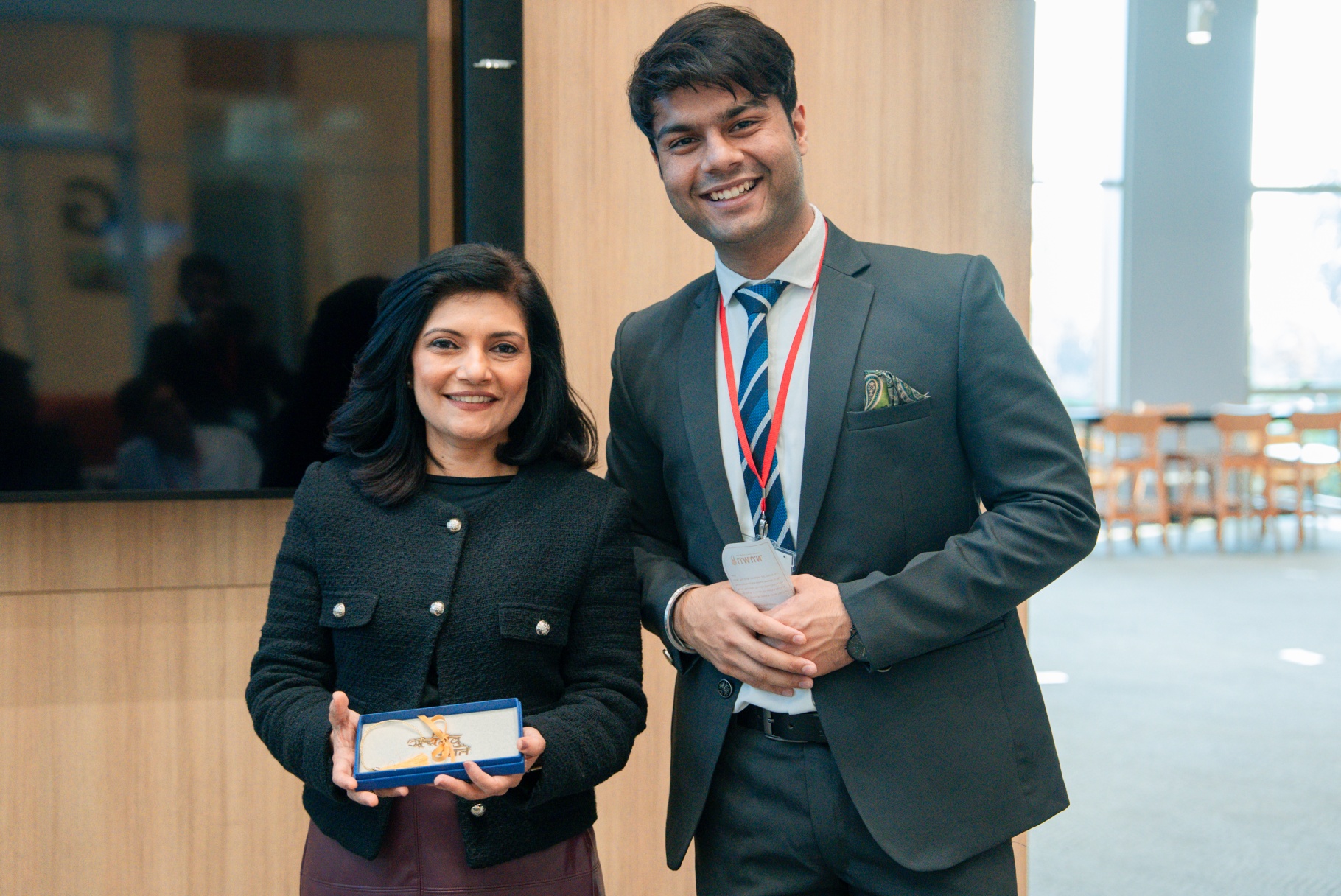
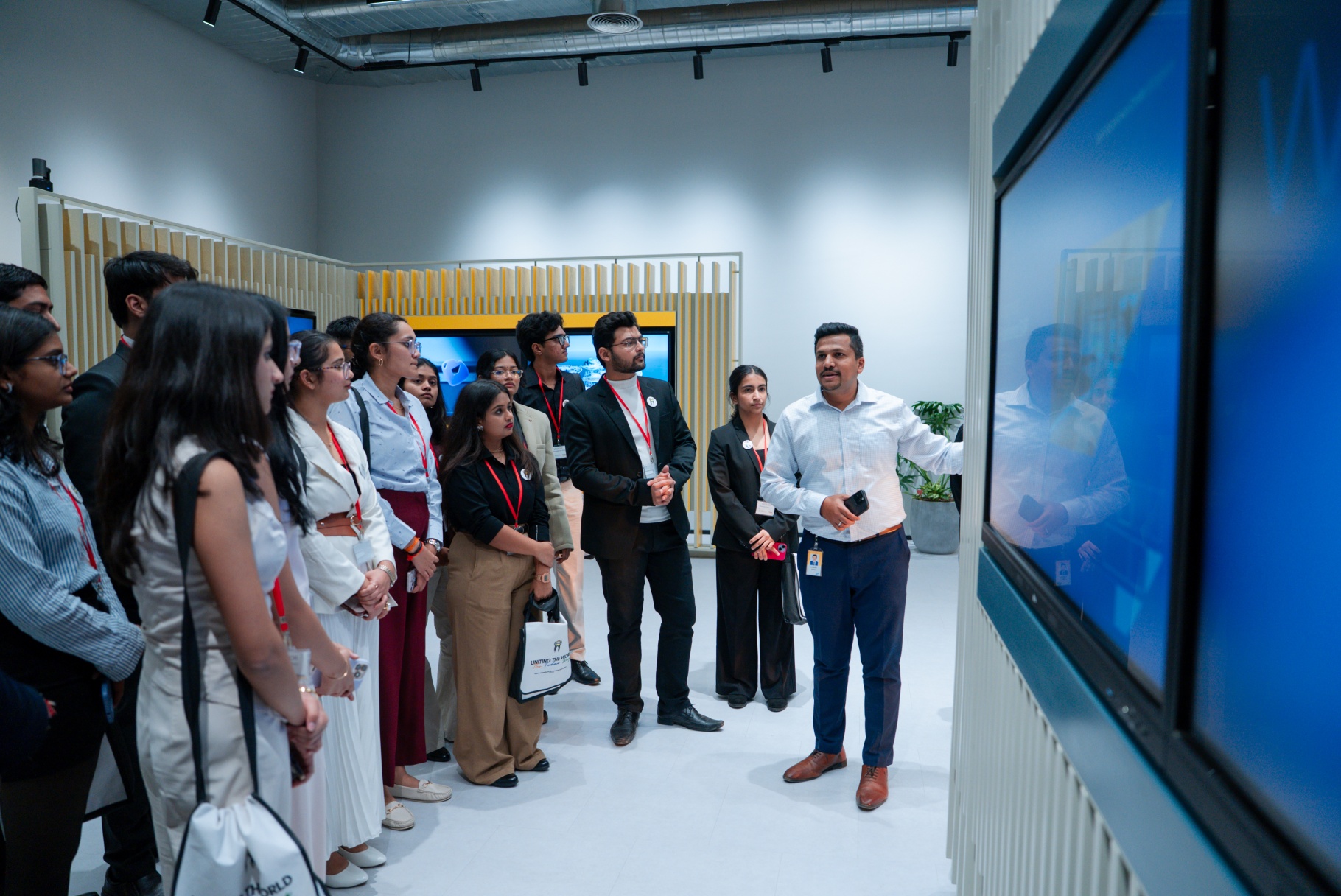
Trellix operates in a domain where failure is not commercial. It is civilisational. The company secures 25 percent of global ATMs, 60 percent of oil and gas companies, 75 percent of water systems, and 90 percent of utilities. Mahipal Nair (Managing Director, Trellix India and Head of HR APJ/India) opened the session by establishing this scale, backed by 38 years of cybersecurity heritage from the McAfee and FireEye lineage.
Sudhir Kumar Rai (Director, Data Science) and Pavan Kumar Podila (Head, Threat Research and MITRE cybersecurity leader) walked students through the technical architecture. EDR (Endpoint Detection and Response) systems generate 20 billion events per day. Network systems generate trillions per hour.
AI Flow: raw data is collected from devices, emails, and cloud systems. This data is converted into numerical embeddings, processed by machine learning models to identify anomalies, and then Generative AI (LLMs) explains the threat in simple language while suggesting actions such as isolating a compromised system. This represents a shift from detection-only systems to detection, explanation, and action.
The Ukraine case study grounded the discussion. Cyberattacks disrupted water, electricity, and banking before any physical weapons were deployed. Cyber warfare often precedes physical warfare.
The panel, including Abhijit Bindage (Senior Director, Software Engineering), Madhukar Pai (leadership perspective), and Brahmotri Jena (Talent Acquisition Leader), emphasised that cybersecurity professionals are modern-day defenders of digital infrastructure, and the industry actively needs more skilled individuals.
“Be open to challenges. Do not hesitate to take help. Do not say no to responsibilities.”
Company 2: Razorpay (Fintech at Transaction Scale)
Vishnu Acharya (Head, Strategy and Corporate, Partner at Razorpay Ventures and MarsShot.vc) and Vijay Thakral (Chief of Compliance, previously Flipkart, Paytm, Big4) explained how Razorpay operates as a full-stack fintech platform across three continents.
The company powers payments for Zomato, Swiggy, Flipkart, Uber, BookMyShow, and Zerodha.
The session covered the complete payment lifecycle: transaction initiation, authorisation, routing through card networks, reconciliation, and settlement. A single transaction involves routing, banks, networks, compliance checks, and fraud detection simultaneously.
Key concepts:
- Agentic payments: intelligent systems that initiate, manage, and optimise payments with minimal human intervention. LLM-based interfaces like ChatGPT and Gemini are beginning to act as transactional agents, not just conversational tools.
- TPV (Total Payment Volume): the key metric measuring the total value of transactions processed.
- Revenue model: Razorpay charges merchants a small fee per transaction, not customers. Even during refunds, the gateway retains its fee, which is why businesses aim to minimise cancellations.
- Digital Personal Data Protection Act: organisations must obtain consent before collecting data, clearly state its purpose, and allow users to withdraw consent.
- Scale amplifies inefficiency: even a 1 percent drop in success rates can lead to significant revenue loss.
“Razorpay has made their customers grow. We are embracing AI solutions.”
Company 3: RedBus (Consumer Platform at National Scale)
Anoop Menon (CTO, RedBus) began by saying he prefers real conversations over stiff presentations. RedBus has grown since 2006 into one of the largest bus ticketing platforms globally, operating in 8 countries (India, Singapore, Malaysia, Indonesia, Vietnam, Cambodia, Peru, Colombia).
The company serves 52 million users, connects 10,000+ towns, partners with 5,500 bus operators, and handles 300,000 to 350,000 bookings daily, rising to 500,000 on long weekends. The business is profitable.
RedBus owns no buses. It is a platform that connects passengers with operators.
Key innovations:
- Dynamic pricing using data science: analysing demand, timing, and booking patterns to optimise ticket prices for operators.
- Real-time GPS tracking: actual GPS devices in buses, not crowd-sourced data like train apps.
- Women-focused safety features: single women can see how many other women are on their bus, safer boarding points are highlighted, and buses highly rated by female travellers are flagged. These features came from real user feedback, not AI-generated insights.
- Ratings as self-regulation: travellers rate bus condition, driver behaviour, punctuality, and service. Better-rated operators get more bookings, while poorly rated ones lose customers.
- Expansion: RedRail (train booking with a 3x refund seat guarantee) and hotels, driven by customer overlap analysis.
On AI and careers, Menon was clear: AI will augment, not replace jobs. Engineers must learn to read and understand code, not just write it. Product and business roles should focus on insights and decision-making.
Company 4: BigBasket (Supply Chain at Speed)
Keshav Kumar (Head of Engineering, 22+ years including Amazon, Philips, Motorola, and Tata) walked students through BigBasket‘s engineering architecture. The company started as Fabmart.com in 1999 and was reimagined as BigBasket in 2011.
- Client-server architecture: frontend communicates with backend through APIs. Most processing happens in backend distributed systems that provide scalability, fault tolerance, and high availability.
- ML-powered search: NLP disambiguates queries (Apple as fruit vs brand) and personalises results based on user behaviour.
- Dynamic pricing: prices change based on demand, supply, location, and competition.
- FIFO inventory: First In First Out ensures older perishable products are sold first, reducing waste.
- AI demand forecasting: historical data, seasonal patterns, weather, and events are used to predict future demand for better inventory planning.
- Quick commerce: 10 to 30 minute delivery through dark stores (small local warehouses), route optimisation, and real-time tracking.
- Gig economy: delivery riders work on flexible schedules, dynamically scaled based on demand.
- Platform ecosystem: partnerships (like Croma for electronics) allow selling without holding inventory, reducing cost and increasing product variety.
- BB Matrix: BigBasket’s internal technology platform that manages supply chain, vendor coordination, and inventory flow.
“Make things even before necessity arrives.”
Company 5: SAP Labs (Enterprise Software at Global Scale)
Sindhu Gangadharan: Managing Director SAP Labs India, Head of Customer Innovation Services, Board Member Siemens India, Chairperson NASSCOM, President IGCC, TEDx Speaker, Fortune Top 50 Leader. She has spent 26 years at SAP, starting her journey as a software engineer.
The scale she shared reflects the company’s global impact: 87 percent of global business transactions run on SAP systems, and 9 out of 10 automotive companies in Bangalore use SAP.
Her session focused less on SAP’s products and more on what it takes to lead at this scale. Her career message to students:
- Be bold. Do not fear failure. Failures are stepping stones to meaningful innovation.
- Parental encouragement and belief play a crucial role in pushing boundaries.
- Never fear trying new things. Keep learning and continuously evolve.
- Consistency beats shortcuts. Leadership means empowering others and taking responsibility for bold decisions.
Students also toured SAP’s 400+ acre campus in Bangalore, experiencing collaborative spaces and an innovation culture that values people and ideas alongside technology.
Company 6: PhonePe (Consumer Product With Empathy)
Amit Doshi (Chief Marketing Officer, PhonePe) shifted the conversation from engineering to customer understanding. His core message: knowing your customer means identifying real pain points and solving them in a simple, friendly, and relatable way.
He emphasised that great products focus on a few meaningful features rather than becoming unnecessarily complex.
He applied the classic 4Ps framework to PhonePe:
- Product: simple, reliable, and trusted payments.
- Price: minimal friction with clear value for users.
- Place: being available wherever the customer already is.
- Promotion: consistent, relatable, and trust-driven communication.
He highlighted that marketing works best when it reflects real product strengths rather than exaggerated claims. Branding is a long-term investment built through consistency, clarity, and credibility.
His career advice focused on self-development, curiosity, and the habit of asking questions as essential for professional growth.
What 6 Companies Reveal About Working in Tech
The six sessions trace different operating models, but the structural lessons converge:
- Every company runs on data. Trellix processes 20 billion security events daily. Razorpay handles millions of transactions. RedBus analyses 350,000 bookings. BigBasket forecasts demand using weather and event data. The key skill is not just coding, but understanding what the data actually means.
- AI is applied to specific problems, not as a general solution. Dynamic pricing at RedBus, demand forecasting at BigBasket, threat detection at Trellix, and payment routing at Razorpay were all defined by human problem identification. AI executes these solutions.
- Scale creates challenges that small companies never face. A 1 percent failure rate at Razorpay’s scale becomes a major issue. Perishable inventory loss at BigBasket translates into significant financial impact. Engineering at scale requires a different level of thinking.
- Customer trust becomes the core product. RedBus offers strong refund policies in certain cases. Razorpay operates under strict RBI regulations. Trellix cannot afford security breaches. PhonePe builds trust through consistency and user-centric design rather than promotions.
- Careers in technology extend beyond engineering. Razorpay needs compliance professionals. RedBus requires operations managers. SAP needs leaders who empower teams. PhonePe depends on marketers who understand human behaviour. BigBasket relies on supply chain experts who understand ground realities.
Parul University‘s ecosystem prepares students across all these dimensions. The B.Tech programme covers AI, ML, cybersecurity, cloud computing, and data science.
The Practical Learning Tours provide industry exposure, while PIERC (254 startups and Rs 20 crore+ funding) supports students who want to build their own ventures. Additionally, 2,200+ recruiters visiting the campus represent companies across all these domains.
Frequently Asked Questions
What is Razorpay?
Razorpay is an India-based fintech company that serves as the link between the customers and the merchants processing online transactions through payment gateways. The payment lifecycle is handled by such fintech intermediaries from initiation to settlement. Revenue comes from small per-transaction merchant fees. It powers platforms like Zomato, Swiggy, Flipkart, and Uber across three continents, operating under strict RBI compliance and the Digital Personal Data Protection Act.
How does RedBus use AI?
Redbus is smartly adapting to AI. They are using it in terms of safety, data analysis, timely bookings, demand tracking and more. Deciding price through demand analysis, booking patterns and timings. Real-time GPS tracking to avoid hassles, demand prediction, fraud detection, personalised application experience, safety features that help gain the safer boarding points, female-rated buses which comes from the real users. Redbus has remarkable records with its operations in 8 countries, 52 million users and 350,000 daily bookings.
What is quick commerce?
Quick commerce means delivering or receiving the products within 10 to 30 minutes of ordering. This happens when connecting platforms have their small local warehouses, they have delivery routes, real-time tracking, and help gig economy riders. Joined by the head of engineering at BigBasket ,who explained about the FIFO inventory (older products sold first for perishables), AI demand forecasting and the platform ecosystem approach (partnerships like Croma for electronics without inventory).
What does SAP do?
SAP is a global enterprise software company. 87 percent of global business transactions run on SAP systems. 9 out of 10 automotive companies in Bangalore use SAP. MD Sindhu Gangadharan (Fortune Top 50, NASSCOM Chairperson, 26 years at SAP) told Parul University students that SAP is not just software but infrastructure for the modern world. The company's 400+ acre Bangalore campus was toured by students.