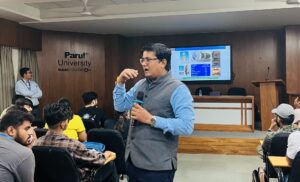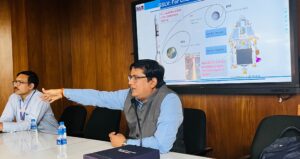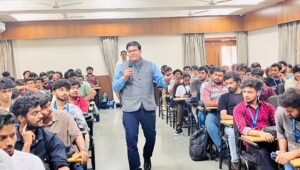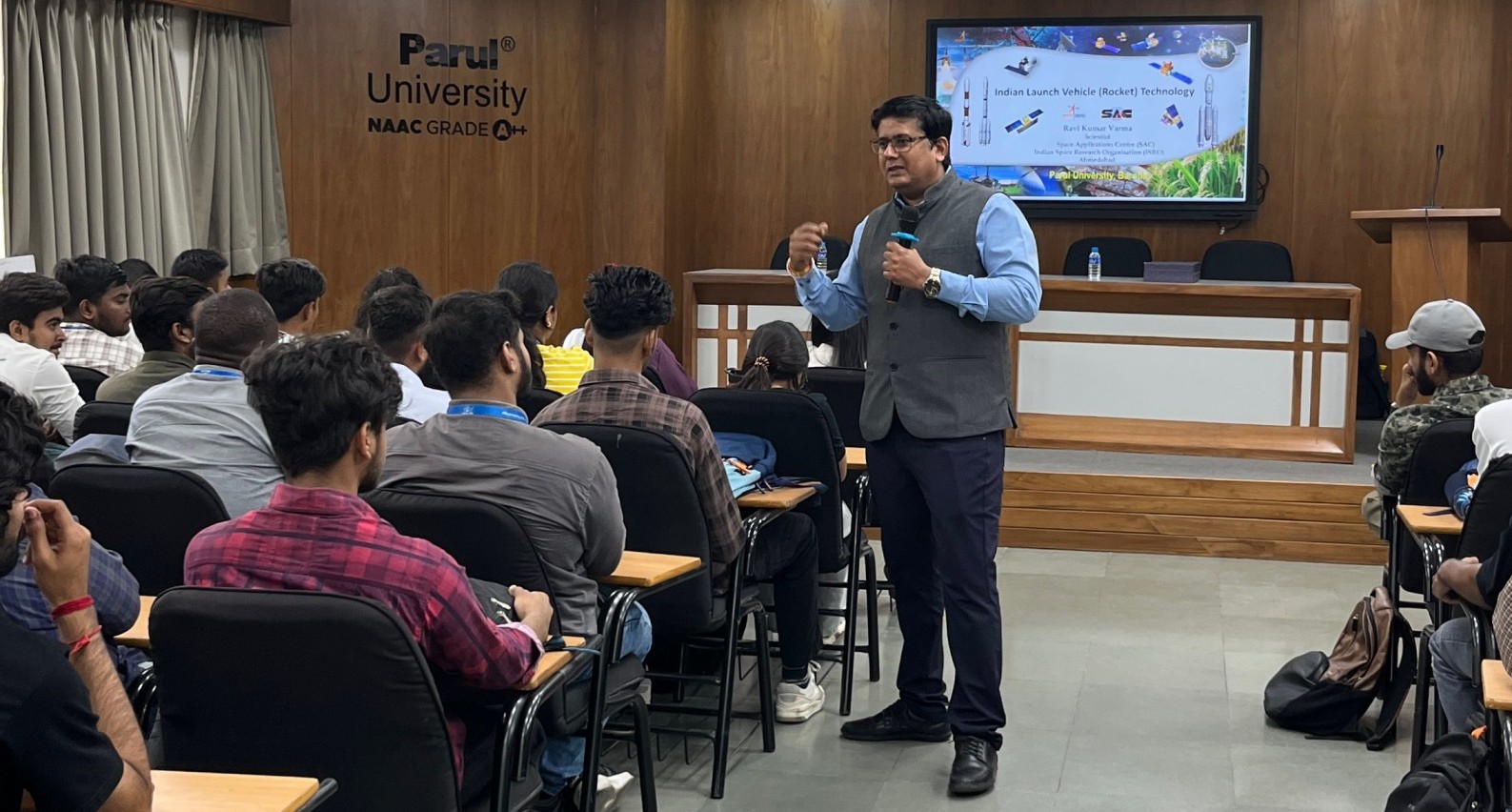
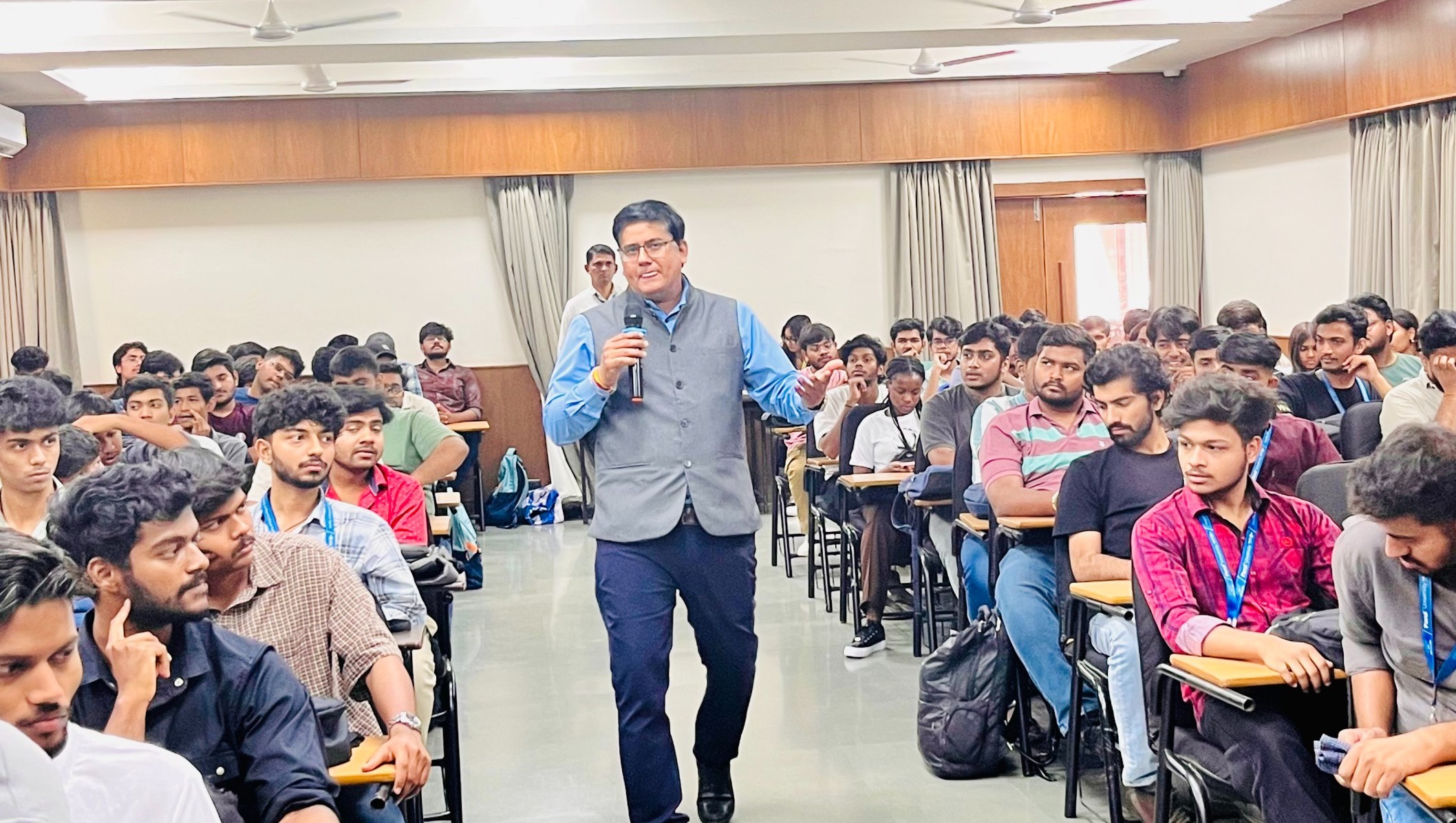
The session, hosted by Parul University’s Micro-Nano Research and Development Centre (MNRDC), ended up covering a staggering range: India’s full launch vehicle fleet (PSLV, GSLV, LVM3), the real reason Sriharikota ranks as the world’s second-best launch site, the 40-day orbital chess game that got Chandrayaan-3 to the Moon’s South Pole, the science behind cryogenic fuel and absolute zero, scramjet engines, space debris collision avoidance, carbon nanotube composites in satellite construction, what daily life actually looks like aboard the International Space Station, and the four foundational pillars that hold up India’s entire space programme. Engineering students from across disciplines packed the hall for what turned into one of those sessions people talk about long after it’s over.
Shri Ravi Kumar Varma is based at ISRO’s Space Applications Centre, one of the organisation’s heavyweight research facilities, right here in Ahmedabad. SAC has a lineage that goes back to 1966, when Dr. Vikram Sarabhai himself set it up. The session was put together by Parul University’s MNRDC, a research centre established in 2024 under the Gujarat Industrial Policy 2020, their core focus areas include nanomaterials, nanoelectronics, MEMS (that’s Micro-Electro-Mechanical Systems), and biomedical nanotechnology. Coordination came from Mr. Akash Shukla (Assistant Professor, MNRDC) and Dr. Mahendra Singh Rathod (Associate Professor – Research Cadre, MNRDC). Both played a hands-on role in making the session happen.
But here’s the thing that sets this apart from every other guest lecture. Shri Varma didn’t come in with a polished PowerPoint and a rehearsed narrative arc. He opened cold, threw that question about rockets versus launch vehicles into the room, then let the next two hours take shape organically from whatever students threw back.
India’s Launch Vehicle Fleet: PSLV, GSLV, and LVM3
Shri Varma broke down India’s operational launch vehicles in a way that made the engineering tangible rather than textbook. Start with the PSL, the Polar Satellite Launch Vehicle — which is, bluntly, ISRO’s most reliable workhorse. It comes in four different configurations depending on how many solid rocket strap-on motors are bolted on, and it handles everything from Earth observation satellites to geostationary and navigation missions. No other vehicle in India’s history has been this versatile or racked up this kind of track record.
Then there’s the GSLV, designed to haul communication satellites weighing up to two metric tonnes using a cryogenic upper stage that India developed entirely on its own. That indigenous cryogenic engine was a hard-won achievement — the kind of technology other countries refused to share, which forced ISRO to build the capability from scratch.
And at the top of the stack sits the LVM3. India’s most powerful operational rocket. Four metric tonnes to geostationary orbit. Ten metric tonnes to low Earth orbit. Its fully homegrown C25 cryogenic upper stage is what powered Chandrayaan-3 all the way to the Moon. In its human-rated configuration (HRLV), it’s the vehicle that will carry India’s Gaganyatris into space under the Gaganyaan programme. That’s not a future ambition on a whiteboard somewhere — it’s actively being prepared.
Shri Varma also touched on what’s coming next. The Small Satellite Launch Vehicle (SSLV) is being designed for quick, on-demand small satellite launches, think days of preparation, not months. There’s the Reusable Launch Vehicle Technology Demonstrator, which is exactly what it sounds like: ISRO’s attempt to crack the problem of building a rocket you can fly more than once. And then there’s the Scramjet Engine programme, which is arguably the most ambitious of the lot.
Chandrayaan-3: Why India Reached the Moon’s South Pole First
That changed when India’s Chandrayaan-1 confirmed the presence of water ice at the South Pole. Suddenly the calculus was completely different. Water ice at the lunar poles isn’t just scientifically interesting, Shri Varma described it as a gold mine. Break water into hydrogen and oxygen and you’ve got rocket fuel and breathable air, which means the South Pole becomes the logical basecamp for any serious long-term human presence beyond Earth.
But landing there? That’s an entirely different beast. Permanently shadowed craters, wildly uneven terrain, communication blackout zones. India built the AI systems and sensor technology needed to navigate all of it, and Chandrayaan-3’s Vikram Lander struck a landing that no other country’s space agency had managed. As Shri Varma put it, the rest of the world is only now beginning to follow the path India opened up.
He put the scale in perspective too. The other 636 tonnes is fuel, structural hardware, and the accumulated engineering of decades, all designed to do one thing: beat gravity. That ratio, he told the room, tells you everything you need to know about what launch vehicle design is really about.
The Session’s Breadth: From Orbital Mechanics to Absolute Zero
What made this session different from a standard guest lecture was how far it ranged and how naturally. The conversation didn’t feel forced into boxes. It moved where the questions took it.
Take Sriharikota. Most students know it’s where ISRO launches rockets. Shri Varma explained why it’s the world’s second-best launch site, after Kennedy Space Center and Kourou in French Guiana. Eastward launches from Sriharikota exploit the rotational velocity of the Earth, free kinetic energy, essentially. Spent rocket stages fall harmlessly into the Bay of Bengal rather than onto populated land. And the site’s near-equatorial position gives the most efficient trajectory for orbit insertion. Geography, physics, and safety all converge in one place.
Cryogenic technology got its own deep dive. At temperatures below minus 150 degrees Celsius, hydrogen and oxygen stop being gases and become compact, energy-dense liquids, which is what makes cryogenic engines so powerful relative to their weight. Shri Varma brought in the concept of absolute zero (minus 273.15°C) and made it stick with a beautifully simple thought experiment: imagine walking toward a wall, but with every step you only cover half the remaining distance. You get closer and closer, but you never actually touch it. That’s how temperature behaves near absolute zero. He went further still, describing Bose-Einstein Condensates, a state of matter where atoms cooled to micro-Kelvin temperatures essentially lose their individual identities and merge into a single quantum entity. The physics students in the room were audibly engaged.
Space debris came up too, and here the conversation turned practical. Before every single launch, ISRO runs a Collision Avoidance Analysis to confirm that the flight path won’t intersect with any catalogued debris. It sounds routine, but the orbital environment around Earth is getting more congested by the year, and the margin for miscalculation is vanishingly small.
On satellite construction, Shri Varma drew a direct line between nanoscale research, the exact kind of work Parul’s MNRDC is set up to do — and what actually goes into building hardware for space. Carbon nanotube composites and self-healing materials are already being used in satellite structures because they can take the punishment of radiation exposure and extreme thermal cycling that would degrade conventional materials over time.
A physical toll so severe that researchers estimate a single day spent in space takes roughly the same toll on the human body as fourteen days on Earth. These aren’t abstract numbers, they’re the lived reality of every astronaut aboard the station, and they’re exactly the kind of problem India’s Gaganyaan programme has to solve before sending its own crew into orbit.
FAQs
Who spoke at the ISRO session at Parul University?
Shri Ravi Kumar Varma, Space Scientist at ISRO’s Space Applications Centre (SAC) in Ahmedabad. The session was organised by Parul University’s Micro-Nano Research and Development Centre (MNRDC) on 16 March 2026. Over the course of two hours, it covered Indian launch vehicles (PSLV, GSLV, LVM3), the Chandrayaan-3 mission and its South Pole landing, cryogenic propulsion technology, scramjet engine development, space debris protocols, nanotechnology’s role in satellite materials, and what life is actually like aboard the International Space Station.
What is the MNRDC at Parul University?
The Micro-Nano Research and Development Centre (MNRDC) was set up in 2024 under the Gujarat Industrial Policy 2020. Its research spans nanomaterials, nanoelectronics, MEMS devices, and biomedical nanotechnology, all of which intersect directly with the kind of advanced materials work that goes into building satellites and space-grade hardware.
Does Parul University have connections with ISRO?
ISRO’s Space Applications Centre operates right here in Ahmedabad, Gujarat — the same state where Parul University is based in Vadodara. That geographic proximity matters. MNRDC’s ongoing research into nanomaterials and carbon nanotube composites overlaps directly with what ISRO needs for next-generation satellite construction. Expert sessions like this one aren’t just inspirational, they create concrete, tangible exposure for engineering students to the people and problems at the heart of India’s space programme.