The introduction was long because the life it was describing was long. Over 300 publications. More than 30 patents in 8 countries. Two decades at IISc. Work with Stanford. A national nanofabrication centre that he built and opened to researchers across India. A startup called PathShodh Healthcare Pvt. Ltd that is putting diagnostic devices into the hands of frontline health workers in villages that have never seen a pathology lab. An Infosys Prize. A fellowship in technology innovation. Multiple national honours.
He titled his presentation Innovation to Impact. The distinction between reading about innovation and interacting with someone who has spent 25 years embodying it is like the distinction between a map and the landscape.
Innovation 1: Lab-on-Chip Diagnostics (PathShodh Healthcare Pvt. Ltd)
The question came to him in the early 2000s: can we bridge healthcare divides? He described the urban experience of illness. You go to a doctor. The doctor prescribes a blood test. You go to a pathology lab with sophisticated equipment in an air-conditioned room. You wait a day. You get results. A functional system for people who live near it.
Then he said: many small towns in India do not have this kind of pathology. Forget villages. Even small towns.
The answer had to satisfy the World Health Organization‘s three criteria: Affordable, Accessible, and Available (the 3As). Most healthcare technology fails in at least two of these. His answer was a lab on a chip. A device roughly the size of a cell phone, capable of running multiple blood tests: glucose levels for diabetes, HBA1C for diabetes management, haemoglobin for anaemia and malnutrition, kidney function tests, and liver function tests.
The timeline matters. The idea came in the early 2000s. It took years to build the right team: biologists, chemists, electronics engineers, software developers, manufacturing people, and eventually MBAs, because if the technology was ever going to become a product, it needed business thinking from the start. The first generation received recognition and was protected by 30+ international patents in 8 countries.
In 2015, he and his team incubated PathShodh Healthcare Pvt. Ltd at IISc. The startup took the accumulated research and turned it into a manufactured product. The next generation devices (the nano series) were smaller, capable of more tests including urine analysis, and are now deployed across 17 states. He said it slowly: diagnostics at your doorstep. Remote areas. Resource-challenged communities.
He said hospitals have started replacing international brands with these devices. Not made in India by borrowing technology from abroad. Invented here. Translated here. Made here.
“We were not thinking about this. We were dreaming about it. But dreaming is not good enough. You have to start working toward it.”
Innovation 2: The Electronic Nose
An electronic nose is a sensor array that detects volatile compounds in the air. He gave the example of explosives: humans cannot smell most explosive materials. An electronic nose that detects vapours from those materials would be a significant contribution to security.
The deeper ambition, which he called the holy grail of the field, is breath-based diagnostics. Every exhaled breath contains thousands of volatile organic compounds whose levels change with health status. If an electronic nose can detect these levels, a single breath could diagnose a patient with no needle, no lab, just a breath. He said the technology cannot do it now, but maybe in ten years it can.
The technology already works in simpler forms. ISRO stores flammable gases at its satellite launch site in Sriharikota. A leak can be disastrous. His team developed sensor technology that is now deployed at Sriharikota to detect any leakage. From dreaming about breath diagnostics to protecting a launch site, the same underlying technology.
The direction is toward building a chip that can smell. Not a sensor array. An actual chip. The computation required involves inference engines, massive storage for smell patterns, and sophisticated machine learning. It is a genuinely interdisciplinary problem.
Innovation 3: Brain-Inspired Computing
He introduced this by describing a problem he said everyone should be worried about. Current AI runs on hardware designed for precision computing. Chips built for computers and phones, now being used to run large language models and learning algorithms. The hardware was not designed for that. Learning and inference do not require precision computing the way traditional software does. The hardware is extremely inefficient for its current use.
“We already use 20 percent of the world’s energy in data centres. Companies like Google and Microsoft are building power plants next to their data centres. If the current trend continues, the entire global energy demand could be consumed by data centres by 2035. There would be no energy left for anything else.”
Then the contrast: a human brain uses only 20 watts. Data centres run on trillions of watts. The brain does everything those data centres are trying to do: pattern recognition, learning, inference, memory, creativity. On 20 watts.
Brain-inspired computing is the attempt to build hardware that operates more like the brain. Not simulating the brain in software but creating physical hardware architectures that learn and process the way neurons do, at a fraction of the energy cost. His team built a demonstration the previous year: processing NASA’s Pillars of Creation image using conventional digital hardware required one billion computational steps. Using their brain-inspired hardware, the same processing took 26,000 steps. The energy saving is not incremental. It is of a different order entirely.
“AI can do great things only if it does not burn the planet.”
He said he hopes to have another startup in this area in a couple of years.
The Semiconductor Story: From Sand to Chip
When a student asked about the semiconductor supply chain, Prof Bhat gave the starting point. Silicon oxide is extracted from silica sand or quartz sand and purified to remove the oxide. The result is silicon of very high purity: out of a million silicon atoms, only one may be different. This silicon is the raw material for semiconductor fabrication facilities that produce the chips powering every device.
He said: a materials scientist makes the wafer. An electronics engineer designs the circuit. A computer scientist writes the software. Three completely different kinds of knowledge, all necessary, none sufficient on their own.
He explained nanotechnology using a biscuit. The biscuit has surface area (top and bottom). Break it in half: new surfaces form. Total mass unchanged, surface area increased. Keep breaking: surface area grows exponentially while mass stays the same. Catalysts work on surface area. Smaller particles have more surface area, so reactions speed up. The same principle applies to transistors: 40 years ago, a table-sized transistor powered a room-sized computer. Today, at 10 nanometres (one hundred times thinner than a human hair), a billion transistors fit on a fingernail. That is why nanotechnology matters.
The Ecosystem Builder
Throughout the session, he kept returning to ecosystem building. He built the National Nanofabrication Center at IISc, open to any researcher across India, supporting the India Semiconductor Mission, the National Supercomputing Mission, the National AI Mission, and the National Quantum Mission under one roof. He framed this as public service: you do not gain directly from building infrastructure, but without it, none of the technologies he described could have been developed.
He also described IISc’s plans to build a medical school, bringing basic sciences, engineering, technology, and medicine under one institution. India is a medical tourism hotspot: people seek treatment here because it is cheap and good, but all medical equipment used in treatment is imported. If India depends entirely on others for tools and medicines, it has no leadership position. And in the current geopolitical environment, those supply chains can be disrupted.
“The next blockbuster drug should come out of India. Not from the US. Not from Europe. From here.”
He ended with four words: curiosity, humility, perseverance, and erudite thinking. He said it without drama. He had already shown what a life built around those words looks like.
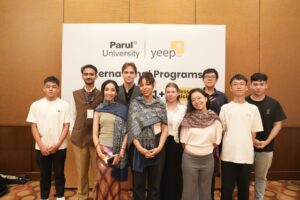
B.Tech Parul University students visited the AI Tour at Bengaluru.
Frequently Asked Questions
What is lab-on-chip technology?
It is a diagnostic device the size of a cell phone. It runs multiple blood tests that detect HbA1c, kidney function, liver function and glucose. Prof Navakanta Bhat at IISc developed this through PathShodh Healthcare Pvt. Ltd, now deployed across 17 states in India. The technology satisfies the WHO's 3As: Affordable, Accessible, and Available. Hospitals are replacing international brands with these Indian-made devices.
What is brain-inspired computing?
Hardware architectures that operate like the human brain, learning and processing at a fraction of the energy cost of conventional computers. The human brain uses 20 watts. Global data centres use trillions. Prof Bhat's team processed NASA's Pillars of Creation image in 26,000 computational steps using brain-inspired hardware, versus 1 billion steps on conventional hardware. He projects a startup in this area within a couple of years.
How are semiconductors made?
Silicon oxide is extracted from silica or quartz sand, purified to remove oxide, producing silicon of extreme purity (one impurity per million atoms). This silicon is fabricated into chips by semiconductor facilities. The process requires materials scientists (wafer), electronics engineers (circuit design), and computer scientists (software). At 10 nanometres, a billion transistors fit on a fingernail.
What is Prof Navakanta Bhat known for?
Dean and Professor at IISc Bangalore. 300+ publications. 30+ patents in 8 countries. Infosys Prize. Built the National Nanofabrication Center (supporting India Semiconductor Mission, National AI Mission, National Quantum Mission). Founded PathShodh Healthcare Pvt. Ltd (lab-on-chip, deployed 17 states). Electronic nose deployed at ISRO Sriharikota. Brain-inspired computing research. Work with Stanford.