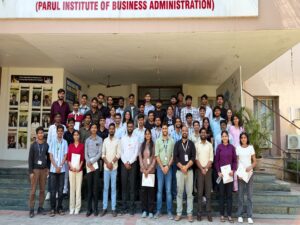
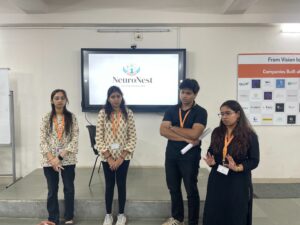
An MBA gives you structured business thinking. Most first-time founders fail because they skip steps – they do not understand their unit economics, cannot price their product, do not know how to read a term sheet, and have never done a competitive analysis. An MBA teaches these frameworks systematically. Specifically, an MBA in Entrepreneurship Innovation and Startup Acceleration provides:
- Financial literacy – reading balance sheets, understanding cash flow, calculating break-even points, managing budgets. CA Rachit Anjaria showed PIERC Cohort that most founders have zero accounting background and this kills their startups.
- Strategic thinking — There’s a certain kind of thinking that sharpens when you’re forced to dissect fifty businesses across two years. Competitive positioning, market entry, when to scale and when to hold, how to structure a partnership that doesn’t blow up in year three, these aren’t things most first-time founders think about until they’re already bleeding. An MBA doesn’t just teach frameworks; it builds the instinct to ask the right questions before the wrong decision is already made.
- Network and credibility – The classroom is almost secondary. What an MBA really sells is the room you’re in. Your cohort goes on to run companies, lead funds, sit on boards and they remember who you were at 27, which counts for something. Add alumni networks, professor introductions, and the quiet credibility that comes with the name on your degree, and you’re not just buying education. You’re buying access to a world that otherwise takes decades to get into on your own.
- Communication skills – pitching, negotiation, presentation, stakeholder management. Shlok Solanki taught Cohort that selling is about emotional intelligence and trust-building – skills that are practised in MBA programmes.
- Structured problem-solving – frameworks like SWOT analysis, business model canvas, and value proposition canvas give you repeatable tools for any business challenge.
The Case for Startup First: When Learning by Doing Beats Learning by Studying
The counterargument holds real weight. The startup world moves fast. Two years in a classroom means two years of missed market timing. Real entrepreneurship teaches lessons that no case study ever can: the gut-punch of customer rejection, the quiet dread of a dying bank balance, the rush of your first paying customer.
Starting first gives you a few things an MBA simply can’t.
If your idea has a time window — a technology shift, a regulation change, a gap that won’t stay open forever — waiting two years may mean arriving to a party that’s already over. You also learn whether your idea actually works by testing it in the market, not by writing about it in a heated classroom debate.
Look at Zerodha, Razorpay, Zomato. Their founders didn’t study business first — they learned it by building one. And when it comes to raising money, investors fund traction, not transcripts. A founder with 100 paying customers and no MBA will get a meeting faster than a founder with a degree and an empty CRM.
The startup-first path makes the most sense when you have a validated idea chasing a time-sensitive window, the technical ability to build the product yourself, or co-founders who bring the business instincts you lack. In those cases, the classroom isn’t just unnecessary — it might actually be the thing slowing you down
The 2026 Answer: Do Both Simultaneously
The MBA-or-startup debate assumes they are mutually exclusive. At Parul University, they are not. The MBA Entrepreneurship & Innovation programme is integrated with PIERC – meaning you study business frameworks in the classroom and apply them to a real startup simultaneously. During your MBA, you can validate a problem through PIERC’s customer discovery process, build an MVP in the Fab Lab, test it with real customers during field visits, access ₹2.5 Lakhs in SSIP non-refundable funding, pitch to real evaluators during cohort pitch days, and graduate with both an MBA degree and a funded venture.
Which MBA Specialisation Fits Which Founder Type?
If you are exploring which MBA path to take at Parul University, consider your startup’s primary need:
- MBA Entrepreneurship & Innovation – for founders who want to build their own startup. Integrated with PIERC. Covers design thinking, startup strategy, innovation management, venture building.
- MBA Finance – for founders whose startup is in fintech, investment, or financial services, or who want deep financial modelling skills for fundraising and cap table management.
- MBA Marketing – for founders whose startup’s competitive advantage is distribution, branding, or customer acquisition. Covers digital marketing, brand strategy, and growth.
- MBA IT – for founders building tech startups who want to understand both the technology and the business side.
- MBA International Trade & Business – for founders planning cross-border startups, export businesses, or global market entry.
- Integrated BBA-MBA (5 years) – for students straight from 12th who want the longest runway: 3 years of BBA fundamentals + 2 years of MBA specialisation with PIERC access throughout.
FAQ - MBA or Startup - Choose Wisely!
Should I do an MBA before starting a startup?
It depends on your situation. If you lack business fundamentals (finance, marketing, strategy), an MBA gives you frameworks that prevent expensive mistakes. If you have a time-sensitive opportunity with technical skills to execute, starting may be better. At Parul University, the MBA Entrepreneurship & Innovation programme lets you do both simultaneously through PIERC integration.
Which MBA specialisation is best for startup founders?
MBA Entrepreneurship & Innovation is purpose-built for founders. MBA Finance suits fintech founders and those focused on fundraising. MBA Marketing suits founders whose edge is distribution and branding. MBA IT suits tech startup founders. The best choice depends on where your startup's primary challenge lies.