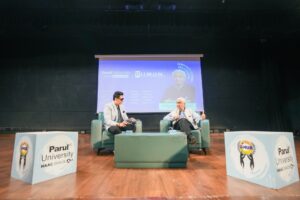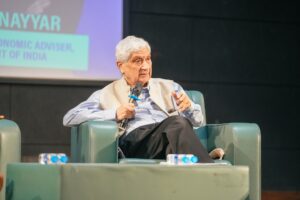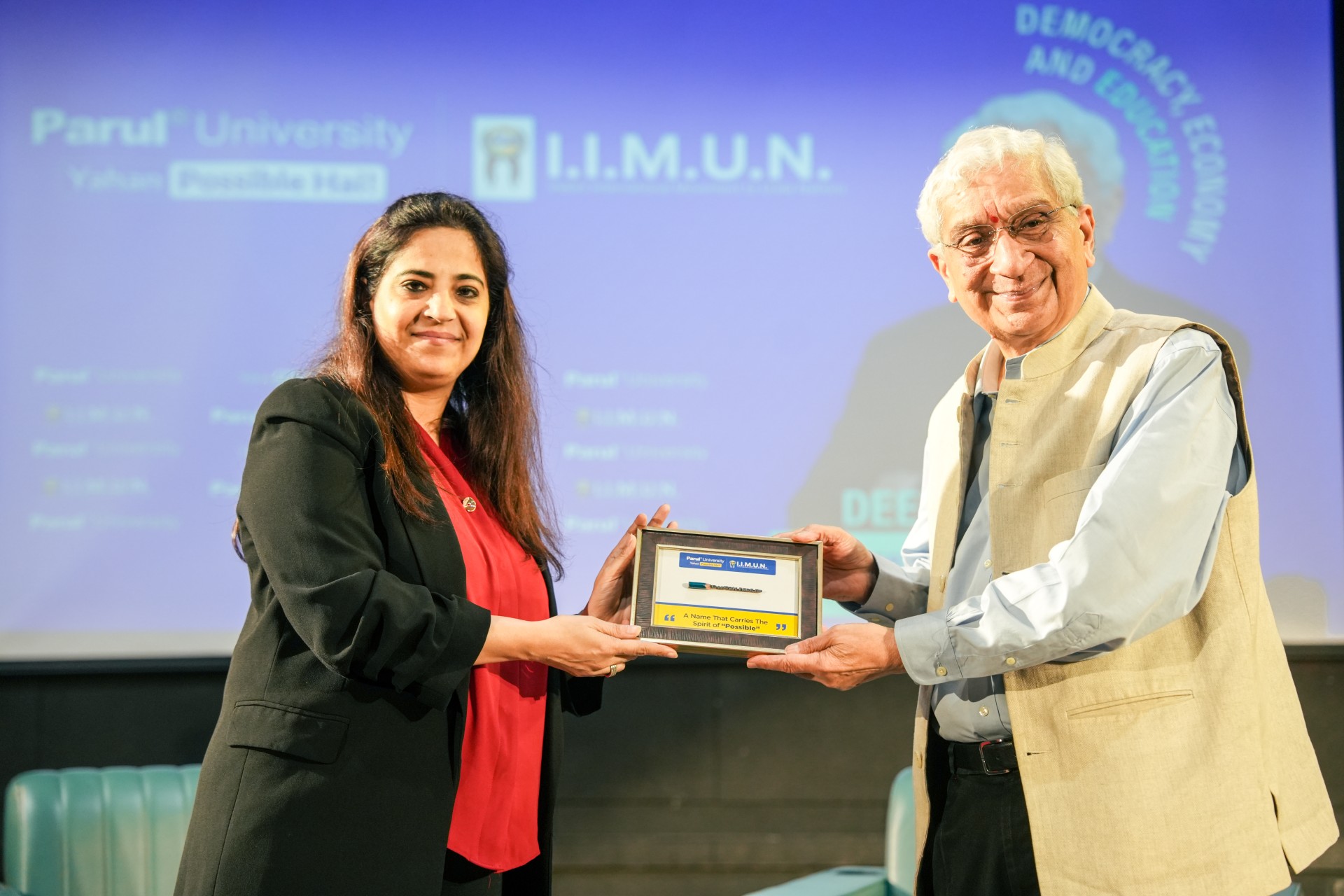
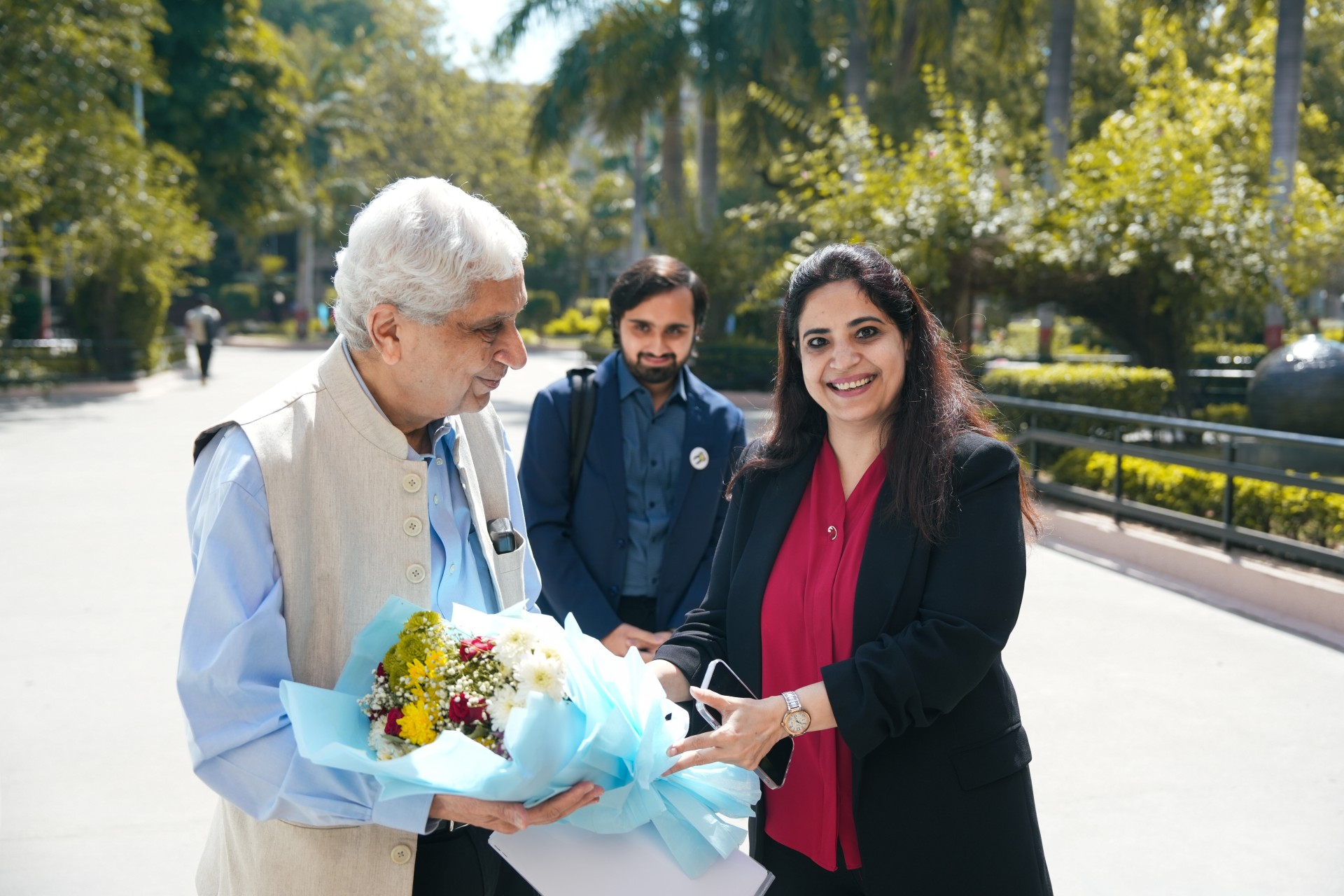
At the IIMUN session organised by Parul University, Prof. Deepak Nayyar was invited. He is currently working as Emeritus Professor of Economics at JNU, New Delhi, and Honorary Fellow of Balliol College, Oxford. He was the former Chief Economic Advisor of the Government of India.
Here are the Key positions and credentials of Prof. Deepak Nayyar:
- Chief Economic Adviser to the Government of India (1989-1993)
- Rhodes Scholar, Balliol College, University of Oxford. Honorary Fellow of Balliol College. Educated at Stephen’s College and Delhi School of Economics
- Vice Chancellor, University of Delhi (2000-2005). Emeritus Professor, JNU. Distinguished University Professor, New School NYC. Kluge Chair, US Library of Congress. Taught at Oxford, University of Sussex, IIM Calcutta. Chairman, UNU-WIDER Helsinki. 7,000+ Google Scholar citations
- Studied the social and economic transformation of Asia over five decades
- Books: Catch Up (OUP, bestseller), Resurgent Asia (OUP), Asian Transformations (OUP), Stability with Growth (co-author Joseph Stiglitz, Nobel laureate). The Intelligent Person’s Guide to Liberalization (Penguin, translated into many languages). Chairman, Sameeksha Trust (Economic and Political Weekly)
- Worked 18 hours a day for 18 months during the 1991 crisis to prevent India’s default
The session at Parul University with IIMUN was hosted by RJ Kshitij. The audience who attended the session were students from law, commerce, and journalism. The flow of the session also included a Q&A -session to give students direct access to a former policymaker.
Also check who attended the PU Talks: 150+ speakers from global leaders to youth icons.
India's 1991 Crisis: Two Weeks of Forex and 18 Months of 18-Hour Days
In 1991, India had foreign exchange reserves that would last exactly two weeks. The country was on the verge of sovereign default. Prof. Deepak Nayyar, then Chief Economic Adviser, worked 18 hours a day for 18 months to ensure India did not default. India was one of the few countries that managed to avoid it.
What India did, according to Prof. Deepak Nayyar, was to create a different India. The reforms were calibrated:
- Moved from Command and Control to a more open, market-oriented system
- Opened the trade account while remaining cautious about the capital account
- Did not follow the Washington Consensus blindly; followed India’s own calibrated path
- That calibration is why India survived the 1997 Asian financial crisis and the 2008 global financial crisis
Prof. Deepak Nayyar described the capital account restraint as the masterstroke of Indian economic policy over the last three decades.
What Prof Deepak Nayyar Said About AI, Education, and Manufacturing
Prof. Deepak Nayyar covered multiple topics during the IIMUN session. The key arguments, in summary:
On AI and Classrooms
- There can be no substitute whatsoever for a university education
- Learning happens outside the classroom from the community of students, not just inside it
- Universities are places for raising doubts and asking questions about everything
- The Oxford PPE story: a student asked ‘What is courage?’ and answered with two words (‘This is courage’) was awarded a first
- Nobel laureate John Hicks asked him why he came to Oxford. His answer: to resist the authority of the spoken word and the printed word
- AI will help the top 10 percent, but what about the other 90 percent?
- If we do not fix the skill gap, the demographic dividend will become a demographic disaster
On India's Manufacturing Crisis
- In 1990, India and China had roughly the same share of manufacturing in GDP. India’s has since fallen from 20 percent to about 14 percent
- Agriculture: 45 percent of employment but only 15 percent of output. Employment elasticity is zero or negative
- High-skill services (IT, finance): 35 percent of GDP but only 8 percent of employment
- Informal services (rickshaws, dhabas, gig economy): 22 percent of employment, very little output
- Manufacturing is the only sector that can absorb surplus labour and allow upward mobility
- There is no latecomer to development that has become a high-income country without industrialization.
On Asia's Transformation
- In 1970, Asia was the poorest continent. By 2020: 30 percent of world income, 40 percent of world trade
- India is experiencing three simultaneous transformations: economic, digital, and social
- The digital transformation (QR code adoption by street vendors) is ahead of many developed nations
- But the economic transformation is incomplete: islands of excellence in a sea of struggle
- Students need to understand the Bharat in villages as well as the India in Bangalore and Gurgao
What Students Asked Prof Deepak Nayyar
The session included direct Q&A with students:
- Roushi Suthar (BBA, Leadership and Management) asked, “What is the one critical skill students need for India’s growth?” Prof Deepak Nayyar’s answer: Think not only of career and ambition, but what you might do for society. Gandhiji said you have to wipe the tears of the poorest person.
- Vihan Shah (BBA) asked about contributing to the country’s growth. Prof. Deepak Nayyar responded: In governments, you win some, you lose some. His one litmus test in government: How will it shape the lives of ordinary people in India?
- Deepak Nayyar on politics: Entry into politics in India requires either a political family or money. Why should it be kinship and dynasty? If you want change, that is where you go.
- Deepak Nayyar, on values: Be steadfast in your values. Do your best to persuade. Keep in mind how what you do will shape the lives of the less fortunate.
Why Parul University Hosted This Session
Parul University has hosted 150+ speakers through PU Talks, including Former Chief Justice of India D.Y. Chandrachud, Attorney General Dr. R. Venkataramani, ISRO Chairman S. Somanath, and Padma Bhushan awardee Dr. Vijay Bhatkar (architect of India’s supercomputing initiative). The IIMUN session with Prof Deepak Nayyar, former Chief Economic Adviser, adds a specific dimension: a diagnostic conversation about structural economic challenges, delivered by the person who shaped India’s response to its most serious crisis.
The university operates 200+ programs across 25 disciplines, with practical learning tours to 280 companies in 19 cities; student-organized events (PIMC judged by Supreme Court justices; VFF with 40 student-run restaurants), and PIERC (230+ startups, Shark Tank deals). When Prof. Deepak Nayyar told students that learning happens through questioning and doing, not through memorising, the university’s own ecosystem demonstrates exactly that approach.
Check how the university’s Foundation Day: Dr Parul Patel, origin, NAAC A++ became more special.
FAQ
Who is Prof. Deepak Nayyar?
Prof. Deepak Nayyar is the former Chief Economic Adviser to the Government of India (1989-1993) and a Rhodes Scholar from the University of Oxford. He worked 18 hours a day for 18 months during the 1991 balance-of-payments crisis to prevent India's default. He has taught economics at Oxford and institutions in the USA and UK, and has studied Asia's economic transformation over five decades.
What did Prof. Deepak Nayyar speak about at Parul University?
India's 1991 economic crisis (two weeks of forex reserves). Why classrooms cannot be replaced by AI (Oxford courage story, John Hicks). Manufacturing falling from 20% to 14% of GDP. The demographic dividend at risk from AI and jobless growth. Asia's transformation from poorest continent to 30% of world income. Why students must think beyond careers toward societal obligation. The session was through IIMUN, hosted by RJ Kshitij.
What is IIMUN at Parul University?
India's International Movement to Unite Nations (IIMUN) hosted a session at Parul University featuring Prof. Deepak Nayyar, former Chief Economic Adviser. The format was a conversational Q&A for law, commerce, and journalism students. Parul University regularly hosts PU Talks with 150+ speakers including former CJI Chandrachud, ISRO Chairman Somanath, and Attorney General Venkataramani.