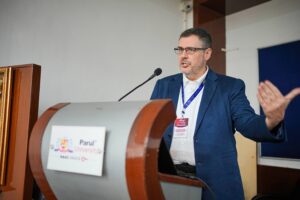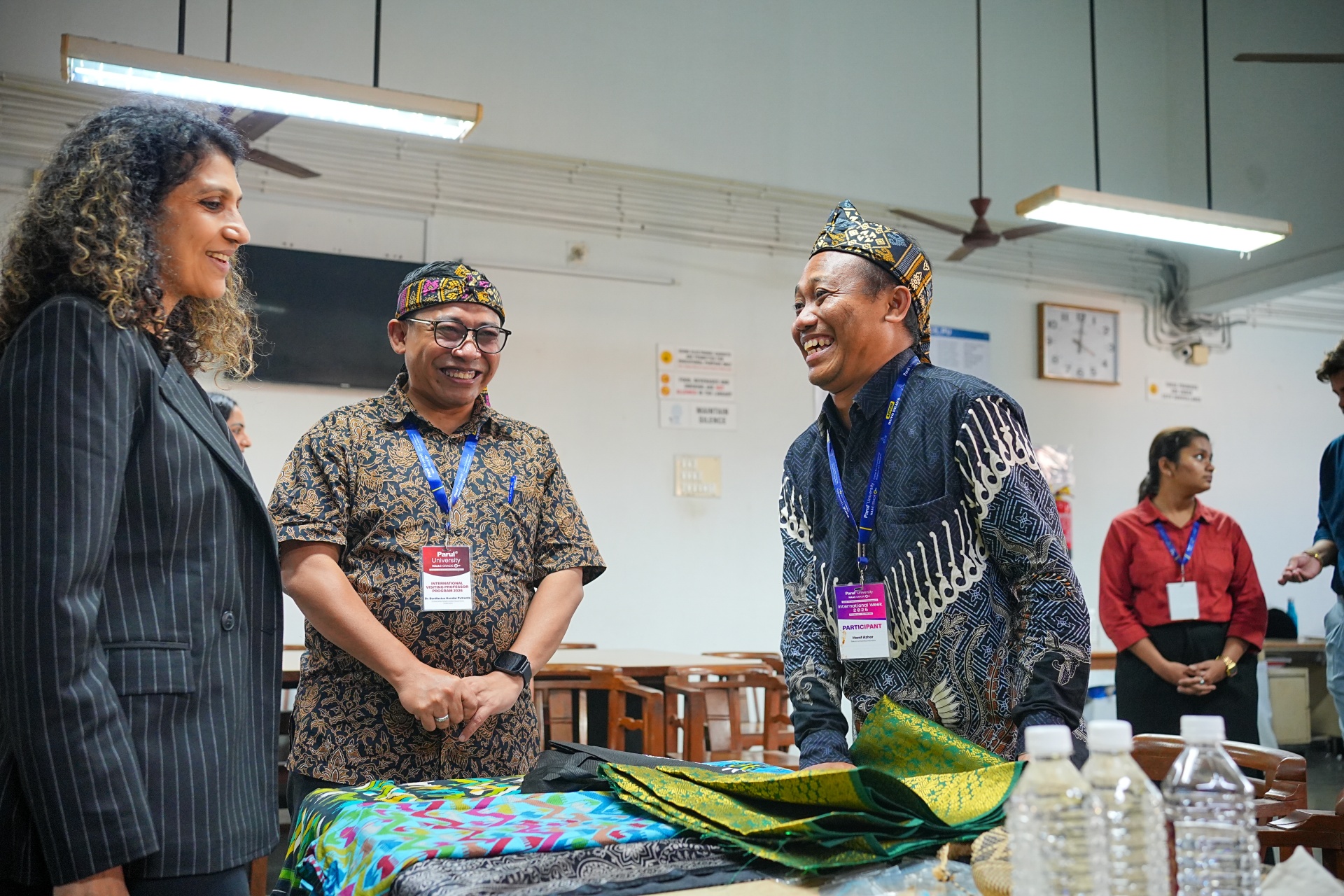

Dr. Bonifacius Hendar Putranto, Universitas Multimedia Nusantara, Indonesia, no PowerPoint, no slides. Just Tagore’s Gitanjali, Indian classical music on the screen, and 15 days of asking MBA students to close their eyes and listen. By Day 2 they were already waiting for it. That became the soul of the entire intercultural communication programme at Parul University.
The actual teaching was built around case studies. In one session, six student groups debated a scenario: a US returnee working in an Indian organisation. The question was how Kim’s Cross-Cultural Adaptation Theory applies. What emerged from the groups:
- The returnee must adapt to organisational culture, not expect colleagues to adjust to them
- Indian workplaces value contact-based communication, which differs from the individualistic US work style
- Adaptation is two-way: person to community and community to person must remain in balance
- Management must foster informal interactions (team dinners, brunches) to encourage contact-based communication
When negative labels like aggressive behaviour arise around a returnee, Dr. Putranto introduced the Buddy System: pair the returnee with someone who understands both cultural contexts. This provides a safe communication channel and guidance. Management often avoids these conversations, he said, but avoidance makes things worse. He also had every student wear name badges in capital letters so he could address each person by name, reinforcing a management principle: personalised address enhances engagement and communication effectiveness.
Over subsequent sessions, he taught harmony and respect as interdependent forces. Without respect, harmony becomes unproductive closeness or groupthink. Without harmony, respect turns into rigidity or tyranny. He introduced Sorrells’ Dynamic Framework on praxis (reflective action), Al-Araki’s cultural backpack (primary, secondary, tertiary socialisation), four forms of identity (I-identity, see-identity, do-identity, should-identity), and referenced Spivak’s Can the Subaltern Speak? on voice and representation. At the close, he returned to Gitanjali and read verses about how titles, wealth, and recognition become ornaments that weigh people down. True contribution begins when these ornaments are set aside.
Student Khushi Gajjar shared her experience on Linkedin on how she understood, communication is not just about language but about empathy, context, cultural awareness, and mutual understanding. Firdaus Alam wrote: this was more than a seminar. It was a journey of perspectives, culture, and meaningful conversations. He did not just teach us. He connected with us. However, in response to the same, Dr. Bonifacius Hendar Putranto thanked Parul University and students for hosting international and intercultural collaboration in the future. If you’re equally passionate about building your own startup, you can enroll into MBA at Parul University.
USA: The Drawing That Changed How Nursing Students See Schizophrenia
Dr. Trae Stewart from MCPHS (Massachusetts College of Pharmacy and Health Sciences, USA) displayed a drawing on screen. It was made by a patient diagnosed with chronic schizophrenia during his time working in a psychiatric unit. The nursing students in the Nursing Building found it confusing. It did not look like what was described. Dr. Stewart then explained: it depicted a beheaded person wearing a mask. In that gap between what the drawing showed and what students expected, the entire lesson about altered perception landed. Patients with schizophrenia perceive and express reality in ways that require clinical sensitivity to interpret.
He introduced Elyn R. Saks, a law professor at USC Gould School of Law who lives with chronic schizophrenia. Her book, The Center Cannot Hold, documents episodes of not eating for days, keeping curtains closed until day and night became indistinguishable, and losing her sense of time. Dr. Stewart then walked through the clinical framework. Key teaching points:
- Five types of hallucinations: auditory (voices that comment, criticise, or command), visual (shadows progressing to clearer images), olfactory (phantom unpleasant smells, also possible in stroke), gustatory (metallic or bitter tastes without consumption), tactile (itching, sensation of ants crawling, intensified by cocaine use)
- Command hallucinations are particularly concerning: patients feel forced to obey them
- Disorganised speech and loose associations indicate formal thought disorder, not intentional incoherence. Example: ‘I want to smoke a joint, joints keep my body together, together we can do anything’
- Schizophrenia occurs in episodes, not all at once. Some patients become emotionally numb after repeated episodes
- Patients with psychosis are rarely inherently dangerous. Risk increases when combined with substance use or extreme fatigue, not from psychosis alone. Stigma around violence is exaggerated
- In a separate psychotropic medications workshop, students presented on Escitalopram (SSRI for depression/anxiety, monitor suicidal ideation in early weeks) and Lorazepam (benzodiazepine for acute anxiety, risk of dependency, gradual tapering essential)
When a student asked at what stage a psychosis patient becomes dangerous, Dr. Stewart responded that the question itself reflects the stigma. His closing: a pill can balance a chemical, but a nurse balances a life. Stay curious, stay precise, and never forget that your patients are trusting you with their most vulnerable moments. If you wish to build a career in the nursing and healthcare domain, enrol into B.Sc. Nursing at Parul University!
China: A Mountain, Alice Munro, and Five Student Stories Reviewed Live
Dr. Al Ryanne Gatcho from Hunan Institute of Science and Technology (China) taught English Literature students across three sessions at Parul University’s Faculty of Liberal Arts. His approach was practical rather than theoretical: how can you write a short story without understanding its structure? He compared the absence of structure to a fish out of water.
He used a mountain to explain story architecture:
- Base (exposition): stable, calm, characters introduced. Like the surface of an ocean with no conflict
- Inciting incident: the moment stability shifts to tension, the point that captures reader interest
- Rising action: a series of events building tension and complexity (distinct from climax)
- Climax: the summit, the most meaningful moment, not just the most dramatic, where the direction of the narrative is decided
- Resolution: does not need to be happy. Predictable endings reduce impact. Open-ended conclusions keep readers engaged
Students identified the exposition in The Necklace (the arrival of the invitation letter) and analysed Alice Munro‘s The Office in a 15-minute in-class exercise. In a later session on publishing, he explained why choosing the right platform matters: if you choose the wrong platform, you have to change your writing to fit.
In the third session, he reviewed five student stories.
Rudransh presented a fantasy titled A Search For What Doesn’t Exist. Dr. Gatcho appreciated the line ‘this child has no fate yet’ as the conceptual anchor but noted naming overload, weak character development, and emotional build-up arriving too late.
Anamika wrote about a young woman finding her voice despite a controlling father. His favourite lines: ‘the voice shook but did not break’ and ‘love remained intact with a voice’. He praised that it showed adjustment rather than rebellion, which is rare.
Yashna’s The Last Adventure impressed him with its ambiguity and philosophical ending, though he suggested better foreshadowing for the time machine. His feedback method: the author sits in the centre while the class gives constructive criticism. He taught students to critique the work, not the person. If you too wish to champion such world-class exposure, explore admissions after 12th & Graduation, Parul University.
Jamaica: The Whiteboard Where Disasters Became Data
Mr. Lance Scott from Mico University College (Jamaica) structured his entire geology session around student presentations. Each student at Parul Institute of Technology chose a disaster, presented under five headings (name, exposure, vulnerability, outcome, positive outcomes), and then Scott synthesised everything on a whiteboard. She has covered these events – Gujarat Earthquake of 2001, Bhopal Gas Tragedy, Hiroshima and Nagasaki, and Odisha Cyclones. He encouraged students to find positive outcomes even in disasters, shifting analysis from emotional reaction to scientific assessment. Subsequently, if you wish to master it in depth, enrol into B.Tech programmes at Parul University.
Poland: Motherhood Penalties and Cement Emissions Through Simulation
Dr. Bozena Mielczarek from Wroclaw University of Science and Technology (Poland), with 40+ years of academic experience, presented two research projects in one session. Both used simulation modelling. Both addressed problems that appear unrelated but share a common methodology.
The first: the motherhood penalty in Polish pensions. Key findings from her simulation:
- Women in Poland retire 5 years earlier than men but live longer, meaning pension capital is divided across more years, producing lower monthly payments
- Career interruptions from childbearing reduce pension contributions, compounding the gap
- Simulation scenarios tested: women with 0, 1, or 2 children; with or without family support; across different professions and salary levels
Her connecting insight: as researchers, you cannot change the world, but you can change one small thing, and that one small thing can result in a domino effect. MBA student Tanush Jajoo wrote on Dr. Mielczarek’s simulation session on how simulation supports decision-making, risk analysis, and business planning added great value to his understanding of modern management.
Several other students shared their experiences –
FAQ
Do international professors actually teach at Parul University?
Yes. The IVPP 2026 brought 20 professors from 12+ countries to teach multi-day and multi-week sessions. Students shared their experiences on social media platforms and thanked Parul University for this global exposure.
What subjects did they teach?
Intercultural communication and Kim's Adaptation Theory (Indonesia), psychiatric nursing and schizophrenia (USA), creative writing and publishing (China), disaster risk assessment and climate change (Jamaica), simulation modelling, motherhood penalty, and CO2 reduction (Poland), global marketing and BRICS (Vietnam), business statistics and regression (Germany), endocrine theory in breast cancer (Russia), research methodology (Australia, South Africa), AI in education (Australia), cultural intelligence (Poland), and Indian music and dance (India).
How long do visiting professors stay?
It varies. Dr. Putranto (Indonesia) taught for 15 days. Dr. Gatcho (China) conducted three sessions across multiple weeks. Dr. Mielczarek (Poland) delivered 2-day sessions.