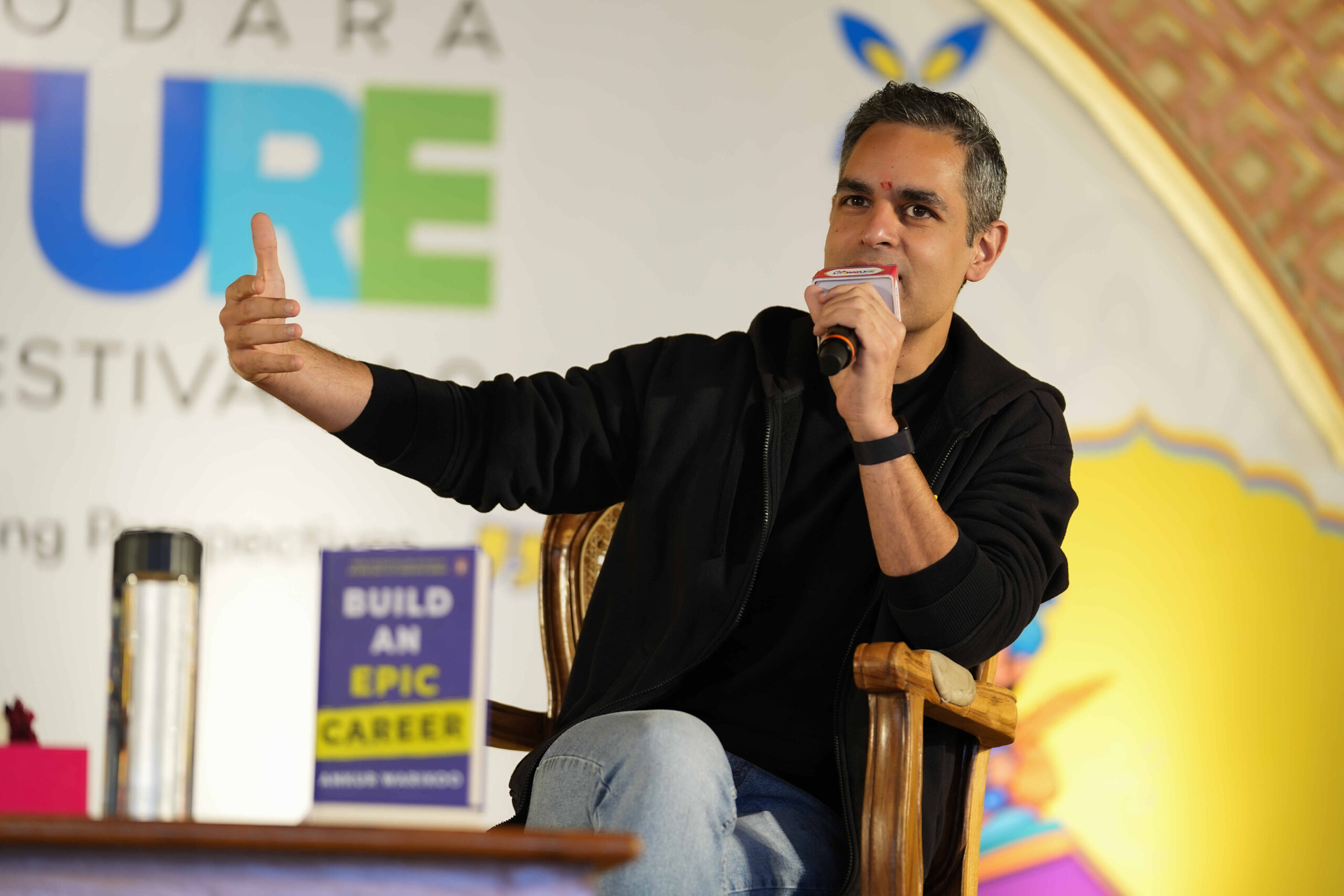
The full capacity of the Vivekananda Vedanta Bhavan on the morning of January 28, 2026, before the session started, indicated the eagerness of the crowd to listen. Ankur Warikoo. The hall, which had a defined capacity, filled well before the session was scheduled to begin. Students had positioned themselves on the floor near the front. Others stood at the sides. The anticipation was noticeable.
This is worth noting, because the person they were waiting for arrived in his comfy clothes stating his attitude towards life, spoke without a teleprompter, and opened by introducing himself through his failures rather than his achievements. It was a deliberate choice – and it was the first thing the session had to teach.
The Rat Race Isn’t Real – But the Pressure Is
Warikoo’s first substantial passage addressed the phenomenon that many in the audience were living and fewer were naming: the experience of being young, educated, and persistently uncertain about whether you are doing enough, learning enough, or becoming enough.
“We think we are in a race with others,” he told the audience. “But the only race we have to win is with ourselves.”
He introduced a practical response to the comparison culture: the personal report card. Structured around four domains – health, wealth, relationships, and skills – the report card is not graded against anyone else’s performance. It is a self-measurement tool: where am I now, relative to where I was, in the areas that actually matter to the life I want to live?
The effect of building this habit, he argued, is not just clarity. It is the gradual attrition of comparison. When people around you begin to acknowledge your growth – not your relative ranking but your actual development – comparison stops feeling urgent. Confidence, he said, grows from this: not from being told you are good, but from observing yourself becoming better.
The four-quadrant personal report card – practical starting points:
• Health: Am I sleeping consistently, moving regularly, and eating in ways that sustain my energy?
• Wealth: Do I understand money – how it works, how to save it, how to let it grow over time?
• Relationships: Am I investing time in the people who matter to me and pruning the ones that drain me?
• Skills: Am I learning something that will be valuable in three years, not just next semester?
‘Jo Jeetta Hai, Woh Apni Haar Se Seekhta Hai’: The Lesson Nobody Teaches
Warikoo was frank about the misconception he carried into his early career: that successful people were simply people who did not fail. He had watched from the outside and concluded that the gap between those who made it and those who didn’t was primarily about ability, background, and perhaps luck. Experience, he said, revealed this to be completely wrong.
“Jo jeetta hai, woh hamesha haar se seekhta hai.” The winner always learns from loss. It is a sentence that sounds like a motivational poster. He insisted it is a piece of operational intelligence: understanding your failures with precision – what specifically went wrong, why, what you would change – reduces the probability of repeating them. This is not resilience in the abstract sense. It is a practical skill that can be developed with deliberate practice.
He was careful to separate this from failure worship – the performance of publicly embracing failure as a personality brand. The point is not to celebrate failure. The point is to extract from it what it actually contains, which is almost always more useful than what success offers.
He admitted, with the kind of honesty that kept the hall attentive, that most of his significant life lessons came not from any formal education but from three sources: society, failures, and the hard work of paying attention to both. His degree had not taught him what he needed to know. Living – specifically, failing and choosing to learn from it – had.
Content Is Brain Food: Choose Yours Deliberately
The session’s most practically urgent passage for students in their twenties concerned social media and content consumption. Warikoo was precise about the mechanism: algorithms are designed to produce dopamine responses. They are not designed to make you smarter, more informed, or more capable of independent thought. Their commercial interest and your developmental interest are not aligned.
“You should be choosing your content. Instagram should not be choosing it for you.”
His most quoted line from the session followed: “You become the average of the five people you follow.” He intended this as a serious observation about how content shapes perspective. What you consume regularly – the quality of thinking, the standards of engagement, the kinds of questions being asked – gradually shapes what feels normal to you. Changing what you consume changes what you become capable of thinking.
He was not anti-social-media. He is, professionally, one of its most effective users. But he distinguished between using it as a tool – choosing consciously, curating deliberately, engaging with content that challenges rather than confirms – and being used by it.
He also offered a less expected recommendation for connection: Reddit. For students who struggle to find communities of serious, like-minded people in their immediate environment, online spaces with genuine discussion culture can provide what he called a ‘tribe’ – people whose thinking is worth spending time with.
Two Skills That Will Always Matter More Than Your Degree
When students asked the question they were most anxious about – ‘Karna kya hai?’ What should I actually do? – Warikoo gave an answer that was deliberately not sector-specific.
Two skills, he said, are non-negotiable in any field, at any level of seniority, across any professional era: communication and the ability to work well with other people. Not presentation skills. Not public speaking polish. Communication – the capacity to make yourself understood, to listen accurately, to adjust your expression based on who is receiving it. And not team-building in the HR sense, but the genuine ability to work alongside people whose strengths and styles differ from yours.
Technical skills change. Industries shift. The specific knowledge that makes someone valuable in 2026 may not be the same knowledge that makes them valuable in 2036. But the capacity to communicate clearly and to collaborate effectively is what allows people to keep acquiring new technical skills – and to remain valuable through transitions.
On financial habits – specifically for students who were earning their first income or were about to – he was direct. Start systematic investments immediately. Not because the amounts will be large but because the habit is the point. The distinction he drew between mindsets was memorable
• ‘Garibiyat ka mindset’: spend first, save whatever is left
• ‘Ameeriyat ka mindset’: save first, spend what remains
• The mindset is the variable – the amount is secondary
• Discipline in investing matters more than intelligence about markets
AI as Mentor, Not Answer Machine
The session’s most directly forward-looking passage concerned artificial intelligence – a topic that was on every student’s mind, even if not everyone was asking about it directly. Warikoo’s advice was more nuanced than either the utopian or dystopian framing that dominates most conversations about AI.
Use it, he said. But use it wisely. The risk of AI is not that it will replace you – it is that, if you depend on it to think for you, it will weaken the very capacities that make you irreplaceable. The ability to reason through problems, to tolerate uncertainty, to generate original responses to novel situations – these are what AI cannot replicate, and they are precisely what dependency on AI erodes.
His practical recommendation was specific: “Don’t ask AI to give you answers. Ask it to act like a teacher and help you solve the question.” This reframe – from answer machine to thinking partner – preserves the human development that formal education sometimes fails to produce.
What an epic career actually looks like, in Warikoo’s definition: not a position, not a salary, not a company name. A career that changes with you – that reflects not a fixed destination but a continuously updated answer to the question of who you are becoming, and what that version of you is capable of contributing.


